Last Updated: September 25, 2026
On a nano, suction control beats raw power. The best aquarium gravel vacuum for small tanks uses a narrow intake tube so you lift waste without draining the tank in seconds, and no honest maker publishes comparable suction numbers — pick by tube size and fit, not a GPH figure.
As an Amazon Associate we earn from qualifying purchases.
By David Nguyen
Quick answer: For most people in 2026, the best aquarium gravel vacuum for small tanks is the Aqueon Mini — our #1 rated choice. See the full ranked comparison, alternatives and buying advice below.
How to Choose a Small-Tank Gravel Vacuum
Small-tank vacuums live or die on control. A narrow tube, a way to limit water loss and a hose that reaches your bucket matter more than any flow claim. Because manual siphons are not flow-tested alike, judge them on geometry and fit.
Use a Narrow Intake Tube
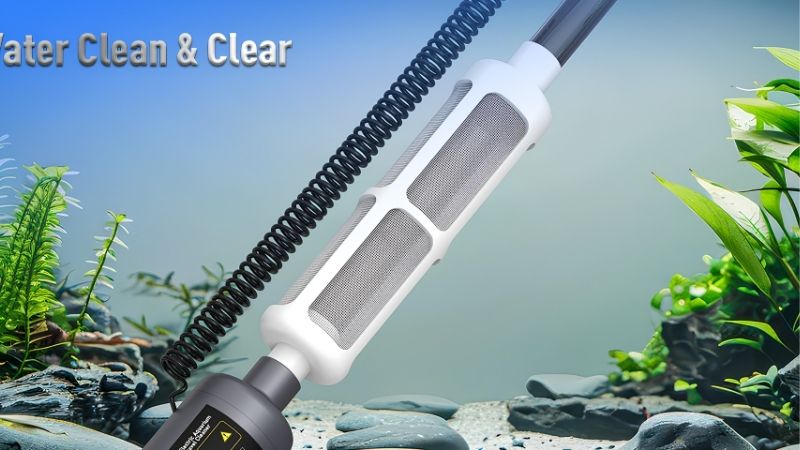
A slim intake is the core feature. The Fluval EasyVac Mini uses a 10-in (25 cm) tube and the Python Mini a 1-in-diameter, 6-in tube — narrow enough to work between plants and lift detritus without pulling substrate out.
A wide tube is not automatically safer or better; on a nano it moves too much water and gravel at once. Match tube diameter to the gaps in your scape, since narrow beats broad for controlled small-tank cleaning. On a densely planted nano, a slim 10-in tube also slips between stems without uprooting them as you clean.
Control Water Loss
Every siphon removes water as it cleans, which is the point on a nano where a full change is only a gallon or two. The Aqueon Mini is positioned for 1 to 5 gal [Aqueon, 2025/2026], so its scale suits removing a small, controlled volume.
An oversized siphon empties a nano too quickly, so adjust flow or choose a mini model. Pair cleaning with your normal partial change rather than fighting the flow, and keep a marked bucket to track how much you actually pull. Removing roughly 10 to 20% at a time keeps parameters stable on a small tank, which a mini makes easy to meter.
Match Hose Reach to the Bucket
Hose length sets where the water goes. These minis share a 6-ft hose — the Aqueon, Python and Fluval all run about 6 ft — which reaches a floor bucket beside most stands without excess coil to manage. Most nano keepers drain into a small bucket rather than a floor drain, so 6 ft is ample.
Confirm the reach clears your stand height to the bucket rim. Too short and you fight gravity; too long and the coil kinks, so 6 ft is a practical match for a small tank on a typical stand. A 6-ft hose also coils compactly for storage, unlike the longer hoses on full-size faucet changers.
Use a Gravel Guard Where Needed
Fine substrate needs protection. The Imagitarium Mini adds an inlet guard and a suction bulb primer, which keeps sand out of the tube while starting the siphon without mouth-priming or repeated shakes.
A guard matters most on sand or shrimp tanks where lifting substrate is a risk. On coarse gravel it is less critical, so match the feature to your substrate rather than paying for a guard a gravel tank may not need. Shrimp tanks especially benefit, since an inlet guard keeps juveniles and cull shrimp from being pulled into the tube.
Top Picks
Four mini siphons cover small tanks, differing mainly in tube geometry, priming and hose reach rather than measurable flow. No standardized suction figure exists across them, so these picks turn on fit and control. Prices are relative and shift.
| Product | Best For | Key Spec | Watch Out For |
|---|---|---|---|
| Aqueon Mini | Best Overall | 1-5 gal; 6-ft hose; ~$10 | Small scale limits bigger tanks |
| Python Pro-Clean Mini | Best for up to 10 gal | Up to 10 gal; 1×6 in tube; ~$9 | Positioning range, not a flow test |
| Fluval EasyVac Mini | Best Value | 10-in tube; 6-ft hose; ~$8 | No priming bulb |
| Imagitarium Mini | Best for sand/priming | Suction bulb + inlet guard; ~$12 | Highest price here |
Aqueon Mini
The Aqueon Mini takes Best Overall because its maker explicitly positions it for 1 to 5 gal tanks [Aqueon, 2025/2026], with a 6-ft hose, at about $10 as of 09/2026. That stated small-tank scope is the clearest fit signal here.
Its downside is the flip side of that scope: it is built for nanos, so a 10-gallon or larger tank outgrows it. For a true small tank, though, the sizing match is exactly what you want. For a nano keeper, though, its low price makes it easy to keep a spare on hand for quick spot cleans.
Python Pro-Clean Mini
The Python Mini stretches to a maker-stated up to 10 gal with a 1-in-diameter, 6-in tube and a 6-ft hose, around $9 [retailer, 2026]. It bridges nano and small community tanks better than a strict 1-to-5-gal tool.
That range is manufacturer positioning, not an equal flow test, so do not read it as more suction. On the smallest nanos its slightly larger scope can pull water fast, so meter your changes accordingly. On a 10-gallon it moves water briskly, so stop the siphon before you pull more than a fifth of the tank.
Fluval EasyVac Mini
The Fluval EasyVac Mini is the value pick at about $8 [retailer, 2026], with a 10-in (25 cm) tube and a 6-ft (1.8 m) hose. The narrow tube works well between plants on planted nanos.
It lacks a priming bulb, so you start it by shake or dunk, a minor chore some beginners dislike. For the price, though, it is a capable, controlled small-tank vacuum. At about $8 it is the value pick, and the narrow tube handles fine gravel between foreground stems well.
Imagitarium Mini
The Imagitarium Mini adds a suction bulb and an inlet guard at about $12 [Petco, 2026], the priciest here. The bulb primes without mouth-starting and the guard keeps fine substrate out of the tube.
It is the pick for sand or shrimp nanos where substrate protection matters. On coarse gravel those features add cost you may not need, so choose it for the guard, not as a general upgrade. The bulb also restarts the siphon quickly between passes, useful when you clean a scape in sections.
Frequently Asked Questions
Small-tank vacuum questions usually come down to sizing and whether flow numbers mean anything. Each answer opens with the verdict, then the practical detail for a nano.
What size vacuum for a 5-gallon tank?
A mini sized for that range — the Aqueon Mini is positioned for 1 to 5 gal, making it a direct fit. On five gallons you want a narrow tube and a small removal volume, not a full-size siphon.
Pair cleaning with your weekly partial change so water loss is intentional. A tool matched to the tank keeps you from emptying it faster than you can refill. A marked container helps you replace exactly what you remove, keeping the small volume balanced.
Can a large siphon drain a nano too fast?
Yes. A wide, full-size siphon pulls water quickly, and on a nano that can empty the tank before you finish a pass. An oversized tube is out of range for small tanks unless you can throttle the flow.
Choose a mini or pinch the hose to slow it down. Matching intake size to tank volume keeps cleaning controlled rather than a race against the water line. Even a full-size siphon can work on a nano if you throttle it, but a mini removes the guesswork.
Do bulb primers help?
Yes, for convenience. A squeeze bulb like the Imagitarium starts the siphon without mouth-priming or repeated shaking, which is handy on small tanks where you restart the siphon often.
It does not clean better, just starts easier. If your model lacks a bulb, a quick dunk-and-cover start works fine, so treat priming as ergonomics rather than performance. On tanks you service weekly, that faster restart saves a surprising amount of fiddling over a year.
Is GPH a useful comparison?
Not for manual siphons. No standardized same-head GPH is published across these vacuums, so a suction-speed percentage between them would be invented rather than measured.
Compare tube diameter, hose reach and priming instead. Those are the real, verifiable differences, since flow through a gravity siphon depends on head and geometry that no single GPH figure captures. Those specs, unlike an invented flow figure, are printed on the packaging so you can match the tool to your tank.
Final Thoughts
For the best aquarium gravel vacuum for small tanks, size and control win over flow claims: a narrow intake, a hose that reaches your bucket, and a scale matched to a nano. The Aqueon Mini leads on stated 1-to-5-gal fit, the Fluval EasyVac is the value choice, and a bulb-and-guard model like the Imagitarium suits sand — just remember manual siphons are not flow-rated, so choose by fit, not GPH.
As an Amazon Associate we earn from qualifying purchases at no extra cost to you. Prices and availability are accurate as of the date shown and are subject to change.
Ready to decide? Our #1 pick for 2026 is the Aqueon Mini.
Live price & availability on Amazon.
Related Reviews & Guides

Best Digital TDS Meter for Aquarium: A Careful Buyer Guide
Best Filter for 20 Gallon Aquarium Setups: Sized Properly