Last Updated: October 9, 2026
- Top Pick: ZEBRA DANIO: A COMPLETE GUIDE TO THE BEAUTIFUL AQUARIUM FISH TRANSFORMING MODERN MEDICINE, GENETICS, AND BIOTECHNOLOGY
- Best Value: 10-Pack Longfin Leopard Zebra Danio Live Freshwater Aquarium Fish Active Schooling Species Spotted Pattern Flowing Fins Hardy Community Fish for Tank Setup Compatible Freshwater Systems
- Premium Choice: 10-Pack Longfin Gold Zebra Danio Live Freshwater Aquarium Fish Active Schooling Species Golden Color Zebra Pattern Flowing Fins Hardy Community Fish for Tank Setup Compatible Systems
Zebra Danio Care: School Size, Flow and Temperature
Zebra danios turn aquarium length into behavior. In a long tank, a school accelerates, changes direction and disperses; in a short decorative cube, the same energy becomes repeated laps, crowding and fin-focused interaction. Their small body size is therefore a poor basis for tank choice. Build for motion, then use temperature—not the word “tropical”—to screen companions.
The accepted species is Danio rerio. Its biology is unusually well documented because zebrafish are major research organisms, but laboratory housing standards and experiments are not automatic pet-care instructions. Use FishBase for taxonomy, distribution and environmental context, GBIF for biodiversity records, and the NCBI zebrafish overview to understand its scientific significance.
As an Amazon Associate we earn from qualifying purchases at no extra cost to you.


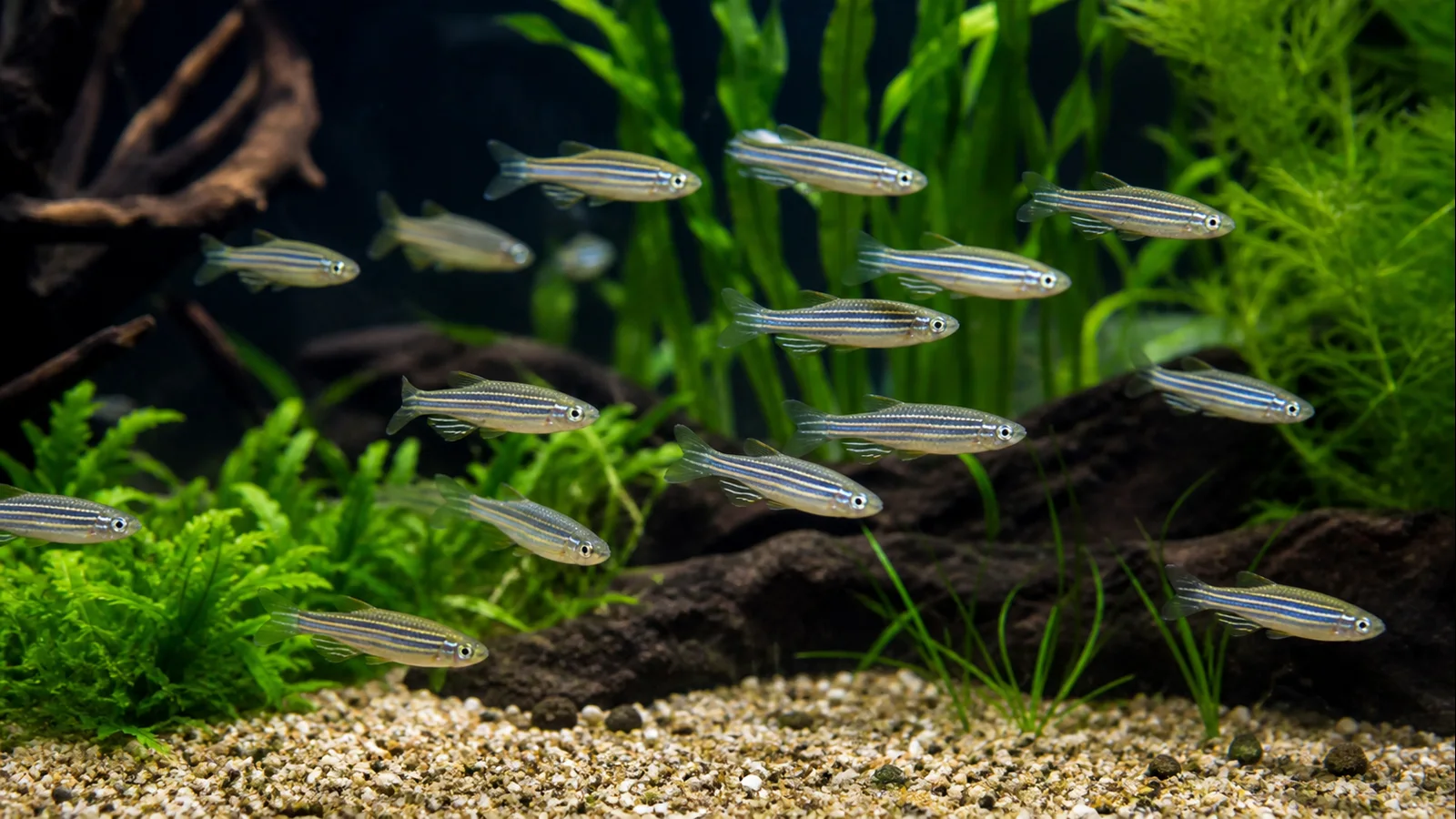
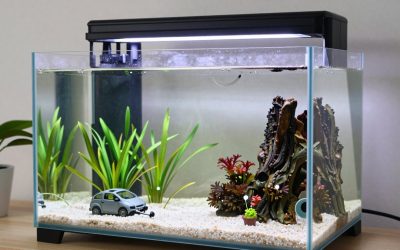
Editorial illustration; not evidence for species identification.
Buy a runway, not a volume label
A tank about 75 litres/20 US gallons in a long format makes a useful baseline for a school. More length improves options for a larger group and companions. A very tall aquarium can hold the same litres but provides less of the horizontal route danios use. Keep a fitted lid over every gap: these fast surface-oriented fish can jump when startled or chasing.
Arrange plants, rounded wood or stone at the ends and back, preserving a clear central lane. The structure gives resting places and breaks direct pursuits without turning the aquarium into an obstacle course. Use a substrate that is easy to maintain and check décor for narrow trapping points.
Start with at least eight to ten zebra danios rather than a token trio. A larger proper school spreads attention, produces more natural group movement and reduces the chance that one individual receives every chase. Stocking still depends on tank dimensions and filter capacity; “more is better” stops being true when the aquarium is crowded.
Our beginner fish comparison provides context, but hardy reputation must not excuse an uncycled tank. Complete a fishless cycle and verify that the biofilter processes waste before animals arrive.
Resolve temperature before choosing a community
Wild and captive records show zebra danios tolerating a wider, generally cooler span than many tropical community fish. For ordinary home care, roughly 20–25°C/68–77°F is often workable, selected according to breeder conditions and stable room control. Published endpoints are not targets for daily swings. FishBase habitat data describe occurrence; they do not establish that every captive strain thrives indefinitely at every reported value.
This is the hidden compatibility problem. Holding danios continuously at the hot end to suit a warm-water species may raise metabolism and reduce the intended thermal fit. Holding a warm specialist cool enough for danios transfers the compromise to the other animal. Choose companions with a comfortable overlap, not merely an overlap at opposite limits.
Use a thermometer even if no heater is needed. Seasonal rooms can fluctuate quickly, and a heater may provide stability in winter. Avoid sunlit windows and air-conditioning drafts. If summer temperature rises beyond the planned window, increase surface movement and seek safe room cooling; do not add ice directly and create abrupt local changes.
Water quality and useful current
Zebra danios can enjoy moderate circulation and well-oxygenated water, but they should not spend the whole day trapped in one jet. Choose a filter whose delivered flow suits the tank after media and head losses. The aquarium filter guide helps compare internal, hang-on-back, canister and sponge designs.
Aim the outlet along the tank to create movement plus sheltered zones behind planting. Surface ripple supports gas exchange. Watch for debris accumulating in dead spots and for fish that can never rest. Adjust direction before buying a larger pump.
Ammonia and nitrite should be undetectable. Manage nitrate and dissolved waste with appropriate stocking, modest feeding and regular partial water changes. The RSPCA fish welfare page explains why cycling and environmental preparation matter even for species marketed as tough.
Separate activity from aggression
Healthy zebra danios chase and change positions within the school. Brief displays are not the same as one fish being continuously driven into a corner. Watch resource access: can every animal rest, reach food and use the full tank? Torn fins, clamped posture, isolation, weight loss or a repeated single target mean the social setup needs intervention.
First check school size, swimming length, line-of-sight breaks and feeding distribution. If an individual remains targeted, separate safely. Do not keep adding danios to an already inadequate footprint in hopes that numbers alone will solve the problem.
Avoid slow, long-finned companions that may be stressed by constant activity or investigated through fin nipping. Very timid fish can lose every meal. Large predators see danios as prey. Suitable communities are built from similarly robust, quick species with compatible temperature, chemistry and adult space needs.
Feed fast fish without feeding the filter
Use a complete fine flake or small floating/sinking granule as the nutritional base. Rotate safe, appropriately sized frozen or live foods such as daphnia, cyclops and brine shrimp. Danios feed readily near the surface and midwater, so spread food along their swimming lane instead of dropping one large pile.
Offer a modest portion once or twice daily, adjusted for age, temperature and body condition. Their speed can make an excessive ration disappear quickly; that does not mean the amount was appropriate. Inspect the substrate and filter intake for leftovers, and monitor whether subordinate fish actually swallow food.
Breeding requires a separate plan. Adults may scatter eggs and eat them. Do not allow accidental fry to create crowding, and do not attempt repeated spawning without cycled grow-out capacity and placements. Laboratory zebrafish protocols are designed for research facilities and should not be copied casually at home.
If a danio stops eating, gasps, becomes bent, swells or develops lesions, do not choose medication from a symptom list. Test the environment, document onset and isolate with biosecurity in mind. Persistent or severe signs require an aquatic veterinarian or qualified fish-health professional; treatment dosing depends on diagnosis, product, actual water volume and patient condition.
A maintenance schedule for an active school
Daily observation is easiest during feeding. Count the school, scan fins and body lines, and notice whether one fish lags. Confirm temperature and filter operation. A sudden school-wide change is often a reason to investigate the environment immediately.
Weekly, test core water parameters and perform a partial change sized to the measured load. Condition municipal water and closely match temperature. Vacuum accessible debris while leaving stable biological surfaces intact. Clean mechanical filter material when flow drops, preserving biological media according to manufacturer directions.
Monthly, inspect the lid, cable openings, intake guard and impeller. Reassess planting: too much growth can erase the swimming lane, while an aggressive total trim removes all refuge. Check whether juvenile purchases are approaching adult stocking density.
Never release zebra danios outdoors or into drains. Their global scientific and aquarium use does not make release harmless or legal. Rehome unwanted fish through responsible aquarists or retailers and consult local authorities for lawful options.
Zebra danio care is an exercise in matching scale to speed. A long mature tank, substantial school, oxygenated but varied flow and a moderate stable thermal plan let their activity remain engaging rather than stressful. If the community requires one species to live at its tolerance edge, revise the community instead of normalizing the compromise.
Related Reviews & Guides
Aquarium Air Pump Buying Guide Output in 2026: What Actually Matters
How to Choose Aquarium Water Test Kit in 2026: What Actually Matters