Last Updated: October 4, 2026
- Top Pick: Pawfly Aquarium Air Pump 50 GPH Fish Tank Oxygen Pump for 10-60 Gallon Fish Tanks Buckets Dual Outlet Adjustable Ultra Quiet Aerator Pump with Airline Tubing Air Stones Connectors and Check Valves
- Best Value: Uniclife 64 GPH Aquarium Air Pump with Dual Outlets Adjustable Quiet Fish Tank Air Pump with Air Stone Airline Tubing Check Valve and Connector Accessories for 10-100 Gallon Fish Tank
- Premium Choice: AQQA Aquarium Air Pump, 3W Powerful Dual Outlet Adjustable Oxygen Aerator
Choosing an aquarium air pump is easy to get wrong because the numbers on the box rarely tell the whole story. A pump rated for a large tank may struggle if it is pushing air through a deep column of water, two long airline runs, sponge filters, or fine-pore air stones. On the other hand, buying the largest pump available for a small tank can create excessive surface turbulence, noisy bubbling, and equipment that must be dialed back all the time.
The key to how to choose aquarium air pump size is matching usable airflow—not just a gallon rating—to your tank depth, air-driven equipment, and desired bubble output. In 2026, many compact pumps include adjustable controls and dual outlets, but those conveniences do not eliminate the need to size the pump correctly.
As an Amazon Associate we earn from qualifying purchases at no extra cost to you.



Decide These 3 Things First
- What will the pump run? One small air stone needs far less air than a large sponge filter, an under-gravel filter, or two air-driven decorations. Count every device and every outlet you plan to use.
- How deep is the water? Measure from the top edge of the tank, where the pump sits, to the air stone or filter lift tube. A 20-gallon tall aquarium can require more pressure than a shallow 30-gallon breeder tank.
- Do you need one or two outlets? A dual-outlet model is useful for two separate devices, two tanks, or one device now and another later. But two outlets do not automatically mean twice the effective airflow at each outlet.
As a quick starting point, use a single-outlet pump for a basic 5- to 20-gallon setup with one air stone or small sponge filter. Choose an adjustable dual-outlet pump for most 20- to 55-gallon community tanks, especially if the tank is deeper than 18 inches or has two air-driven accessories. For tanks above 55 gallons, heavily stocked systems, or multiple sponge filters, look beyond gallon claims and prioritize output, pressure capability, and independent airflow control.
Tank Size, Water Depth, and Airflow Capacity
Tank volume matters, but depth is the more commonly overlooked sizing factor. Air pumps must overcome water pressure before air reaches the stone or filter. As a practical shopping rule, choose a pump rated at least one size above your tank when the water depth exceeds 20 inches, when airline tubing runs longer than 6 feet, or when you are using restrictive equipment such as fine-bubble stones.
For one modest air stone, a pump advertised for 10 to 20 gallons is generally appropriate for a 5- to 15-gallon aquarium. A 20- to 40-gallon-rated pump usually suits a standard 20-gallon tank with one sponge filter or two small stones. A pump rated around 50 to 60 gallons can be a sensible choice for a 29-gallon or 40-gallon tank using a medium sponge filter, provided it has an adjustment dial.
Do not assume a “100-gallon” label means the pump is ideal for every 100-gallon aquarium. A 100-gallon system that is 24 inches deep and fitted with two large sponge filters needs considerably more practical output than a shallow 100-gallon stock tank with a single coarse air stone. Models marketed around 64 GPH, such as the Uniclife dual-outlet pump, may fit tanks in the 10- to 100-gallon range depending on the load. A 50 GPH dual-outlet model such as the Pawfly can be a better match for lighter-duty 10- to 60-gallon applications.
Airflow is often listed in liters per minute (L/min) or gallons per hour (GPH). These ratings are useful for comparison, but they are not interchangeable with actual air delivery at the bottom of your aquarium. Look for output numbers, then leave headroom rather than selecting the bare minimum.
Outlet Count and Equipment Load
Buy for the equipment you will operate, not only the gallons of water in the tank. One outlet can be split with a gang valve, but splitting one outlet divides available air and may make adjustment less precise. For most setups with two air-driven items, a true dual-outlet pump is the cleaner option.
A basic load might be one 1-inch to 2-inch air stone. A moderate load could be a medium sponge filter with a 3-inch to 4-inch stone. A heavier load could include two sponge filters, a breeding box, a bubble wall, or an under-gravel filter. Each added item creates resistance and reduces the air available to the others.
For a 20- to 40-gallon tank with one sponge filter, a 2- to 4-watt adjustable pump is typically enough. For two sponge filters in a 40- to 75-gallon tank, consider a dual-outlet unit in roughly the 3- to 6-watt range. The AQQA 3-watt dual-outlet style is an example of the middle ground: enough flexibility for two modest devices without committing to a large commercial-style pump.
If you use only one side of a dual-outlet pump, cap or control the unused outlet according to the manufacturer’s instructions. Leaving it open can reduce pressure to the outlet in use. Avoid crimping airline tubing to restrict flow; use an adjustment dial or gang valve instead.
Materials and Construction
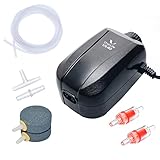
Most consumer aquarium pumps use a plastic housing with rubber feet, an internal electromagnetic mechanism, and flexible diaphragms that move air. The important distinction is not whether the exterior is plastic—it almost always is—but whether the pump is built to control vibration and accommodate routine accessory replacement.
Look for a rigid ABS or similarly thick plastic shell, four rubberized feet, and a recessed or protected adjustment knob. A pump measuring about 4 to 6 inches long and weighing 0.5 to 1.5 pounds is usually stable enough for a standard aquarium stand. Very light units under 0.4 pounds can work well, but they are more likely to walk or buzz on a hollow cabinet unless placed on a foam or silicone pad.
Check the included accessories closely. A useful starter kit typically includes 6 to 10 feet of airline tubing, one or two air stones, check valves, connectors, and sometimes a control valve. Airline tubing is inexpensive, but check valves are essential: they help prevent aquarium water from siphoning backward into a pump during a power outage.
Replace standard airline tubing when it becomes stiff, yellowed, cracked, or loose at the connection points. Expect basic tubing to last roughly 1 to 3 years, depending on heat, sunlight, and handling. Diaphragms are wear items as well; a pump that becomes weaker or louder after extended use may need a replacement diaphragm rather than a full replacement.
Noise, Adjustability, and Real-World Performance
An air pump is never completely silent. The best choice is one whose hum and vibration are manageable in the room where the aquarium sits. Bedroom tanks deserve more attention to vibration control than tanks in basements, offices, or fish rooms.
Look for an adjustable output control if you are buying slightly above your current needs. This lets you reduce bubbling for a betta tank, shrimp tank, or planted aquarium while retaining reserve capacity for hotter weather, medication periods, or an added sponge filter. A dial with a usable adjustment range is more valuable than a vague “ultra quiet” claim.
Placement makes a major difference. Set the pump on a solid surface above the aquarium’s water line whenever possible. If it must sit below the water line, install a check valve in each airline and position it 2 to 4 inches above the highest possible water level. Keep the pump at least 6 inches from splashes and drips, and leave several inches of open space around its vents.
For a quiet setup, avoid placing the pump directly on a glass lid, thin metal shelf, or hollow cabinet panel. A 1/4-inch foam pad, folded towel, or purpose-made vibration pad can reduce transmitted buzzing. Also clean or replace clogged air stones: a clogged stone makes the pump work harder and often makes it louder.
Price Tiers and What You Get
Budget: $8 to $15. This range includes many compact pumps rated for roughly 10 to 60 gallons, plus some value-oriented dual-outlet models advertised up to 100 gallons. The Pawfly 50 GPH model at about $10 and the AQUANEAT adjustable dual-outlet model at about $10 illustrate this category. Expect basic plastic housings, included tubing and stones, and adequate performance for light to moderate loads. Verify that check valves are included.
Mid-range: $15 to $35. These pumps commonly offer 3- to 6-watt motors, dual outlets, better feet, more useful airflow adjustment, and stronger performance through deeper water or sponge filters. The Uniclife 64 GPH pump at about $15 sits near the entry point of this tier, while the AQQA 3-watt dual-outlet pump at about $25 represents a typical step up.
Premium: $35 to $80 or more. Pay this when you need high output, multiple outlets, a larger system, exceptionally low vibration, or dependable backup aeration for valuable livestock. Premium does not always mean quieter at full power; larger-capacity pumps can still hum. It should mean better control, steadier construction, and easier access to replacement parts.
Warranty, Delivery, and Assembly
For a small appliance that runs 24 hours a day, a 12-month warranty is a reasonable baseline. A 24-month warranty or clearly available replacement diaphragms adds confidence, especially on pumps above $25. Save the packaging and receipt until you confirm the pump can maintain airflow through your actual tubing and equipment.
Before ordering, confirm whether the listing includes one or two air stones, check valves, tubing, and a splitter or control valve. Delivery boxes for compact pumps are often only 6 to 9 inches wide, but fragile stones and small valves can be misplaced in packing material.
Assembly should take 10 to 15 minutes. Cut tubing with a clean, square end; push it fully onto the pump outlet; place the check valve with its directional arrow pointing toward the aquarium; and submerge the air stone or filter. Run the pump for 5 minutes, then adjust airflow. If one outlet appears weak, test each outlet separately before assuming the pump is defective.
Spec Checklist
| Spec | Budget | Mid | Premium |
|---|---|---|---|
| Typical price | $8-$15 | $15-$35 | $35-$80+ |
| Suggested tank use | 5-30 gallons; light loads | 20-75 gallons; sponge filters or two devices | 55-150+ gallons; heavy or multi-device loads |
| Power draw | 1.5-3 watts | 3-6 watts | 5-15+ watts |
| Outlets | 1 or 2 | 2, often adjustable | 2-4 or more |
| Included accessories | Usually tubing, stone, basic valve | Tubing, stones, check valves, connectors | Varies; prioritize replaceable parts over bundles |
| Best buyer | First aquarium or backup aeration | Most home aquariums | Large, deep, heavily stocked, or multi-tank systems |
Red Flags
- A gallon rating with no wattage, airflow figure, outlet count, or maximum depth guidance.
- No check valve included or no mention of using one when the pump sits below water level.
- A single fixed-output pump marketed for both a 5-gallon tank and a 100-gallon tank without an adjustment control.
- Thin, stiff tubing that kinks immediately or slips off the outlet.
- Claims of “silent” operation without rubber feet, vibration isolation, or clear placement instructions.
- A low price paired with no warranty information, no replacement diaphragm availability, and no customer support details.
FAQ
How big should an air pump be for a 20-gallon aquarium?
For one air stone, choose a pump rated for about 10 to 30 gallons. For a medium sponge filter, two stones, or a tank deeper than 16 to 18 inches, choose an adjustable pump rated for roughly 20 to 40 gallons. A dual-outlet model gives useful room to expand.
Can an air pump be too powerful for a fish tank?
Yes. Excessive bubbles can create strong current, disturb slow-swimming fish, and cause unnecessary noise and splashing. A larger adjustable pump is safe when dialed down, but an oversized fixed-output pump can be frustrating in a 5- to 10-gallon aquarium.
Does an air pump add oxygen directly to the water?
Its biggest benefit is surface agitation. Rising bubbles circulate water and break the surface, allowing oxygen to enter and carbon dioxide to leave. The bubbles themselves contribute less oxygen than the water movement they create.
Do I need an air pump if I have a filter?
Not always. A hang-on-back, internal, or canister filter that creates steady surface movement may provide adequate gas exchange. An air pump is still useful for sponge filters, under-gravel filters, emergency aeration, breeding setups, or tanks that need more surface agitation.
Ready to decide? Our #1 pick for 2026 is the Typical price.
Live price & availability on Amazon.
Related Reviews & Guides



6 Best Quietest Air Pumps For Aquarium 2026

Acrylic Vs Glass Aquarium Which Is Better: Best Compared Guide