Last Updated: September 25, 2026
How many cichlids in a 55 gallon tank depends on group, not on total inches. For mbuna the working answer is 12-16 juveniles settling to 10-14 adults across three or four species, at one male to three or four females, with 384-480 GPH of loaded turnover. Peacocks sit lower, at six to eight adults across two or three species.
As an Amazon Associate we earn from qualifying purchases.
As an Amazon Associate we earn from qualifying purchases at no extra cost to you. Prices and availability are accurate as of the date shown and are subject to change.

ELEBOX Aquarium Background Blue Black Fish Tank Background Wallpaper Double-Sided Aquarium Backing, Aquarium Decorations for 10 Gallon 20 Gallon Aquarium 11.8" x 24.4"
Selected for "How Many Cichlids in a 55 Gallon Tank: A Stocking Chart": this listing is tanks (ELEBOX Aquarium Background Blue Black Fish Tank Background Wallpaper D), matching the equipment this article covers.
View on Amazon
Tetra 55 Gallon Glass Aquarium, Rectangular Fish Tank
Selected for "How Many Cichlids in a 55 Gallon Tank: A Stocking Chart": this listing is tanks (Tetra 55 Gallon Glass Aquarium, Rectangular Fish Tank), matching the equipment this article covers.
View on Amazon
Saim Aquarium Mountain View Stone Ornament, Artificial Mountain Hill View Stone Rock Cave Aquarium Decorations Fish Tank Decor for Betta Cichlids Hideaway Cave, Hermit Crab Hideout - Large
Selected for "How Many Cichlids in a 55 Gallon Tank: A Stocking Chart": this listing is tanks (Saim Aquarium Mountain View Stone Ornament, Artificial Mountain Hill V), matching the equipment this article covers.
View on Amazon
Landhoow 55 Gallon Aquarium Lid with Center Hinge, Fish Tank Screen
Selected for "How Many Cichlids in a 55 Gallon Tank: A Stocking Chart": this listing is tanks (Landhoow 55 Gallon Aquarium Lid with Center Hinge, Fish Tank Screen), matching the equipment this article covers.
View on AmazonBy David Nguyen
Quick answer: Our top pick in 2026 is the Mbuna, smaller species — our #1 rated choice. See the full ranked comparison, alternatives and buying advice below.
Counts, Ratios and How to Read Them
This is a lookup. The first table answers how many cichlids in a 55 gallon tank by group; the second gives the adjustments that decide whether your particular tank can carry that count. Both belong here rather than at the end, because the numbers are the article.

The Deciding Numbers: Actual Water, Count, Ratio and Turnover
A 55 gallon measures 48 x 13 x 21 in (122 x 33 x 53 cm) and holds roughly 48 gallons (182 L) once substrate and rock displace the rest. Every figure below is calculated against that working volume rather than against the number printed on the tank.
| Group | Adult size | Stock at purchase | Adult count | Male to female | Species |
|---|---|---|---|---|---|
| Mbuna, smaller species | 3-4 in (7.6-10 cm) | 14-16 juveniles | 12-14 | 1 to 3 or 4 | 3-4 |
| Mbuna, larger species | 4-5 in (10-13 cm) | 12-14 juveniles | 10-12 | 1 to 3 or 4 | 3 |
| Peacocks, Aulonocara | 4-6 in (10-15 cm) | 8-10 juveniles | 6-8 | 1 to 3 or 4 | 2-3 |
| Peacocks with yellow labs | 4-6 in (10-15 cm) | 8-10 juveniles | 6-8 | 1 to 3 or 4 | 2-3 |
| Open-water haps | 6-8 in (15-20 cm) | Not suitable | 0 | – | 0 |
| Tanganyikan shell dwellers | 1-2 in (2.5-5 cm) | 6-8 to start | Colony of 15-25 | Colony forms itself | 1 |
| Julidochromis or brichardi | 3-4 in (7.6-10 cm) | 6 juveniles | 1 pair plus fry | Pair bonding | 1-2 |
| Synodontis catfish | 4-6 in (10-15 cm) | 3-4 | 3-4 | Not applicable | 1 |
Stock at purchase is deliberately higher than the adult count because losses and rehoming during the first year are normal in this group, not a sign of failure. Buying the adult count directly leaves the tank understocked while the social order is forming.
The Rule Behind Those Counts
Inches per gallon does not work here and never did. Mbuna counts are set by aggression management rather than by waste: enough fish that no single individual absorbs a dominant male’s attention, capped by whatever filtration and water changes can actually carry.
The cap is a reading rather than a formula. Stock until nitrate reads under 20 ppm immediately before the weekly 30-40% water change, and stop there. If nitrate sits above 40 ppm at that point, the tank is over its limit regardless of what the chart allows.
Reading the Chart, Units and Margin of Error
Counts assume 8-10x loaded turnover, which for 48 gallons (182 L) of water means 384-480 GPH (1454-1817 LPH) arriving in the tank. Most single mid-range canisters do not reach that alone once media and hoses cut rated flow by 30-50%.
| Variable | Effect | Adjustment |
|---|---|---|
| Loaded turnover under 6x | Nitrate climbs between changes | Reduce count by 3-4, or add a second filter |
| Water change under 30% weekly | Nitrate accumulates | Reduce count by 3-4 fish |
| Fewer caves than fish | Aggression concentrates | Add rockwork before adding fish |
| Two males of one species | Sustained chasing | Rehome one, or raise females to 4 |
| Species of similar colour | Cross-species aggression | Replace one species, keep the count |
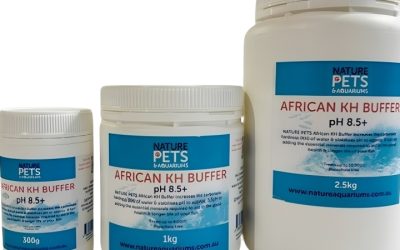
| KH under 8 dKH (143 ppm) | pH drifts down between changes | Fix buffering before stocking at all |
| Tank in a room over 80 °F (27 °C) | Lower oxygen, higher aggression | Add surface agitation, hold the count |
| Mixed with Synodontis catfish | Adds bioload, not aggression | Reduce cichlid count by 2-3 |
Apply the second table after the first. The chart says what a well-equipped 55 gallon can hold; the adjustments say whether yours qualifies this month, and that second question is the one that decides how the tank looks a year from now.
Adjusting for Your Actual Tank
Working out how many cichlids in a 55 gallon tank you can keep is only half a stocking plan. Species mix, rock layout and the physical shape of the tank all move the answer, sometimes by as many as three or four fish in either direction.
Adjusting for Species and Bioload
Smaller mbuna at 3-4 in (7.6-10 cm) allow the higher counts in the chart. Swapping in a species that reaches 5 in (13 cm) does not cost you one fish, it costs two or three, because waste output scales with body mass rather than with length.
Adding catfish changes the arithmetic without changing the aggression. Three Synodontis add real bioload to a tank already near its filtration ceiling, so take two or three cichlids off the count rather than treating the catfish as a free addition to the group.
Adjusting for Rockwork and Layout
Cave count should exceed fish count. A pursued fish needs somewhere to break line of sight within a second or two, and in a tank only 13 in (33 cm) front to back there is very little open water available in which to escape a determined chase.
Split the rock into two or three separate structures along the length rather than building one central mound. Separate territories divide the floor into zones; a single pile creates one prize worth defending and pushes every dispute into the same corner of the tank.
Tank Size, Placement and Fit
Measure the stand against the tank base and the cabinet height against your canister before ordering, because a 55 gallon build with rock passes 700 lb (318 kg) and most flat-pack furniture is not rated for it. Corner overhang is not acceptable at this weight.
Be honest about the shape as well. At 13 in (33 cm) front to back, a 55 gallon forces a choice between a rock wall and swimming lanes, which is why a 75 gallon at 48 x 18 in (122 x 46 cm) holds the same tank length far more comfortably for the same stocking count.
Where This Chart Stops Working
Any answer to how many cichlids in a 55 gallon tank is an average taken across many tanks. Three situations override the chart entirely, and spotting them early matters considerably more than adding another row of counts to the table above.
When the Formula Fails
One unusually aggressive male makes a correct count wrong. The chart predicts the typical outcome; it cannot predict the individual in your tank, and no rearrangement fixes a fish that pursues the same target from lights on to lights out every day.
Have a rehoming route agreed before stocking, through a local club or shop. Expect to remove one or two fish during the first six months. That is a normal running cost of keeping this group rather than evidence that the original plan was wrong.
Variables the Chart Cannot Hold
Order of introduction changes results substantially, since a fish added later faces residents that a simultaneous stocking would never have created. Adding in groups, and rearranging rockwork on the same day, both reduce that effect noticeably in practice.
Sex ratio is invisible in a shop tank at 1.5 in (3.8 cm), so early counts are a bet. That is precisely why the chart stocks high and settles lower, and why males are the fish most often rehomed once colouring reveals what you actually bought.
When to Stop Counting and Start Watching
Once fish are in, observation outranks the table. Chasing that continues after lights out, a fish held permanently in one corner, or the same fin damage recurring weekly all mean the stocking is failing whatever number the chart permitted.
Respond within days rather than weeks. Rearranging rockwork resets territories and often settles it; where it does not, removing the aggressor works reliably and costs far less than replacing the fish that would otherwise be lost over the following month.
Verifying the Count and Re-Checking It
Any figure for how many cichlids in a 55 gallon tank is a prediction, and predictions need testing against readings. This section covers what to measure, how often to repeat it, and what quietly drifts across a year in a tank running at this density.
What to Measure and How Accurate It Is
Four readings settle it: ammonia, nitrite, nitrate and KH. Liquid kits hold accuracy better than strips, which drift within weeks of the container being opened in a warm room, and KH is the test most rift lake keepers skip until pH has already fallen.
Measure loaded turnover once by timing the outflow into a container of known volume. Rated GPH is taken with an empty housing, so that single measurement is usually the difference between a count that works on paper and a tank with nitrate climbing.
How Often to Re-Check
Nitrate weekly, taken immediately before the water change. KH monthly. Rising nitrate at an unchanged routine means the fish have grown into the count rather than that anything broke, which typically happens between month eight and month eighteen after stocking.
Re-run the chart once a year. Fish that fitted at 2 in (5 cm) are a different proposition at 4-5 in (10-13 cm), and the adult count column is the one that matters after the first year, not the purchase column you originally worked from.
What Drifts Over Time
Buffering substrate dissolves as it works, so KH falls slowly and pH follows. Canister flow drops as media compacts and as sand wears the impeller. Heater accuracy moves 2-4 °F (1-2 °C) across a year without any visible sign that it has.
Season pushes in one direction. Rooms above 80 °F (27 °C) in July and August raise tank temperature, lowering dissolved oxygen while raising both metabolism and aggression, so midsummer is when a marginal stocking count usually declares itself.
How Many Cichlids in a 55 Gallon Tank: Questions
These follow from the chart rather than replacing it. Every answer to how many cichlids in a 55 gallon tank stays with counts, ratios and readings, since those decide the outcome far more reliably than an impression of how crowded the tank looks.
Is a 55 gallon really enough for mbuna?
It works with smaller species, heavy filtration and disciplined water changes. The limit is shape rather than volume: 13 in (33 cm) of depth leaves little open water beside a rock wall, which is why 75 gallons (284 L) is the more comfortable answer.
Can I keep just three or four cichlids?
Not with mbuna. Low counts concentrate a dominant male’s attention onto one or two targets, which is the usual route to a tank that slowly reduces itself to a single survivor. Peacocks tolerate lower numbers better, at six to eight adults.
What filtration do those counts assume?
384-480 GPH (1454-1817 LPH) loaded, which usually means a canister paired with a hang-on-back rather than one unit alone. Two filters also give redundancy, which matters at this density because a stalled filter shows in the readings within hours.
How many species should I mix?
Three or four for smaller mbuna, two or three for peacocks. Avoid species with similar colour patterns, since males frequently treat lookalikes as rivals, and that cross-species aggression is harder to resolve than ordinary competition within a single species.
See More:
Conclusion
The answer to how many cichlids in a 55 gallon tank is 12-16 smaller mbuna juveniles settling to 10-14 adults across three or four species, or 8-10 peacock juveniles settling to six to eight, each at one male to three or four females.
Treat those counts as conditional on 384-480 GPH loaded turnover, a weekly 30-40% change, more caves than fish, and nitrate holding under 20 ppm before each change. Where any of those four is missing, take three or four fish off the number rather than hoping.
Ready to decide? Our #1 pick for 2026 is the Mbuna, smaller species.
Live price & availability on Amazon.
Related Reviews & Guides


Best Kettle Corn Machines in 2026: Top Picks for Every Budget
Cherry Shrimp Care Guide: Setup, Feeding, and Best Supplies