Last Updated: October 4, 2026
🛒 Best Price Today on Amazon
Prime members get fast, free shipping on everything above, plus member-only deals. New members get a 30-day free trial — cancel anytime.
Top Harlequin Rasbora Care Complete Beginner Picks for 2026
Here are our current top harlequin rasbora care complete beginner picks, compared on real Amazon owner reviews, price, and features. Live prices update below.
As an Amazon Associate we earn from qualifying purchases at no extra cost to you.





The harlequin rasbora (Trigonostigma heteromorpha) is one of the most popular community fish in the freshwater hobby, and for good reason. Its warm copper-orange body, bold black triangle, and easygoing temperament make it both beautiful and beginner-friendly. Native to the soft, slightly acidic streams and peat swamps of Southeast Asia, this hardy little schooling fish adapts well to a wide range of conditions, tolerates the small mistakes new hobbyists tend to make, and looks spectacular in a planted tank. This complete beginner’s guide covers tank setup, water parameters, feeding, tank mates, and health so you can keep a thriving school.
Overview and Appearance
Harlequin rasboras are small, deep-bodied fish that grow to about 1.5 to 2 inches. Their defining feature is the crisp black wedge or “Lambda” marking on the rear half of the body, set against a pinkish-copper to orange base color that intensifies in mature, well-fed fish kept in good conditions. The contrast is most striking against a dark substrate and a backdrop of green plants.
They are peaceful, active shoaling fish that should always be kept in groups. A solitary harlequin becomes stressed, drab, and reclusive, while a proper school produces the tight, coordinated swimming that makes the species so eye-catching.
- Adult size: 1.5 to 2 inches (4 to 5 cm)
- Lifespan: 5 to 8 years with good care
- Temperament: Peaceful, social, schooling
- Minimum group: 6, ideally 8 to 10 or more
Tank Setup and Water Parameters
A school of harlequin rasboras can live in a 10-gallon tank, but a 20-gallon long aquarium gives them room to school properly and far more stability. If you are setting up your first tank, our complete fish tank setup guide covers everything from cycling to stocking order, and our 10-gallon aquarium setup guide is a great starting point for a small school.
One of the reasons harlequins are so beginner-friendly is their forgiving parameter range:
- Temperature: 72 to 81°F (22 to 27°C)
- pH: 6.0 to 7.8
- Hardness: soft to moderately hard
- Flow: gentle to moderate
Keep the temperature steady with a properly sized heater; our aquarium heater buyer’s guide explains how to match wattage to tank size. They show their best colors in a planted tank with a dark substrate, some floating plants to soften the light, and open water to swim through. A gentle filter keeps the water clean without buffeting the school; see our picks for the best filters for a 20-gallon tank. Perform regular partial water changes, and if the water ever turns hazy after setup, our guide to cloudy water causes and fixes will help you diagnose it.
Diet and Feeding
Harlequin rasboras are unfussy omnivores that readily accept almost any prepared food, which is part of what makes them so easy to keep. A varied diet keeps their color rich and their immune system strong.
- Staple: good-quality flakes or micro-pellets sized for small mouths
- Frozen and live: daphnia, bloodworms, brine shrimp, and cyclops
- Frequency: small amounts once or twice a day
Feed only what the school finishes in about two minutes to avoid leftover food fouling the water. Rotating in frozen or live foods a few times a week noticeably deepens their orange coloration. For more on building a balanced menu, see our guide to aquarium fish food types.
Tank Mates and Behavior
Few fish are better community citizens. Harlequin rasboras are non-aggressive, stay in the middle of the water column, and ignore other peaceful species entirely. The key to seeing their natural behavior is keeping a real school, six at the absolute minimum and eight to ten or more for the best display.
Excellent tank mates include:
- Small tetras such as neon, ember, and rummynose
- Corydoras catfish and other peaceful bottom dwellers
- Surface fish like hatchetfish and other gentle community species
- Dwarf shrimp and snails
- Otocinclus and other small algae eaters
They can also share a tank with a calm betta in a larger setup; our betta tank mates guide explains how to do that safely. Avoid large, fin-nipping, or aggressive fish that may bully or eat them. For a fuller stocking plan, our 20-gallon aquarium setup guide lists balanced community combinations.
Common Health Issues
Harlequin rasboras are robust and rarely fall ill in a well-maintained, cycled tank. When problems do appear, they almost always trace back to poor water quality, stress from being kept in too small a group, or a disease brought in by an unquarantined new fish.
Ich (white spot) is the most likely issue, showing as white specks on the body and fins after a chill or a stressful move. It responds well to a slight temperature increase and a reliable medication; our guide to ich treatments walks through the process. Fin rot can occur in dirty water, appearing as ragged, receding fins, and usually clears up once water quality is corrected.
Prevention is straightforward: cycle the tank fully before adding fish, quarantine new arrivals, keep the school large, and stay consistent with water changes. Our roundup of disease prevention products covers a simple quarantine and treatment kit every keeper should have on hand.
Frequently Asked Questions
How many harlequin rasboras should I keep together?
Keep a minimum of six, but eight to ten or more is far better. They are schooling fish that only show their full color and natural behavior in a group. Larger schools are calmer and less prone to stress.
What size tank do harlequin rasboras need?
A small school can live in a 10-gallon tank, but a 20-gallon long aquarium is recommended for proper schooling and more stable water. Bigger groups need proportionally more space.
Are harlequin rasboras good for beginners?
Yes. They are hardy, tolerate a wide pH and temperature range, eat almost anything, and are completely peaceful. They are one of the best community fish for a first stable, cycled aquarium.
What do harlequin rasboras eat?
They are easygoing omnivores. A quality flake or micro-pellet as a staple, supplemented with frozen or live daphnia, bloodworms, and brine shrimp, keeps them healthy and brings out their orange color.
Do harlequin rasboras need a heater?
Yes. They are tropical fish that need stable temperatures between 72 and 81°F. A properly sized heater prevents the chills that commonly trigger ich and other stress-related illness.
Related Reviews & Guides



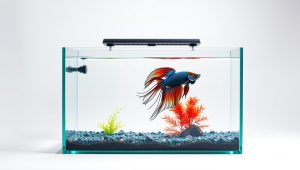
6 Best Betta Fish Tanks With Divider 2026
Aquarium Stocking Calculator: Numbers and How to Use It