Last Updated: September 25, 2026
Goldfish water temperature sits at 68-74 °F (20-23 °C) for fancy varieties and 60-70 °F (16-21 °C) for single-tails, with the daily swing held under 2 °F (about 1 °C). Stability matters more than the exact figure, because temperature controls oxygen supply and metabolic demand at the same time, in opposite directions.
As an Amazon Associate we earn from qualifying purchases.
As an Amazon Associate we earn from qualifying purchases at no extra cost to you. Prices and availability are accurate as of the date shown and are subject to change.

DaToo Aquarium Thermometer with Large LCD Display Fahrenheit/Celsius(℉/℃) Fish Tank Thermometer for Aquarium Reptile Terrarium Digital Water Thermometer with Suction Cup
Selected for "Goldfish Water Temperature: How It Works and What to Watch": this listing is tanks (DaToo Aquarium Thermometer with Large LCD Display Fahrenheit/Celsius(℉), matching the equipment this article covers.
View on Amazon
AQUANEAT Aquarium Thermometer, Fish Tank Thermometer, Digital Temperature Test, with Large LCD Display (1 Pack)
Selected for "Goldfish Water Temperature: How It Works and What to Watch": this listing is tanks (AQUANEAT Aquarium Thermometer, Fish Tank Thermometer, Digital Temperat), matching the equipment this article covers.
View on Amazon
fishpond Riverkeeper Digital Thermometer | Fly Fishing Water Temperature Stream Thermometer | Lake Water Temperature Guage
Selected for "Goldfish Water Temperature: How It Works and What to Watch": this listing is aquarium equipment (fishpond Riverkeeper Digital Thermometer | Fly Fishing Water Temperatu), matching the equipment this article covers.
View on Amazon
API GOLDFISH PROTECT Aquarium Water Conditioner 4-Ounce Bottle
Selected for "Goldfish Water Temperature: How It Works and What to Watch": this listing is water treatment (API GOLDFISH PROTECT Aquarium Water Conditioner 4-Ounce Bottle), matching the equipment this article covers.
View on AmazonBy David Nguyen
What Temperature Actually Controls
Goldfish water temperature is not one setting among many. It simultaneously determines how much oxygen the water can hold, how quickly the fish digests what it eats, and how fast the filter bacteria work, which is why a small change moves several readings at once.

The Deciding Numbers: Range, Swing Limit and Heater Wattage
Three figures carry this whole topic. Fancy varieties are comfortable at 68-74 °F (20-23 °C) and single-tails at 60-70 °F (16-21 °C). Both tolerate a wider band briefly but not indefinitely, so pick one figure inside the range and then hold the tank there.
The swing limit is under 2 °F (about 1 °C) across a day, and new water during a change should land within the same margin. Heater wattage runs roughly 3-5 W per US gallon where the room sits about 10 °F (6 °C) below target, so 40 gallons (151 L) needs 120-200 W.
Why Oxygen and Metabolism Move Together
Warmer water holds less dissolved oxygen. Fresh water saturates at roughly 9.1 mg/L at 68 °F (20 °C), around 8.3 mg/L at 77 °F (25 °C), and about 7.6 mg/L at 86 °F (30 °C). Supply falls steadily as the water warms, by straightforward physics rather than by anything biological.
Demand moves the opposite way. Metabolic rate rises steeply with temperature, so a goldfish at 82 °F (28 °C) burns oxygen considerably faster than the same fish at 70 °F (21 °C) while the surrounding water holds less of it. That widening gap is what surface gasping represents.
Normal Ranges Versus Action Thresholds
The table below separates the comfortable band from the point at which intervention is needed. Keep it near the tank, because the difference between a reading that is merely unusual and one that requires action the same day is not obvious from watching the fish.
| Condition | Reading | What happens | Action |
|---|---|---|---|
| Fancy varieties, target | 68-74 °F (20-23 °C) | Normal digestion and activity | Hold steady, verify weekly |
| Single-tails, target | 60-70 °F (16-21 °C) | Normal digestion and activity | Hold steady, verify weekly |
| Cool | 50-60 °F (10-16 °C) | Digestion slows markedly | Reduce feeding frequency |
| Cold | Below 50 °F (10 °C) | Gut transit nearly stops | Stop feeding, warm slowly if indoors |
| Warm | 78-82 °F (26-28 °C) | Oxygen falls as demand rises | Increase surface agitation |
| Too warm | Above 82 °F (28 °C) | Surface gasping likely | Cool gradually, add air, shade the tank |
| Daily swing | Over 2 °F (1 °C) | Sustained stress load | Check heater accuracy and placement |
| Water change delta | Over 2 °F (1 °C) | Acute shock risk | Match temperature before adding water |
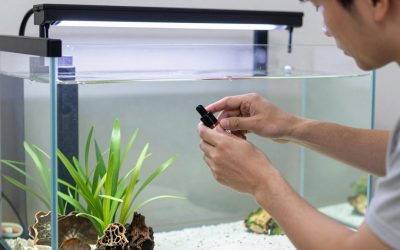
Verify with a thermometer independent of the heater dial. Digital probes and glass thermometers both work; what matters is that the number you act on is not simply the number the heater believes, since those two figures diverge from each other over time.
Applying the Range to a Real Tank
Goldfish water temperature behaves differently in a small tank than in a large one, and differently again depending on where the tank sits in the room. This section turns the target range into practical decisions about volume, placement and equipment sizing.
Tank Size, Placement and Fit
Measure the water depth against the heater length before ordering, since most submersible heaters must be fully covered and a 14 in (36 cm) unit will not fit a 12 in (30 cm) deep tank. Check that it stays submerged at the lowest level you allow before topping up.
Placement drives stability more than wattage does. Direct sun can add several degrees to a small tank across an afternoon, and a spot near an exterior door, a radiator or an air conditioning vent produces exactly the daily swing the range above rules out.
How 20, 40 and 75 Gallon Tanks Behave
Thermal inertia scales with volume. A 20 gallon (76 L) tank, holding only 17-18 gallons (64-68 L) of actual water, follows the room closely and can move 4-5 °F (2-3 °C) across a summer day with no equipment fault involved at all.
At 40 gallons (151 L) the same room produces roughly half that movement, and at 75 gallons (284 L) the tank barely registers a normal daily cycle. Large tanks forgive a heater failure better too, since they cool slowly enough to give you hours rather than minutes to react.
Fancy Versus Single-Tail Preferences
Fancy goldfish do better slightly warmer, near the middle of 68-74 °F (20-23 °C), partly because their compressed body shape makes digestion less efficient and warmth assists gut transit. Single-tails are genuinely cool-water animals and thrive at 60-70 °F (16-21 °C) instead.
The seasons expose that split in opposite directions. In July and August, rooms above 78 °F (26 °C) push small tanks past 82 °F (28 °C) exactly when dissolved oxygen is at its annual low, which is why surface gasping questions cluster in midsummer rather than spreading evenly across the year.
In January and February, unheated rooms and overnight setbacks on home heating drag tanks into the low 60s °F (around 16 °C) and expose undersized heaters that had coped perfectly well through a mild autumn. Check the reading at both ends of the year.
Myths Worth Clearing Out
Three claims about goldfish water temperature persist strongly enough to override every number above. Each is paired below with the measurement that replaces it, since none of the three survives a thermometer being left in the tank and read for a week.
Myth: Cold-Water Fish Means No Heater
Cold-water describes the range these fish tolerate, not a requirement for an unregulated tank. The indoor problem is not cold but variation: a room running 72 °F (22 °C) by day and 62 °F (17 °C) overnight subjects the fish to a swing well outside the safe limit.
The replacement measure is the daily swing rather than the average. Log the temperature morning and evening for a week, and if the difference exceeds 2 °F (about 1 °C), a correctly sized heater is doing stability work rather than heating work and belongs in the tank.
Myth: Room Temperature Is Automatically Fine
Room temperature and water temperature are not the same reading. Evaporation cools the surface, lights add heat from above, and filter and pump motors add a small amount continuously, so a tank can sit consistently above or below the room by a couple of degrees.
Measure rather than assume. Put one thermometer in the tank and another in the room for a week, and treat the tank figure as the only one that counts. In a small tank beside a sunny window the two can diverge by 5 °F (3 °C) on a clear afternoon.
Myth: Raise the Temperature to Treat Illness
Raising temperature is often repeated as a general fix, but it lowers dissolved oxygen at exactly the moment a struggling fish needs more of it, and it accelerates biological processes throughout the tank. It is not a substitute for identifying why the water changed.
Where a fish looks unwell the order is fixed: test ammonia, nitrite, nitrate and temperature, correct anything out of range with a water change, then consider whether something beyond water quality is involved. Persistent signs in clean water need an aquatic veterinarian rather than a heater adjustment.
Holding the Number Steady Over Years
A thermometer reading that is correct today will not stay correct on its own. Heaters drift, thermostats stick, and the room changes twice a year, so this section covers verification of goldfish water temperature, failure behaviour, and what the equipment costs to run across twelve months.
Verifying and Re-Checking
Check the tank against an independent thermometer weekly and record the figure, because a single reading tells you nothing about drift. Two thermometers of different types disagreeing by more than 1 °F (about 0.5 °C) is the signal that the older of the two needs replacing.
Re-verify after any equipment change, after moving the tank, and at each seasonal turn. A heater holding 72 °F (22 °C) through a mild autumn may run continuously in January without ever reaching its setpoint, and continuous operation is the clearest sign that it is undersized.
What Drifts and What Fails
Heaters fail in two directions and both are serious. Stuck on raises the tank until oxygen collapses; stuck off drops it. Prefer units with automatic shut-off when uncovered and a shatter-resistant body, since a heater exposed during a water change is the classic cause of a cracked tube.
Accuracy drifts far more quietly than either failure. A dial reading 72 °F (22 °C) can sit 2-4 °F (1-2 °C) off after a year of continuous use, which is enough to move a fancy goldfish out of its comfortable band without anything appearing to be broken.
Running Cost and Power Interruptions
A heater draws its rated wattage only while actively heating, so a 150 W unit holding a small gap above room temperature costs far less to run than one fighting a cold room all winter. Moving the tank away from exterior walls and vents is the cheapest way to reduce that load.
Power cuts are the sharper risk, and they concentrate in the summer storm season and in midwinter. A 20 gallon (76 L) tank loses temperature within a few hours while a 75 gallon (284 L) tank holds most of a day, so insulating the tank with blankets and running a battery air pump preserves both heat and dissolved oxygen.
Keep that pump and a spare heater on hand in advance rather than sourcing either during an outage. Run every cable as a drip loop into a GFCI outlet, and prefer equipment carrying a recognised certification such as UL or ETL for anything sitting in water.
Goldfish Water Temperature Questions
These goldfish water temperature questions come up most often once a thermometer is actually sitting in the tank. Each answer stays with the reading and the swing rather than with a single ideal number, since stability is what the fish responds to over weeks and months.
What is the ideal temperature for fancy goldfish?
Anywhere in 68-74 °F (20-23 °C), held steady. Choosing 71 °F (22 °C) and staying within a degree of it beats aiming at a precise figure while letting the tank move several degrees across a day. Stability is the value here, not the target itself.
Can goldfish survive without a heater?
In a genuinely stable room, yes, particularly single-tails. The question is whether the room actually is stable, which very few are once overnight setbacks and seasonal change are counted. Log morning and evening readings for a week before making that decision either way.
How do I cool a tank in summer?
Increase surface agitation first, since oxygen is the limiting factor rather than heat itself. Shade the tank from direct sun, shorten the lighting period, float a sealed container of ice water for a gradual drop, and never lower the temperature faster than 2 °F (1 °C) per hour.
Why is my goldfish at the surface?
Test ammonia, nitrite, nitrate and temperature before doing anything else. Surface gasping usually means low dissolved oxygen from a warm tank, a stalled filter, or elevated ammonia. Correct whichever reading is out of range and add surface agitation while you work through it.
What temperature do goldfish fry need?
Spawning is typically triggered by a rise into the high 60s and low 70s °F (about 20-23 °C) after a cooler period. Fry do best held steady in that same band, since their small grow-out tanks follow the room closely and swing considerably more than adult tanks.
See More:
Conclusion
Goldfish water temperature comes down to three numbers: 68-74 °F (20-23 °C) for fancy varieties, 60-70 °F (16-21 °C) for single-tails, and a daily swing held under 2 °F (about 1 °C). A heater at 3-5 W per gallon exists mainly to deliver the third of those three figures.
Verify with a thermometer independent of the heater, log it weekly, and treat any drift as an early warning rather than a curiosity. Oxygen and metabolism move with temperature in opposite directions, so a stable reading protects more of the tank than any single piece of equipment does.
Low Light Aquarium Plants: Species, Care and Placement Tips
How to Clean Algae Off Aquarium Glass Without Stressing Fish