Last Updated: September 25, 2026
Freshwater aquarium light buying guide advice usually opens with brands, when the four things that decide whether a fixture suits you are tank length, water depth, how it mounts and whether it dims. All four of those are measurable before you look at a single product page, so this guide starts there instead.
As an Amazon Associate we earn from qualifying purchases.
As an Amazon Associate we earn from qualifying purchases at no extra cost to you. Prices and availability are accurate as of the date shown and are subject to change.

hygger Clip On 24/7 Lighting Aquarium LED Light,Sunrise-Daylight-Moonlight and DIY Mode, Adjustable Timer/Brightness Fish Tank Light with 7 Colors for Planted Tank (14W for 12~20in Tank)
Selected for "Freshwater Aquarium Light Buying Guide: What to Check First": this listing is lighting (hygger Clip On 24/7 Lighting Aquarium LED Light,Sunrise-Daylight-Moonl), matching the equipment this article covers.
View on Amazon
hygger 18W 24/7 Lighting Aquarium LED Light, Sunrise-Daylight-Moonlight Mode and DIY Mode, Adjustable Timer Adjustable Brightness Fish Tank Light with Extendable Bracket 7 Colors for Planted Tank
Selected for "Freshwater Aquarium Light Buying Guide: What to Check First": this listing is lighting (hygger 18W 24/7 Lighting Aquarium LED Light, Sunrise-Daylight-Moonligh), matching the equipment this article covers.
View on Amazon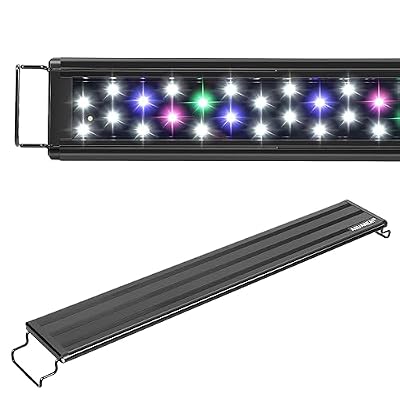
AQUANEAT LED Aquarium Light Full Spectrum for 18 Inch to 24 Inch Fish Tank Light Fresh Water
Selected for "Freshwater Aquarium Light Buying Guide: What to Check First": this listing is lighting (AQUANEAT LED Aquarium Light Full Spectrum for 18 Inch to 24 Inch Fish ), matching the equipment this article covers.
View on AmazonAQUANEAT LED Aquarium Light Full Spectrum for 48 Inch to 54 Inch Fish Tank Light Fresh Water
Selected for "Freshwater Aquarium Light Buying Guide: What to Check First": this listing is lighting (AQUANEAT LED Aquarium Light Full Spectrum for 48 Inch to 54 Inch Fish ), matching the equipment this article covers.
View on AmazonBy David Nguyen
Four Measurements to Take Before You Start Shopping
Any useful freshwater aquarium light buying guide has to begin with an honest description of the tank and of what you want from it, because a fish-only setup, a tank with a few easy plants and a proper aquascape all need genuinely different fixtures at genuinely different prices.
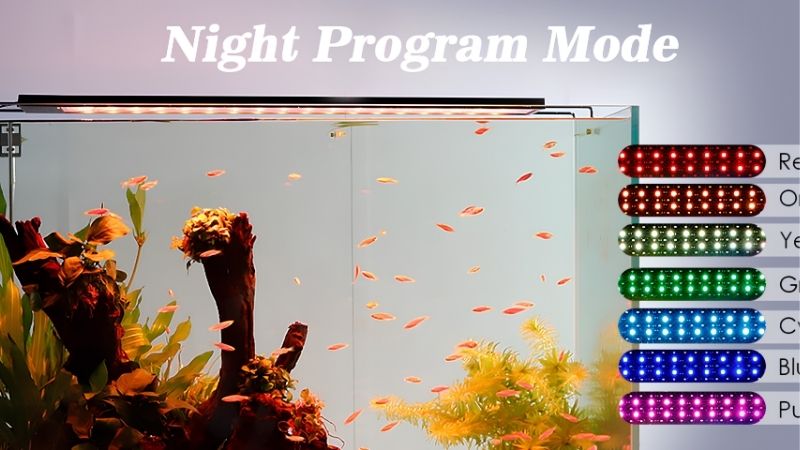
The decisive numbers: length, depth and photoperiod
Fixture length should cover most of the tank’s length, since a short unit leaves visibly dim ends where the plants thin out. A 36 inch (91 cm) tank wants a fixture close to that span, and extendable brackets help only with the mounting rather than with the actual spread of the light.
Depth decides whether plants are viable at all. A fixture giving useful light at the substrate of a 12 inch (30 cm) tank may reach the bottom of a 21 inch (53 cm) tank far more weakly, so measure water depth rather than tank height and plan the photoperiod at 6–8 hours on a timer.
Mounting, dimming and the specifications to ignore
Mounting style rules out far more fixtures than raw output ever does. Clip units need a rim that they can grip, legged fixtures need the right tank width, and rimless tanks frequently need a hanging kit or a bracket sold separately, so check all of this before comparing anything else.
Dimming is the one feature genuinely worth paying for. It lets you correct an algae problem or acclimate a new planted tank without buying again, whereas lumens weight brightness towards green where plants use relatively little, and watts describe consumption rather than performance.
Tank size, placement and physical fit
The position of the tank affects the outcome as much as the fixture does. A tank away from windows holds a predictable light budget, whereas one on a sunny sill effectively runs a much longer photoperiod than the timer suggests, which is a common cause of algae in an otherwise sensible setup.
Weight sets the wider limits here as well: a full tank runs near 10 lb per gallon (about 1 kg per L), so a 55 gallon (208 L) setup passes 600 lb (272 kg) and needs a purpose-built stand. Measure the tank length, the rim width and the water depth with a tape before ordering any fixture.
| Situation | Main number to match | Feature that matters | Recurring cost | Who it fits |
|---|---|---|---|---|
| Replacing a failed hood light | Hood aperture and length | Physical fit above all | None, no bulbs | Kit tank owners |
| First tank, fish and easy plants | Tank length | Simple, dimmable if possible | None | Beginners on a budget |
| Upgrading for real plants | Water depth | Dimming and coverage | Fertiliser, trimming | Low-tech planted keepers |
| Display or aquascape | Colour channels | Ramping and rendition | Fertiliser, more trimming | Aquascapers |
| Buying on lumens alone | Not applicable | None | Replacement sooner | Nobody, measure instead |
The Options, Grouped by Buying Situation
There is no single answer in any freshwater aquarium light buying guide, because the same fixture that suits a first tank will be wrong for an aquascape. Each of the situations below is matched to a type of fixture, with the limitation that comes attached to it stated plainly alongside.
Replacing a failed hood or kit light
When the light built into a hood finally dies, physical fit dominates every other consideration. Measure the aperture, the internal length and the cable route before looking at anything, because a fixture that cannot sit in the hood is the wrong fixture at any price or specification.
Slim LED bars designed specifically for retrofitting are the usual answer here, and many of them are adjustable in length. The limitation is that hood apertures restrict the spread, so expect a dimmer result than the same fixture would give sitting openly on the rim of a rimless tank.
A first tank with fish and a few easy plants
A simple bar, or a basic dimmable fixture covering the tank length, is entirely adequate here. It will grow java fern, anubias and cryptocoryne perfectly well without any carbon injection, and dimming lets you reduce the intensity if algae appears during the first few unstable months.
The limitation here is ambition rather than budget. This category will not support carpets or red stem plants, and buying a stronger fixture in anticipation of them usually produces algae long before the plants arrive, so it is better to start modest and upgrade if the hobby takes hold.
Upgrading an established tank for plants
At this point the freshwater aquarium light buying guide turns on water depth, and dimming becomes close to essential here. An adjustable fixture lets you raise the intensity gradually as plant mass builds, which is far safer than switching to a brighter unit and waiting to see what happens.
The limitation is that light is only ever one input among several. Above roughly medium intensity, plants become carbon limited and the surplus feeds algae, so an upgrade should come with a fertiliser routine and a willingness to trim more often than the tank previously required.
A display tank or aquascape where appearance leads
Multi-channel fixtures with separate white, red and blue output make fish colours read far more naturally and let you tune the look, and built-in ramping settles the fish better than an abrupt switch does. For a tank in a living space this is the upgrade people notice immediately.
The limitation here is complexity as well as cost. More electronics means more that can fail, app-based control can become unsupported after a few years, and the practical difference over a good dimmable fixture on a cheap mechanical timer is far smaller than the price gap suggests.
Direct Comparison and Who Should Not Buy
Most of the difficulty in any freshwater aquarium light buying guide comes down to a single comparison and to one honest question about whether the existing fixture is genuinely the problem at all. Answering both prevents the most common unnecessary purchase in this whole category.
Straight replacement against a genuine upgrade
If the old fixture suited the tank and then simply failed, replacing like for like is the cheaper and lower-risk choice. If plants were struggling under it, an upgrade makes sense, but only alongside a proper fertiliser routine, since more light without more nutrients simply feeds algae.
The deciding question is what actually changed. A fixture that worked for two years and then died is a replacement job, whereas a fixture that never grew plants well was mismatched to the tank depth from the start and it deserves a different specification rather than a straight duplicate.
When a new fixture is the wrong purchase
If the tank already has an algae problem, a brighter fixture will only make it worse. The first moves are a consistent timer at 6–8 hours, reduced intensity or a raised fixture, and checking that nitrate sits at 20–40 ppm rather than being stripped to zero by very heavy water changes.
If plants are struggling under otherwise adequate light, the limiting factor is usually carbon or nutrients rather than the fixture. Confirm that ammonia and nitrite read 0 ppm, review the fertiliser routine, and only then ask whether the light genuinely lacks the output required.
Cheaper approaches that genuinely work
A plug-in timer costs very little indeed and fixes the single most common cause of algae, which is an inconsistent photoperiod driven by whoever happens to be walking past the tank. Holding a steady 6–8 hours does more for the appearance than most fixture upgrades manage on their own.
Changing the mounting height is the other genuinely free adjustment. Raising a fixture a few inches (several cm) reduces intensity at the substrate noticeably, and lowering it recovers that output, which covers a surprising amount of what people buy new fixtures hoping to achieve.
Running Costs, Failure Points and Twelve Month Ownership
LED fixtures usually outlast the tanks sitting beneath them, so the honest conclusion of any freshwater aquarium light buying guide is that the purchase price matters far less than what the fixture commits you to. There are no bulbs at all, which changes the ownership picture against older units.
How LED fixtures actually fail
Output declines gradually rather than stopping outright, slowly enough that most owners never notice until plant growth slows or colours look duller than they remember. Individual diodes do occasionally fail as well, leaving a visibly dark section along part of the fixture housing.
Driver failure is the usual reason that a unit stops working entirely, and it is very rarely repairable at home. Moisture is the underlying cause in a great many cases, since condensation reaches the housing on open-top tanks and corrodes the connections steadily across months of normal use.
What you will actually spend money on
Beyond electricity itself, the ongoing costs are all indirect: fertiliser and trimming time if the fixture supports plants, and a timer where scheduling is not built in. A more powerful light commits you to more maintenance, and that is the real cost rather than anything on the price tag.
Price levels move constantly across the budget, mid-range and premium fixtures, so check the current figures at the time of purchase rather than relying on remembered prices. Lighting discounts cluster into just a few events each year, with late November usually the deepest of them.
Certification, warranty and mounting hardware
Any powered device sitting above the water should carry recognised safety certification such as UL or ETL, run through a residual current device or GFCI outlet, and have a drip loop in the cable. Splash and condensation are constant on any open-top tank, so this genuinely does matter.
Check that the mounting hardware is included and that it suits your tank, since brackets, legs and hanging kits are frequently sold separately and rarely fit rimless tanks without an adapter. Warranty length is worth comparing as well, because the driver is the component that usually fails.
Frequently Asked Questions
These questions come up repeatedly once people stop treating brand names as their first step, because working through any freshwater aquarium light buying guide is really mostly a matter of measuring the tank properly and then being honest about what you intend to grow inside it.
What should I measure before buying?
Tank length, rim width and water depth, plus the hood aperture if the tank happens to have one fitted. Those four figures rule out most of the unsuitable fixtures immediately, and they matter far more than any output specification printed on the packaging or quoted in a listing online.
Is a dimmable fixture worth the extra cost?
Usually yes, and more so than almost any other single feature. Dimming lets you reduce the intensity if algae appears and raise it again as plant mass builds, which avoids buying a second fixture later on when the tank turns out to need something different from what you first expected.
Can I use a plant light on a fish-only tank?
Yes, provided that it can be dimmed or raised. A stronger fixture sitting over a tank with no plants at all simply grows algae on the glass instead, so either turn the output down, or simply accept much more frequent glass cleaning, which most owners find tiresome within a few weeks.
How long should a new fixture last?
Many years, since LEDs have no scheduled replacement at all and their output declines only slowly. Replace it only when growth or appearance changes noticeably, or when the driver fails, rather than following any fixed interval carried over from older fluorescent aquarium lighting.
See More:
Conclusion
The sensible default in any freshwater aquarium light buying guide is a dimmable fixture spanning most of the tank’s length, chosen after measuring the water depth and checking the mounting style, and then run on a timer at 6–8 hours. The budget choice is a simple bar for fish-only tanks.

Quick Picks: Best Adjustable Submersible Aquarium Heaters
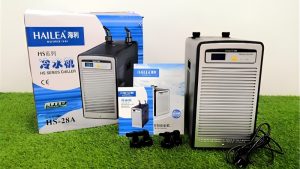
JBJ Arctica vs Hailea Aquarium Chiller: Best Compared Guide