Last Updated: October 21, 2026
- Top Pick: Fritz Fishless Fuel Ammonia Solution for Fishless Aquarium Cycling – 2 oz
- Best Value: Dr. Tim’s Aquatics Ammonium Chloride Aquarium Treatment for Fishless Cycling – Chlorine Free, Fish Tank Cleaner for Saltwater, Freshwater, Reef Aquariums – 100% Natural – 4 Oz.
- Premium Choice: DrTim’s Aquatics Ammonium Chloride Solution and One & Only Live Nitrifying Bacteria Aquarium Cycle Start Up Bundle for Freshwater (2oz Ammonium + 4oz One Only for 60 Gallon Tank)
Fishless cycle aquarium guide means growing a filter bacteria colony before any livestock arrives, using a controlled ammonia dose instead of live fish. This guide covers what the bacteria need, which ammonia sources work, how long the process realistically takes, and the single test that proves it has finished.
As an Amazon Associate we earn from qualifying purchases.
As an Amazon Associate we earn from qualifying purchases at no extra cost to you.


By David Nguyen
What a Fishless Cycle Aquarium Guide Is Built On
The method is simple in principle: supply ammonia deliberately, let two bacterial groups establish, and measure the result. Every instruction in this fishless cycle aquarium guide follows from three numbers that decide whether the colony grows, stalls or dies back.
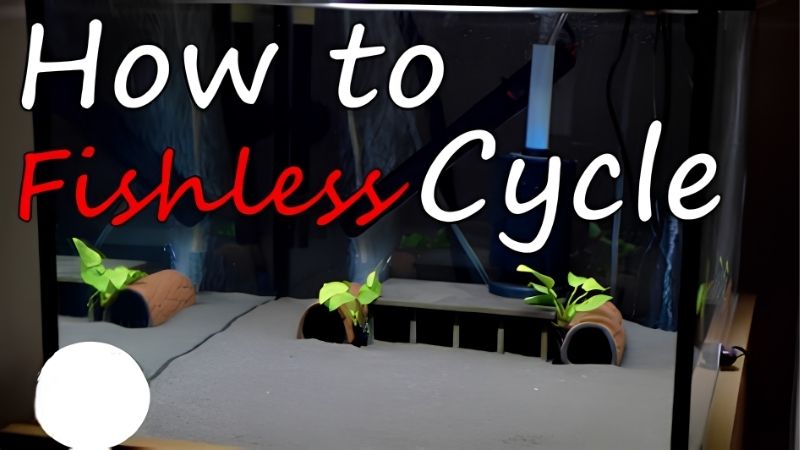
The numbers that define a fishless cycle
Dose ammonia to 2 to 4 ppm and hold it there. Below that the colony grows smaller than the eventual fish load requires; above roughly 5 ppm the nitrite-oxidising group slows markedly, which is the most common reason a cycle appears to stall halfway through the process.
Expect three to eight weeks at 78 to 80 °F (26 to 27 °C) with the filter running continuously. Seeded media from a healthy established tank can cut that to one or two weeks, and a cold room below 70 °F (21 °C) can push it past the eight week mark.
The completion test is fixed and non-negotiable. Dose to 2 to 4 ppm, wait 24 hours, then measure: zero ammonia, zero nitrite and measurable nitrate means the tank is ready. Any other result means the colony cannot yet process a full day of waste from stocked fish.
Which ammonia sources actually work
Pure liquid ammonia gives the most control because the dose is measurable and repeatable. Only unscented, surfactant-free product is suitable, and the usual check is to shake the bottle: persistent foam indicates additives that do not belong in a tank being prepared for fish.
Fish food and a piece of raw shrimp both work by decomposing, and both trade control for convenience. The ammonia release is uneven, the tank clouds and smells, and the reading can overshoot 5 ppm without warning, so daily testing matters more with these methods than with dosing.
Bottled bacteria is a seed rather than a source. It supplies organisms but no food, so an ammonia source is still required alongside it, and the claims on the label should be treated as a possible head start rather than as a substitute for the completion test.
| Method | How ammonia arrives | Dose control | Typical time | Main drawback |
|---|---|---|---|---|
| Pure liquid ammonia | Measured drops, repeatable | Precise, to 2-4 ppm | 3-8 weeks | Must be additive-free |
| Fish food | Decomposition over days | Poor, easy to overshoot | 4-8 weeks | Cloudy water, odour |
| Raw shrimp | Decomposition, uneven | Poor, hard to reverse | 4-8 weeks | Strong smell, messy |
| Seeded media plus ammonia | Measured, colony pre-supplied | Precise | 1-2 weeks | Needs a healthy donor tank |
| Bottled bacteria plus ammonia | Measured, colony seeded | Precise | 2-4 weeks, variable | Results differ by product |
| Fish-in cycling | Fish waste, uncontrolled | None, managed by changes | 4-8 weeks | Exposes fish to ammonia |
Target ranges and action thresholds
Targets during a cycle are not the same as targets in a stocked tank, and confusing the two causes a great deal of unnecessary alarm. A fishless cycle aquarium guide is one of the few situations where high readings are the intended outcome.
During the process the readings are supposed to look alarming. Ammonia at 2 to 4 ppm is intentional, nitrite frequently reads off the top of the chart, and nitrate climbs steadily, none of which is a problem while the tank holds no livestock at all.
Two thresholds still apply. Bring ammonia down with a partial change if it passes 5 ppm, and watch pH, because bacterial activity slows sharply below 6.5 and the process consumes carbonate hardness as it runs, which is what quietly stalls cycles in soft tap water.
Running the Process in a Real Tank
The chemistry is identical everywhere; the speed is not. Applying this fishless cycle aquarium guide to a particular tank means accounting for water volume, room temperature and where the tank physically sits during the weeks it spends running empty of fish.
Tank size, placement and fit
Measure the stand top, the gap behind the tank and the water line against the heater before ordering equipment, since none of it can be adjusted once the tank is filled. Hang-on-back filters need 4 to 6 in (10 to 15 cm) of clear wall behind the rim to sit properly.
Placement decides temperature stability, which decides speed. A tank against an exterior wall, under a vent or beside a draughty window swings with the room, and every hour spent below 70 °F (21 °C) slows bacterial reproduction and extends the total time by days.
How volume changes the arithmetic
Dosing works on concentration, so a 10 gallon (38 L) tank needs roughly half the ammonia of a 20 gallon (76 L) for the same reading. Calculate against real water volume, which is usually 15 percent below the label once substrate and hardscape are in place.
Larger tanks are slower to move but easier to correct. Overshooting to 6 ppm in 5 gallons (19 L) is fixed with a small change; the same mistake in 40 gallons (151 L) means moving a lot more water, which is a practical argument for dosing carefully rather than quickly.
What speeds the process and what does not
Three factors genuinely help: temperature at 78 to 80 °F (26 to 27 °C), strong surface agitation for oxygen, and seeded media kept wet and transferred within an hour or two. Together these can reduce a seven week cycle to a fortnight in a well-set-up tank.
Two things do nothing useful. Heating past 84 °F (29 °C) offers no further benefit and reduces dissolved oxygen, and running the light has no effect at all, since these bacteria are not photosynthetic and the light only encourages algae on bare glass.
Myths That Stall Fishless Cycles
Three beliefs cause most of the failures in a fishless cycle aquarium guide, and each has a mechanism behind it rather than being a matter of opinion. All three still appear regularly in shop advice and on the labels of products sold for the purpose.
Myth: more ammonia means a faster cycle
Beyond roughly 5 ppm the nitrite-oxidising bacteria slow considerably, so a heavy dose extends the process rather than shortening it. Dose to 2 to 4 ppm, let it clear, then dose again, rather than topping up to a high reading and waiting for something to happen.
Myth: a water change restarts everything
The colony lives in filter media and substrate, not in the water, so a partial change removes food rather than bacteria. What genuinely sets a cycle back is chlorinated or chloraminated water passing through the media, or the filter sitting switched off for an extended period.
Myth: cloudy water means the cycle failed
A bloom of heterotrophic bacteria feeding on dissolved organics is normal in the first weeks, particularly with the food or shrimp methods. It clears as the population stabilises, and a clarifier only treats the appearance while leaving the actual process entirely untouched.
Finishing the Cycle and Keeping It
The last day of a fishless cycle aquarium guide is also the first day of ordinary maintenance. What happens in those 48 hours decides whether the colony you spent several weeks building survives its first contact with an actual stocked fish load.
The day the test passes
This is the point at which weeks of dosing and testing convert into a stocked tank, and it is also the point at which the most progress gets lost. The colony is at full size and entirely dependent on receiving a load within a day or two.
Once a full dose clears to zero ammonia and zero nitrite in 24 hours with nitrate present, change enough water to bring nitrate under 20 ppm, usually 50 percent or more after weeks of accumulation. Match temperature to within 1 to 2 °F (about 1 °C) and dechlorinate.
Add fish within a day or two of that change. The colony is sized to a daily ammonia supply, and leaving the tank empty and unfed for a week afterwards lets it shrink back, which produces a small ammonia reading when the first fish finally arrive.
Mini-cycles and what causes them
A mini-cycle is a temporary shortfall rather than a failure, and every established tank has a few. The distinction matters, because the response is different: you manage the load down rather than starting the whole process again from the beginning.
Stock in small groups a week or two apart. Adding the whole plan at once produces more ammonia than the existing colony handles, and the resulting mini-cycle is a genuine shortfall rather than a failure of the original process, resolving as the population catches up.
Deep filter cleaning causes the same effect. Rinse mechanical floss in removed tank water, leave biological media alone unless visibly clogged, and never clean the filter and vacuum the substrate thoroughly in the same week, which strips both colony sites at once.
What the process costs to run
Nothing here is expensive individually, which is exactly why these items get postponed. Treating them as a fixed part of running the tank rather than as optional extras is what keeps a finished cycle finished through the following twelve months.
The recurring items are an ammonia source, dechlorinator and test reagents, and the reagents matter most. Liquid kits expire whether used or not, and nitrate bottles read low when under-shaken, which produces a false pass at exactly the moment accuracy is most valuable.
Season affects the bill and the timing together. A cycle started in a cold room in winter runs the heater at a high duty cycle for weeks and still finishes slowly, which is why tanks given as December gifts so often reach their worst readings in the middle of January.
Frequently Asked Questions
These questions come up in the second and third week of a fishless cycle aquarium guide, when nitrite has appeared, the readings look considerably worse than they did at the start, and the whole process appears to have stopped moving forward.
Is a fishless cycle better than cycling with fish?
Yes, on both welfare and control. Fish-in cycling exposes gill and skin tissue to ammonia and nitrite for weeks and demands daily testing with frequent changes. A fishless cycle produces the same colony without that exposure and allows a much larger starting population.
Why is nitrite stuck high for weeks?
The nitrite stage is normally the longest, often two to four weeks on its own. If it persists beyond that, check that ammonia is not above 5 ppm, that pH has not dropped below 6.5, and that water temperature is holding at 78 to 80 °F (26 to 27 °C).
Do I need to change water during the process?
Only to correct a problem. Change water if ammonia passes 5 ppm, if nitrite is far off the chart, or if pH has fallen enough to stall the colony. Otherwise leave the water alone, since removing ammonia removes the food supply the bacteria depend on.
Can I use tap water straight from the tap?
Only after treating it. Chlorine and chloramine both kill the bacteria being grown, and boiling does not remove chloramine. Check what the local supplier uses and read the dechlorinator label, since not every product states that it handles chloramine as well as chlorine.
See More:
Proving the Tank Is Ready
A fishless cycle aquarium guide comes down to four figures: ammonia held at 2 to 4 ppm, temperature at 78 to 80 °F (26 to 27 °C), pH kept above 6.5, and a completion test showing zero ammonia and zero nitrite within 24 hours alongside measurable nitrate.
Dose, test, record and wait. Three to eight weeks is normal, one to two with seeded media, and the calendar never overrules the test result. When it passes, change water down to under 20 ppm nitrate and stock in small groups rather than all at once.
Fish Tank Setup Complete Guide 2026: Everything Beginners Need
How to Set Up a Freshwater Aquarium Without Losing Fish