Last Updated: October 4, 2026
- Top Pick: Galaxy Rasbora Live Fish Pack – 6 +1 Free Count Celestial Pearl Danio Freshwater Aquarium Fish, Peaceful Schooling Fish for Planted Tanks & Community Aquariums
- Best Value: Galaxy Rasbora Live Fish Pack – 12 +2 Free Count Celestial Pearl Danio Freshwater Aquarium Fish, Peaceful Schooling Fish for Planted Tanks & Community Aquariums (12)
- Premium Choice: Swimming Creatures™ Celestial Pearl Danio (CPD) Live Fish (Celestichthys margaritatus) – Galaxy Rasbora Freshwater Aquarium Fish for Planted Tanks & Peaceful Community Aquariums (6)
Celestial Pearl Danio Care: A Planted Nano Plan
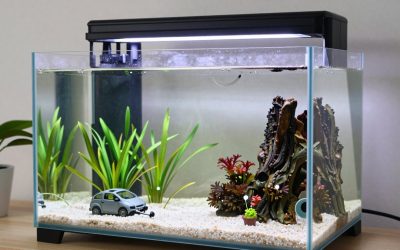
Celestial pearl danios do not need an empty viewing box that makes their spots easy to photograph. They need a small landscape: plant thickets that stop a display from becoming a chase, open pockets where food can be seen, and several routes between them. Their adult size may be tiny, but their social decisions occupy real space.
The accepted name is Danio margaritatus, originally described in the aquarium trade as Celestichthys margaritatus. Confirm taxonomy and distribution through FishBase and GBIF. “Galaxy rasbora” is an older common trade name, not evidence that the fish has different care needs.
As an Amazon Associate we earn from qualifying purchases at no extra cost to you.


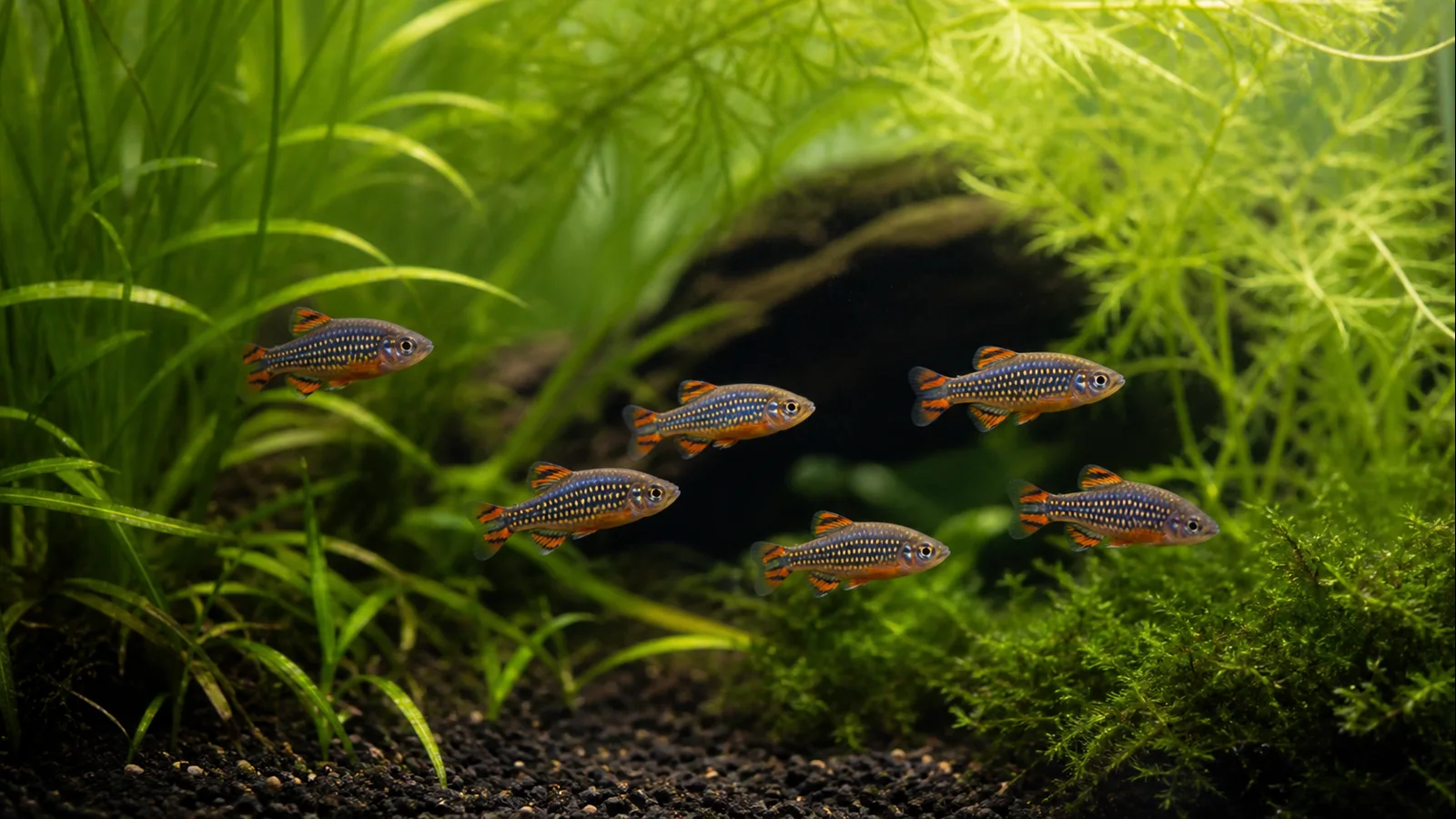
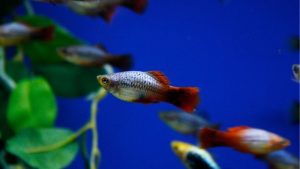
Editorial illustration; not evidence for species identification.
Build the habitat as connected rooms
A mature long aquarium around 45–60 litres/12–16 US gallons can support a modest species-focused group when filtration and maintenance are sound. Larger is easier to stabilize and gives displaying males more separation. Nano never means maintenance-free: small water volumes change quickly after overfeeding, heater error or a dead plant mass.
Plant the back and ends densely with mosses, fine-leaved stems and low broad cover, then retain open patches across the front and middle. The fish can retreat without disappearing permanently, and food can be delivered where you can observe it. Our nano low-light plant list suggests manageable options, while the low-tech planted tank guide covers the system around them.
Use a dark background, subdued lighting transitions and a fitted lid. Cover filter intakes because these fish and any fry are small. Choose a gentle filter with enough biological capacity; a sponge filter or diffused outlet can provide circulation without sweeping microfoods away. Maintain some surface ripple and remove debris from quiet pockets.
Interpret the cool, shallow wild habitat
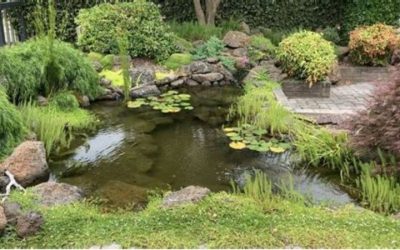
The species was documented from vegetated shallow waters in Myanmar. That informs the value of dense planting and a moderate thermal approach, but a wild locality is not a blueprint for allowing captive water to become stagnant or seasonally extreme. Common captive guidance centers around roughly 20–25°C/68–77°F, with neutral-ish conditions often workable depending on source stock.
Seriously Fish provides a referenced husbandry synthesis. The FishBase species summary records the referenced conservation assessment and offers context that should be checked at publication because assessments can change. Conservation concern after the species entered trade is a reason to prefer traceable captive-bred animals, not a claim that every current shop fish was wild-collected.
Ask the breeder about temperature, pH, hardness and foods. Select stable values within the supported overlap and acclimate based on measured differences. Avoid forcing the tank to an extreme pH because a habitat description mentioned it. Captive care should combine natural-history evidence with the actual history of the fish in front of you.
Ammonia and nitrite must remain undetectable. Manage nitrate by keeping the group within capacity, feeding carefully, maintaining plants and changing water. Use an independent thermometer even when room temperature seems suitable; small tanks can warm under lights and cool near windows.
Group composition is spatial management
Keep a social group, commonly at least eight to ten, rather than a pair or trio. More individuals can improve confidence when the aquarium has sufficient footprint and filtration. Males display to females and to one another, spreading fins and circling. In an under-furnished tank, display can become repeated pursuit with no escape route.
Adult males tend to show stronger red-orange fin color and deeper body coloration; females are usually less intense and fuller. Juveniles can be hard to sex. A female-biased group may reduce concentrated attention, but ratios do not replace plants, room and observation. Retail availability should not pressure you into an unbalanced group without an adjustment plan.
Signs of a workable group include regular exploration, short displays and all fish reaching food. A problem group has one animal constantly hidden, faded, thin, damaged or excluded. Add visual barriers if space remains, distribute feeding, and separate a persistent aggressor or victim when access cannot be restored.
Tank mates complicate feeding. Tiny peaceful shrimp and snails are sometimes used, but shrimplets or eggs may be eaten and invertebrates have their own requirements. Small calm fish can coexist in larger systems, yet a species-only aquarium often makes it easier to see whether each celestial pearl danio eats. Avoid boisterous fish, large mouths and warm-water species that force a temperature compromise.
Deliver food at celestial-pearl scale
Their mouths are very small. Use fine complete granules, crushed quality flake and appropriately sized frozen or cultured live foods such as cyclops, microworms or newly hatched brine shrimp where suitable. Check that each item is actually swallowed; “nano” on a package is not a measurement.
Feed tiny amounts in two or three locations once or twice daily, adjusting for age and body condition. Some food should drift through the open pockets rather than vanish into a moss wall. A pipette can place thawed food precisely, but it must be kept for aquarium use and cleaned safely. Siphon accumulated residue.
Fry may appear in a mature planted aquarium because the species scatters eggs. Incidental survival is not permission to let numbers grow without limits. Intentional breeding needs a separate cycled plan for eggs, fry food, juvenile space and responsible homes. Never collect or release fish to supplement the project.
Arrival and health boundaries
Quarantine new fish in a small but fully functional cycled system with cover, stable temperature and a protected intake. The quarantine guide outlines isolation and equipment hygiene. An empty, uncycled jar is not quarantine; it is an unstable container.
During observation, record appetite, breathing, swimming symmetry, body condition and feces. Do not prophylactically dose medicines without professional rationale. Small fish leave little margin for concentration errors, and indiscriminate treatment can injure animals or the biofilter.
Rapid breathing, persistent wasting, sores, loss of balance or a group-wide decline requires prompt environmental testing and specialist advice. An aquatic veterinarian or qualified fish-health professional should direct diagnosis and treatment. General articles cannot safely determine a pathogen from a photograph or prescribe a dose.
Preserve continuity during maintenance
Make small, consistent interventions. Each week, change an appropriate portion with conditioned, temperature-matched water and lightly siphon open feeding zones. Do not deep-clean substrate, filter and plants on the same day. Rinse reusable filter material only as needed for flow and protect established biological media.
Trim one plant zone at a time so the social map remains intact. Thin moss where detritus collects, preserve several line-of-sight barriers, and keep an open surface for gas exchange. Count fish before and after pruning; tiny individuals can be hidden in removed plants.
At monthly checks, inspect the lid, intake foam, heater if used and the accuracy of the thermometer. Compare photos or notes to catch gradual weight loss. Reassess the adult group composition rather than assuming the initial sex estimate stayed correct.
Seasonal room-temperature changes deserve attention in this small system. Record the aquarium’s morning and evening temperature for several days during weather shifts, then adjust heating or cooling strategy gradually. Sudden correction can be more disruptive than a modest, stable variation within the stock’s documented captive range.
A celestial pearl danio aquarium works when small scale receives serious planning. Dense connected cover, quiet food windows, stable moderate water and a group with room to negotiate displays allow natural behavior without romanticizing the wild habitat. Traceable captive breeding supports better sourcing, while professional escalation protects the fish when a husbandry problem becomes a health problem.
Related Reviews & Guides
Best Budget All in One Saltwater Tank: Top Smart Shortlist
6 Best Silent Air Pumps For Aquarium 2026