Last Updated: October 4, 2026
The best tds meter for rodi output monitoring is the one that reads at more than one point, because a single final number cannot tell you whether the membrane is tiring or the resin is spent. Those are different repairs with very different costs.
As an Amazon Associate we earn from qualifying purchases.
As an Amazon Associate we earn from qualifying purchases at no extra cost to you. Prices and availability are accurate as of the date shown and are subject to change.
By David Nguyen
Quick answer: For most people in 2026, the best tds meter for rodi output monitoring is the HM Digital DM-1 — our #1 rated choice. See the full ranked comparison, alternatives and buying advice below.
How to Choose a TDS Meter for RO/DI
Four things matter: how many points you can monitor, how the meter behaves at very low readings, whether you can calculate rejection from what it shows, and whether the measurement scale stays consistent between readings. A cheap meter installed in the right place beats an expensive one in the wrong one.
Decide How Many Monitoring Points You Need
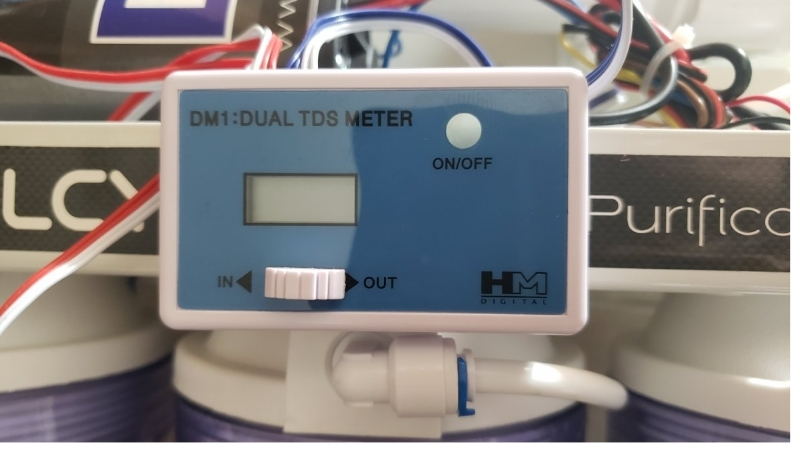
Two points is the practical minimum: feed water and post-membrane, or post-membrane and final output. The HM Digital DM-1 provides two inline probes, while the TRM-1 adds a third for systems with multiple deionisation stages. Both use standard fittings that splice into 1/4 inch tubing without adapters. Feed water can be spot-checked with a handheld if probes are limited.
A third point earns its place on seven-stage systems where cation, anion and mixed bed cartridges are separate. Seeing between those stages shows which cartridge is exhausted rather than forcing you to replace all the media at once. Replacing only the exhausted cartridge is where the savings come from.
Understand Low-Range Behaviour
Most meters here cover 0 to 9,990 ppm with plus or minus 2% accuracy. The DM-1 offers 1 ppm resolution below 1,000 ppm, while the COM-100 displays 0.1 ppm resolution under 100 ppm across a range up to 5,000 or 8,560 ppm depending on scale. All four meters here share that same plus or minus 2% specification.
Resolution is not accuracy. A meter showing 0.1 ppm increments still carries the same plus or minus 2% specification, so treat fine increments as a way of spotting trends rather than proof of laboratory-grade precision. Very clean water also sits near the bottom of any meter’s working range.
Use the Readings to Calculate Rejection
Two numbers give you a diagnosis. Subtract post-membrane TDS from feed TDS, divide by feed TDS, and you have rejection: feed water at 250 ppm reading 5 ppm after the membrane works out to 98%. That single percentage is the most useful health indicator your system produces.
Track that percentage over time rather than watching a single reading. A steady decline in rejection indicates a tiring membrane, while a stable percentage alongside rising final output points squarely at exhausted resin instead. Write the figure down after each production run so the trend is visible over months. Seasonal feed changes explain some variation, so avoid reacting to one reading.
Keep the Measurement Scale Consistent
TDS meters estimate dissolved solids from conductivity using a conversion factor. Inline units apply a fixed NaCl-based conversion, while the COM-100 lets you select between scales, which changes the displayed number for identical water. The 442 and NaCl scales report different figures for identical samples.
Comparing a reading from a fixed-scale inline meter against a selectable-scale handheld set differently produces a mismatch that looks like a problem but is not. Pick one scale, note it, and compare readings only within it. Note the scale in your log alongside the reading to avoid confusion later. Consistency matters more than which scale you choose.
Top Picks
Four HM Digital meters cover inline and handheld needs. Each entry lists manufacturer specifications, a relative price position as of 09/2026, and one genuine drawback. Prices move on small accessories, so confirm current figures before ordering.
| Product | Best For | Key Spec | Watch Out For |
|---|---|---|---|
| HM Digital DM-1 | Best overall inline | 2 probes; 0-9,990 ppm; plus/minus 2% | Two points only on multi-DI systems |
| HM Digital TRM-1 | Best for multi-stage DI | 3 probes; 0-9,990 ppm; plus/minus 2% | Costs about 57% more than the DM-1 |
| HM Digital TDS-3 | Best budget handheld | 0-9,990 ppm; plus/minus 2%; ATC 1-50C | No permanent inline monitoring |
| HM Digital COM-100 | Best low-range resolution | 0.1 ppm under 100 ppm; IP67 waterproof | Resolution is not accuracy |
HM Digital DM-1: Best Overall Inline
At roughly $30 as of 09/2026 the DM-1 gives two permanently installed probes covering 0 to 9,990 ppm with plus or minus 2% accuracy and 1 ppm resolution below 1,000 ppm, using standard 1/4 inch fittings. Inline probes read continuously, so you notice a problem while making water rather than afterwards. For a standard reef RO/DI system it is the sensible default.
Two points suit most four to six stage systems but leave multi-DI setups partially blind. If your system splits deionisation across three cartridges, the extra probe on the TRM-1 is worth the difference. Batteries last a long time in these units, though keeping a spare cell is sensible.
HM Digital TRM-1: Best for Multi-Stage DI
Near under $50 as of 09/2026, about 56.7% above the DM-1 and a gap of roughly $17, the TRM-1 monitors three inline points across the same 0 to 9,990 ppm range with plus or minus 2% accuracy. That extra point is the difference between guessing and knowing which cartridge is finished. Seven-stage systems are exactly where that pays off.
That third reading is only useful if your plumbing has a sensible place for it. On a simple four-stage system the extra probe adds cost without adding diagnostic value, so match the meter to your stage layout. Check you have room to splice a third probe before ordering.
HM Digital TDS-3: Best Budget Handheld
At roughly $25 as of 09/2026 the TDS-3 is the cheapest option, about 14.0% below the DM-1. It covers 0 to 9,990 ppm with plus or minus 2% accuracy and automatic temperature compensation from 1 to 50C. It is also useful for checking salt mix and tank water away from the RO/DI system.
Being handheld, it cannot monitor continuously, so you only see readings when you remember to check. It works best as a second meter for spot-checking mixed saltwater and verifying what an inline unit reports. Many reefers keep one alongside an inline pair for exactly that reason.
HM Digital COM-100: Best Low-Range Resolution
Around $45 as of 09/2026, the COM-100 is an IP67 waterproof handheld showing 0.1 ppm resolution below 100 ppm, with range up to 5,000 or 8,560 ppm depending on the selected scale and plus or minus 2% accuracy. Waterproofing makes it practical around a wet fish room bench. The selectable scales suit people testing more than just RO/DI output.
Selectable scales make it flexible but introduce comparison errors if you change settings between readings. The fine resolution also invites over-interpretation, since accuracy remains plus or minus 2% regardless of the decimal shown. Treat the tenths as directional information rather than a precise value.
Frequently Asked Questions
Four questions come up constantly: where to install probes, what a small post-DI reading means, how to calculate rejection properly, and why resolution and accuracy are not the same thing.
Where should I install the probes?
Put one after the membrane and one after the final DI stage as the default arrangement. That pairing separates membrane performance from resin condition, which is the diagnosis you need most often. Those two points answer the question you will ask most weeks.
If you have a third probe, place it between DI cartridges on a multi-stage system. Adding a feed water reading is also useful, though many people measure that occasionally with a handheld instead of dedicating a probe. Keep probes accessible, since a buried probe is one you will stop checking.
My DI output reads 1 ppm. Is the membrane bad?
Not necessarily. A small final reading usually points at resin nearing exhaustion rather than membrane failure, and the post-membrane number is what distinguishes the two. Resin exhausts gradually, and a creeping final reading is the normal first symptom.
Check rejection first. If the membrane is still removing its rated percentage, replace resin; if rejection has fallen, the membrane is the problem. Acting without both numbers means replacing the wrong part. Colour-indicating resin helps visually, but the meter remains the reliable signal.
How do I calculate rejection?
Take feed TDS, subtract post-membrane TDS, divide by feed TDS and express as a percentage. Feed water at 250 ppm showing 5 ppm after the membrane gives 98% rejection. Do the calculation on the same day you take both readings, since feed water changes seasonally.
Compare that figure against your membrane’s rating rather than against an absolute target. A decline of several percentage points over months is the signal to plan a replacement before output quality suffers. Membranes rarely fail suddenly, so a trend gives you time to order a replacement.
Is 0.1 ppm resolution more accurate?
No. Resolution describes the smallest increment displayed, while accuracy describes how close the reading sits to reality, and the COM-100 remains plus or minus 2% despite showing tenths. Both figures appear on the same specification sheet and are easy to conflate.
Fine resolution still helps for spotting early trends in very clean water. Just avoid treating a 0.3 ppm change as meaningful when the instrument’s own specification allows more variation than that. Calibration drift also matters, so verify occasionally against a known solution.
Final Thoughts
The best tds meter for rodi output monitoring is defined by monitoring architecture rather than the smallest number it can display. The DM-1 near under $30 covers most systems with two points, while the TRM-1 earns its premium on multi-stage deionisation where you need to see between cartridges.
Ready to decide? Our #1 pick for 2026 is the HM Digital DM-1.
Live price & availability on Amazon.
Related Reviews & Guides

PAR Requirements for SPS LPS and Softies: Expert Best Guide
Roller Mat Vs Filter Sock Which To Use: Top Compared Guide