Last Updated: October 4, 2026
The best rodi system for a fish room is decided by daily demand rather than tank count. Once several systems share one water source, production rate, waste ratio and DI capacity all become running costs you live with every week.
As an Amazon Associate we earn from qualifying purchases.
As an Amazon Associate we earn from qualifying purchases at no extra cost to you. Prices and availability are accurate as of the date shown and are subject to change.
By David Nguyen
Quick answer: For most people in 2026, the best rodi system for a fish room is the AWI Typhoon III Extreme — our #1 rated choice. See the full ranked comparison, alternatives and buying advice below.
How to Choose a Fish Room RO/DI System
Four factors carry the decision: your genuine daily consumption, the pressure feeding the system, the balance between production speed and rejection quality, and how much deionisation and monitoring sits behind the membranes. Fish rooms punish under-sizing harder than single displays do, because several systems compete for the same water.
Calculate Daily Demand Honestly
Add every system’s weekly water change volume to daily top-off across the room, then divide by seven. Theoretical output helps here: 150 GPD is about 6.25 gallons per hour, 200 GPD about 8.33, and 300 GPD about 12.5. Quarantine tanks and frequent large changes push that figure higher than most keepers estimate.
Reservoir size buffers the difference between production and use. A 100 gallon reservoir fills in roughly 16, 12 or 8 hours at those rated outputs, which tells you whether an overnight run covers a weekend of changes. Storage also smooths out pressure dips, letting the system work through quiet hours overnight.
Measure Your Source Pressure
Pressure sets whether a system reaches its rating. The BRS 7 Stage Pro Plus systems at 150 and 200 GPD both require 65 to 90 psi, which is a higher floor than smaller single-membrane systems demand. Well systems fluctuate as the pressure tank cycles, so take several readings before deciding.
Below that range, production falls and the waste ratio worsens at the same time. Measure at the tap you will plumb from during peak household use, since a reading taken at a quiet hour flatters what the system will see. A booster pump resolves this, but it is better budgeted at purchase than added later.
Balance Speed Against Rejection
More output does not mean cleaner water. The AirWaterIce Typhoon III Extreme produces 150 GPD at 98% rejection across five stages, while BRS reaches 150 GPD with two 75 GPD membranes and 200 GPD with two 100 GPD membranes. Membrane count and individual element rating matter more than the headline total output.
BRS notes the dual 75 arrangement offers better membrane rejection than the dual 100 configuration in its line. Better rejection means less dissolved load reaching the resin, which can reduce DI spending over a year of heavy production. On a room producing hundreds of gallons monthly, that difference is a real line item.
Weigh DI Capacity and Monitoring
High-volume production consumes resin quickly. BRS splits deionisation into cation, anion and mixed bed cartridges, SpectraPure pairs MaxCap with SilicaBuster, and the Typhoon III Extreme includes dual TDS monitoring with a pressure gauge. Silica-specific media matters for reef use, since standard resin exhausts on silica before other ions.
Monitoring separates two very different problems. A rising post-membrane reading points at the membrane, while a climbing final number with healthy rejection points at spent resin, and only inline meters let you tell them apart. Log both readings each time you fill, because a trend reveals problems long before a single number does.
Top Picks
Four systems spanning 150 to 300 GPD cover most fish rooms. Each entry lists manufacturer specifications, a relative price position as of 09/2026, and one genuine drawback worth weighing.
| Product | Best For | Key Spec | Watch Out For |
|---|---|---|---|
| AWI Typhoon III Extreme | Best value at 150 GPD | 150 GPD; 98% rejection; 5 stages; dual TDS | Fewer DI stages than BRS systems |
| BRS 7 Stage Pro Plus 150 | Best rejection per gallon | 150 GPD via 2×75; 65-90 psi; ~1.5:1 waste | Needs at least 65 psi |
| BRS 7 Stage Pro Plus 200 | Best middle ground | 200 GPD via 2×100; ~1.5:1 waste | Dual 100 trades some rejection |
| SpectraPure Eliminator 6 | Best high output | 300 GPD via 2×150; MaxCap + SilicaBuster DI | Fastest, but check drain capacity |
AirWaterIce Typhoon III Extreme: Best Value at 150 GPD
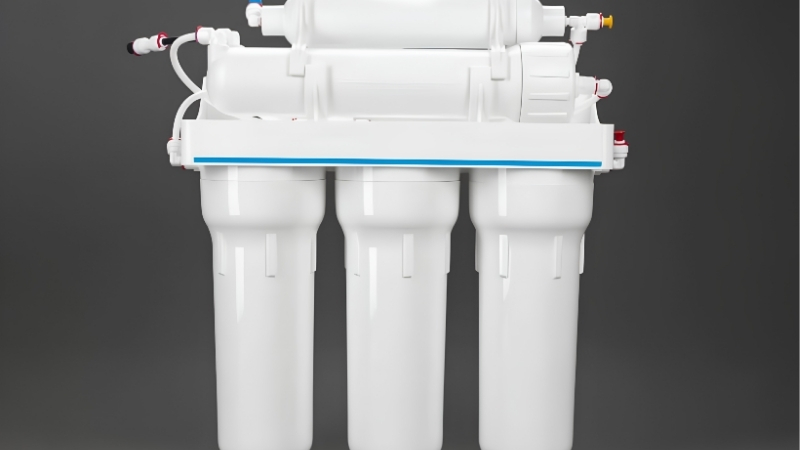
At roughly $350 as of 09/2026 this is the cheapest 150 GPD option here, about 15.5% below the BRS equivalent, a gap near under $70. It delivers 98% rejection across five stages with dual TDS monitoring and a pressure gauge included. For a moderate fish room on decent pressure it covers the essentials without excess.
It carries fewer deionisation stages than the seven-stage BRS systems, so resin replacement is less granular. On high-TDS feed water that can mean discarding partially used media alongside genuinely exhausted resin. Check cartridge sizing is standard rather than proprietary before committing long term. Dual TDS monitoring does offset that, since you can see exactly when media is finished.
BRS 7 Stage Pro Plus 150: Best Rejection per Gallon
Around $425 as of 09/2026, this system reaches 150 GPD using two 75 GPD membranes, requires 65 to 90 psi, and runs roughly 1.5:1 waste with cation, anion and mixed bed DI stages behind the membranes. Seven stages also mean you replace only the cartridge that is genuinely spent.
The dual 75 arrangement is the reason to choose it, since BRS reports better rejection than its dual 100 setup. The trade-off is the higher pressure floor, which low-pressure fish rooms will need a booster to satisfy. Two matched membranes should be replaced as a pair to keep rejection balanced. Confirm your measured pressure before choosing between this and the AirWaterIce option.
BRS 7 Stage Pro Plus 200: Best Middle Ground
At roughly $450 as of 09/2026, about $36 above the 150 version, this system produces 200 GPD using two 100 GPD membranes while keeping the same roughly 1.5:1 waste ratio and 65 to 90 psi requirement. It fills a 100 gallon reservoir in roughly 12 hours at rated output.
Faster production comes with slightly lower membrane rejection than the dual 75 configuration, which can raise resin consumption. Weigh whether the extra 50 GPD genuinely shortens your fill schedule enough to justify that trade. For many rooms the 150 remains the more economical long-term choice.
SpectraPure Eliminator 6: Best High Output
Near under $450 as of 09/2026, within about a dollar of the BRS 200, this system produces 300 GPD using two 150 GPD membranes with MaxCap and SilicaBuster deionisation. It fills a 100 gallon reservoir in roughly eight hours at rated output. SpectraPure also publishes its rating conditions, which makes planning noticeably easier.
Architecture differs substantially from the BRS systems despite the similar price, so compare stage design rather than the sticker. Confirm your drain can handle the volume, since high output sends far more water down it per hour. Membranes in pairs also mean buying two elements at each replacement interval.
Frequently Asked Questions
Four questions decide most fish room purchases: what output you actually need, whether rated figures hold in practice, whether more GPD is better, and how to keep unattended filling safe.
How much GPD does a fish room need?
Work from consumption rather than tank count. Total weekly change volume plus daily top-off, divided across the days you can run the system, gives the honest figure to shop against. Theoretical hourly output then tells you whether that fits your schedule.
A room changing 60 gallons weekly is comfortable on 150 GPD with a reservoir. One changing 200 gallons weekly, or with limited time between changes, is where 300 GPD stops being overkill. Running time available each day matters as much as the total volume you need.
Will 300 GPD really give 12.5 gallons per hour?
That is the arithmetic figure at rated conditions, not a guarantee. Production falls with lower pressure, colder feed water and membrane age, all of which are common in an unheated fish room. SpectraPure states output can vary by roughly 20% with conditions.
Use the theoretical rate to compare systems against each other, then measure your own output over a few hours. Plan reservoir schedules around the measured number rather than the specification sheet.
Is a 200 GPD system better than a 150?
Faster, not necessarily better. BRS notes its dual 75 setup achieves better rejection than the dual 100 arrangement used to reach 200 GPD, so purity and speed pull in opposite directions here. The $36 gap between them is small enough that architecture should decide it.
Choose 200 GPD when fill time genuinely constrains your maintenance schedule. Choose 150 when resin cost matters more, since better rejection reduces how quickly the DI stages exhaust on high-TDS supply. Resin, prefilters and membranes together often outweigh the system price over five years.
How do I fill reservoirs safely overnight?
A float valve alone is not a complete answer, since water can continue to drain even after the valve closes. Pair it with an automatic shutoff valve and a check valve to halt production properly. The BRS automatic shutoff needs at least roughly 40 psi to close reliably.
For unattended runs, a controller with two independent float switches and a backup timer adds a layer that does not depend on one mechanical part. In a fish room, flood protection is worth more than any output figure. RO/DI hardware and media both discount around Prime Day and Black Friday, useful when stocking a fish room.
Final Thoughts
The best rodi system for a fish room matches measured daily demand, available pressure and the resin cost you are willing to carry. The BRS 150 near under $450 balances rejection and waste, while SpectraPure’s Eliminator 6 fills large reservoirs fastest at roughly 12.5 gallons per hour rated.
Ready to decide? Our #1 pick for 2026 is the AWI Typhoon III Extreme.
Live price & availability on Amazon.
Related Reviews & Guides

6 Best Reef Nano Tanks 2026
Best 75 Gallon Aquarium Kit for Goldfish: Top Compared Guide