Last Updated: October 4, 2026
Choosing the best rodi replacement membrane and cartridges is less about brand loyalty than about matching three things: the GPD rating your flow restrictor expects, the rejection your feed water needs, and the replacement timing your own readings justify.
As an Amazon Associate we earn from qualifying purchases.
As an Amazon Associate we earn from qualifying purchases at no extra cost to you. Prices and availability are accurate as of the date shown and are subject to change.
By David Nguyen
Quick answer: For most people in 2026, the best rodi replacement membrane and cartridges is the Dow Filmtec 75 GPD — our #1 rated choice. See the full ranked comparison, alternatives and buying advice below.
How to Choose Replacement Membranes and Cartridges
A replacement that does not match your system creates problems rather than solving them. Check the GPD and restrictor pairing, understand what rejection percentages mean for your feed water, pick prefilters by micron rating, and replace on performance rather than the calendar. Matching parts to your own system beats buying the highest specification available.
Match GPD to Your Flow Restrictor
Every membrane rating pairs with a specific restrictor. In the BRS architecture a 75 GPD membrane uses a 550 mL per minute restrictor, while a 100 GPD membrane needs 800 mL per minute, and swapping one without the other throws the system out of balance. Restrictor sizing controls how much water goes to drain against how much passes the membrane.
Fitting a higher-output membrane behind an undersized restrictor changes the recovery ratio and can harm rejection. If you upgrade output, order the matching restrictor at the same time, and confirm which part number your system actually uses. Keep the old restrictor as a spare rather than discarding it, since these parts are easy to lose track of.
Read Rejection in Context
Rejection describes the share of dissolved solids the membrane removes at rated conditions. Dow Filmtec 75 GPD sits in the 99% class, SpectraPure’s Standard 90 GPD is batch tested at 98% stabilized, and SpectraSelect Plus 90 GPD is rated above 99%. Those three ratings sit close enough that feed chemistry matters more than the label on the box.
The practical difference shows downstream. On feed water at 300 ppm, 98% rejection leaves roughly 6 ppm after the membrane while 99% leaves about 3 ppm, and that remaining load is exactly what your DI resin has to remove. Those rejection figures also assume rated pressure, temperature and feed TDS, so they are not comparable across brands without matched conditions.
Pick Prefilters by Micron Rating
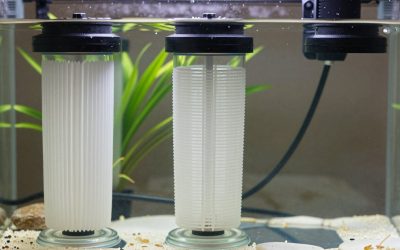
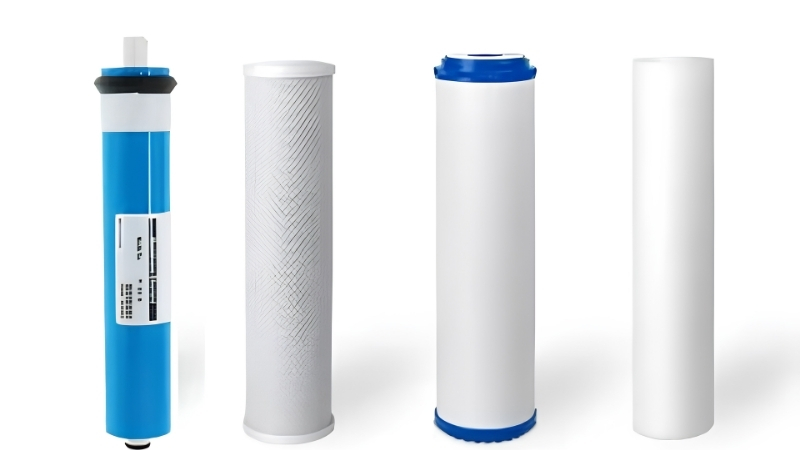
Sediment and carbon stages protect the membrane, which is the expensive part. The BRS 5 Stage Universal Kit bundles a 1 micron sediment filter, two 1 micron carbon blocks and 1.25 pounds of DI resin, though it does not include a membrane. Sediment stages come first so grit does not reach the carbon or the membrane surface.
Carbon matters most, since chlorine passing through destroys thin-film membranes permanently. Confirm your carbon stages suit your municipal disinfectant, because chloramine requires more contact time than free chlorine does. Replacing carbon late is the most common cause of premature membrane failure in home systems.
Replace on Performance, Not Dates
Useful guidance exists, with carbon often replaced at six to twelve months and RO membranes typically lasting roughly three to five years, but those are starting points shaped by feed chemistry and volume produced. A system making fifty gallons a week ages its consumables far faster than one making ten.
Use your TDS readings as the trigger instead. Rising post-membrane TDS points at the membrane, while a climbing final reading with healthy rejection points at exhausted resin, and that distinction saves money on both parts. Log your readings each time you make water, since a trend line is far more useful than a single number.
Top Picks
Three membranes plus a cartridge kit cover most replacement needs. Each entry lists manufacturer specifications, a relative price position as of 09/2026, and one genuine drawback. Prices move often on consumables, so confirm current figures before ordering a full set.
| Product | Best For | Key Spec | Watch Out For |
|---|---|---|---|
| Dow Filmtec 75 GPD | Best value membrane | 75 GPD; ~99% class; 550 mL/min restrictor | Restrictor must match the rating |
| SpectraPure Standard 90 | Best batch-tested option | 90 GPD; 98% stabilized; 2 x 12 in form | Needs its own system recommendation |
| SpectraSelect Plus 90 | Best rejection | 90 GPD; rated above 99% | Highest price of the three |
| BRS 5 Stage Universal Kit | Best cartridge bundle | 1 micron sediment; 2 x 1 micron carbon; 1.25 lb DI | Membrane not included |
Dow Filmtec 75 GPD: Best Value Membrane
At roughly $40 as of 09/2026 this is the cheapest option here, about 13.2% below the SpectraPure Standard. It produces 75 GPD in the 99% rejection class and pairs with a 550 mL per minute flow restrictor in the BRS architecture. For a standard reef system on municipal water it remains the default choice.
It is only correct if your system is built around 75 GPD. Fitting it to a system restricted for 100 GPD leaves the recovery ratio wrong, so check your restrictor before ordering rather than assuming the membrane alone defines output. Dow membranes are widely stocked, which makes sourcing straightforward when a replacement is urgent.
SpectraPure Standard 90 GPD: Best Batch-Tested Option
Around $45 as of 09/2026, roughly 15.2% above the Dow, this membrane produces 90 GPD with 98% stabilized rejection verified by batch testing. It comes in a 2 by 12 inch form factor common to SpectraPure systems. The extra 15 GPD also shortens reservoir fill times slightly.
A 90 GPD membrane needs a system and restrictor specified for it, and the correct restrictor for every non-SpectraPure installation is not universally documented. Confirm compatibility with your housing and restrictor before switching output class. Batch testing is genuinely useful, since it verifies the individual element rather than a product line average.
SpectraSelect Plus 90 GPD: Best Rejection
At roughly $65 as of 09/2026 this premium tested membrane is rated above 99% rejection at 90 GPD, sitting about 61.8% above the Dow, a gap near under $30. Higher rejection means less dissolved load reaching the DI stages. On 300 ppm feed water that difference is roughly 3 ppm instead of 6 ppm reaching the resin. Feed TDS decides whether that gap is worth paying for.
That saving appears in resin consumption rather than at the tap, so the payback depends on your feed TDS and how much water you make. On low-TDS municipal supply the premium is harder to justify than on hard well water. Higher rejection also extends the interval between resin changes, which is where the real saving accumulates.
BRS 5 Stage Universal Kit: Best Cartridge Bundle
Near under $50 as of 09/2026, this kit covers the consumable stages around the membrane: one 1 micron sediment filter, two 1 micron carbon blocks and 1.25 pounds of DI resin, which suits a routine service interval. Having all consumables arrive together also encourages servicing every stage at once.
No membrane is included, so budget that separately when both are due. Kits also assume standard housing sizes, so verify your canisters match before ordering, particularly on systems assembled from mixed-brand components. Buying cartridges as a kit usually costs less than sourcing each stage individually.
Frequently Asked Questions
Four questions cover most replacement decisions: how long membranes really last, whether output can be upgraded, how often carbon needs changing, and whether DI resin colour is a reliable signal.
How long does an RO membrane last?
Roughly three to five years is a common expectation, but that figure depends on feed chemistry, how much water you produce and whether chlorine ever reached it. Volume matters more than calendar age. Membranes degrade gradually rather than failing outright on a particular day.
Judge by rejection instead. Measure feed TDS and post-membrane TDS, calculate the percentage removed, and replace when it drops meaningfully below the membrane’s rating rather than when a date passes. A membrane past its useful life quietly doubles your resin spending.
Can I swap a 75 GPD for a 100 GPD membrane?
Only if you change the flow restrictor too. The BRS pairing puts 550 mL per minute with a 75 GPD membrane and 800 mL per minute with a 100 GPD membrane, and the two must match. Output rating and restrictor size are two halves of the same design decision.
Leaving the original restrictor in place upsets the recovery ratio and can reduce rejection, which increases DI consumption. Order both parts together and confirm the restrictor part number against your specific system. Systems sold as upgrade kits usually bundle both parts for this reason.
How often should carbon blocks be replaced?
Often every six to twelve months, though heavy chlorine or chloramine loads shorten that considerably. Carbon protects the membrane, so this is the stage least worth stretching. Chloramine in particular demands more carbon contact time than free chlorine.
Track gallons produced rather than months where you can. A household making large volumes for water changes exhausts carbon far faster than one filling a nano reservoir occasionally. Prefilter housings with clear bowls make visual checks easier between changes.
Does DI resin colour tell me when to change it?
Colour-indicating resin helps but is not a substitute for measurement. Resin can exhaust for specific ions before the visual change is obvious across the whole cartridge. Two systems on identical water can exhaust resin at very different rates.
Rely on final output TDS as the decision point, and keep the post-membrane reading alongside it. Seeing both numbers separates a tired membrane from spent resin, which is the diagnosis that actually saves money. Inline meters make that comparison effortless once fitted.
Final Thoughts
The best rodi replacement membrane and cartridges are the ones matching your restrictor, your feed water and your measured performance. Dow Filmtec 75 GPD near under $50 covers most systems, while SpectraSelect Plus buys higher rejection that pays back through lower resin consumption on high-TDS supply.
Ready to decide? Our #1 pick for 2026 is the Dow Filmtec 75 GPD.
Live price & availability on Amazon.
Related Reviews & Guides


4 Best Aquarium Silicone Sealants

Fluval 207 Canister Filter Review 2026