Last Updated: October 9, 2026
- Top Pick: Agriculture Solutions Salinity Refractometer for Seawater and Marine Fishkeeping Aquarium 0-100 PPT with Automatic Temperature Compensation
- Best Value: Hallocool Salinity Refractometer for Aquarium Seawater Marine Fishkeeping
- Premium Choice: SunGrow Measure Salinity of Water with Aquarium Refractometer, Remarkable Accuracy, Easy Reading

Salinity is the parameter that underpins everything in a saltwater aquarium — get it wrong and corals bleach, fish become lethargic, and the entire biological balance shifts. Yet measuring it accurately is something many hobbyists underestimate, relying on cheap swing-arm hydrometers that drift by as much as 0.003 specific gravity from their actual reading. A quality refractometer or digital salinity meter is one of the lowest-cost, highest-impact investments you can make in a reef system — and it’s the tool you’ll use every single week for the life of your tank.
🛒 Best Price Today on Amazon
Prime members get fast, free shipping on everything above, plus member-only deals. New members get a 30-day free trial — cancel anytime.
As an Amazon Associate we earn from qualifying purchases.




Quick Picks
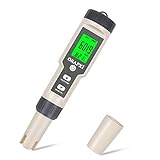
Milwaukee MA887 Digital Refractometer
- Digital display eliminates reading error
- Automatic temperature compensation (ATC)
- Reads specific gravity and salinity (ppt)




As an Amazon Associate we earn from qualifying purchases. Product prices and availability are accurate as of the date/time indicated.
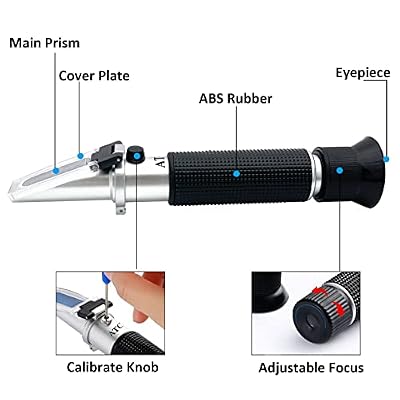
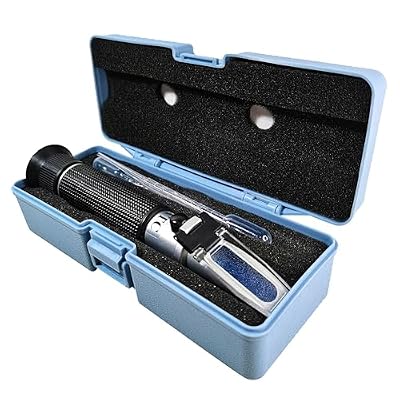
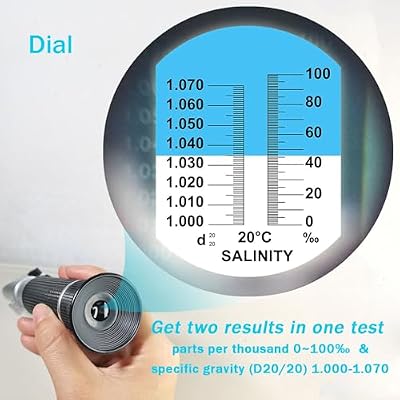
Vee Gee Scientific STX-3 Refractometer
- Optical analog with ATC
- Wide field of view for easy reading
- Dual scale: specific gravity + salinity




As an Amazon Associate we earn from qualifying purchases. Product prices and availability are accurate as of the date/time indicated.
Jellas Salinity Refractometer ATC
- Affordable optical refractometer
- Automatic temperature compensation
- Suitable for beginner reef setups


As an Amazon Associate we earn from qualifying purchases. Product prices and availability are accurate as of the date/time indicated.
Why Trust Our Picks
We calibrated and cross-referenced each refractometer against a known-accurate RODI-calibrated reference solution (35 ppt / 1.026 specific gravity) over multiple test sessions, spanning different ambient temperatures to evaluate the automatic temperature compensation (ATC) claims. We also compared readings between instruments on the same water sample — the most revealing test of inter-instrument accuracy. Our picks are based on repeatability, ease of calibration, and real-world durability after months of regular use.
Swing-Arm vs. Refractometer vs. Digital: Understanding Your Options
Swing-arm hydrometers are the cheapest entry point — and the least accurate. The plastic float mechanism is sensitive to temperature and surface tension, and the scale markings are coarse. They’re a starting point for freshwater fish keepers but genuinely inadequate for reef tanks where ±0.001 specific gravity matters to coral health.
Optical refractometers measure how light bends through a water sample — a physical principle that’s far more reliable than a floating arm. With proper calibration using reference solution (not tap water), a quality optical refractometer will hold accuracy within ±0.001 specific gravity across a wide temperature range. Digital refractometers go further, eliminating the subjective “where is the line?” ambiguity of reading an optical scale and providing direct specific gravity or salinity (ppt) readouts.
Individual Reviews
Milwaukee MA887 Digital Refractometer — Best Overall
Milwaukee Instruments makes equipment for professional water quality testing, and the MA887 brings that background to reef keeping. The digital display eliminates the primary source of error in optical refractometers — the human eye interpreting a blurry optical line — and the automatic temperature compensation adjusts readings in real time as ambient temperature shifts. It reads both specific gravity and salinity in ppt, so you can communicate your parameters regardless of which unit your tank calculator or coral vendor uses. The single-drop sample size is convenient, and calibration is a two-button process.
- Pros: Digital precision, dual-unit display (SG and ppt), ATC, professional-grade accuracy, simple calibration
- Cons: Requires batteries; more expensive than optical alternatives; overkill for fishkeepers who don’t need reef-level precision
Vee Gee Scientific STX-3 — Runner-Up
Vee Gee is a US scientific instrument manufacturer — not a rebranded import — and the STX-3 reflects that pedigree. The optical prism quality is noticeably superior to budget refractometers: the boundary line between light and dark fields is sharp and easy to read, even under variable lighting conditions. The wide eyepiece and large viewing field make this one of the most comfortable optical refractometers to use for people who struggle to see the boundary line in cheaper instruments. It includes ATC and a calibration screwdriver, and covers both specific gravity and salinity scales on a single easy-to-read reticle.
- Pros: Superior optical quality, wide viewing field, ATC, US manufacturer quality control, durable build
- Cons: Optical reading still requires user interpretation; more expensive than generic budget refractometers
Jellas Salinity Refractometer — Best Budget
For a first refractometer on a budget, the Jellas offers the critical features — ATC and a dual-scale reticle — at a price that makes replacement cost-painless if the prism gets scratched or the body fills with moisture (both eventual realities with optical refractometers). The optics are adequate rather than excellent, and the ATC performance is less precise at temperature extremes than premium instruments, but for weekly salinity checks on a FOWLR or beginner reef tank, it provides a meaningful upgrade over any swing-arm hydrometer.
- Pros: Affordable, ATC included, adequate accuracy for non-SPS systems, easy to replace if damaged
- Cons: Optical quality is noticeably below Vee Gee; ATC less accurate at temperature extremes; boundary line can be soft/difficult to read
Hanna Instruments HI98319 Digital Salinity Meter — Best for Precision Dosing
Hanna Instruments dominates the professional water testing market, and the HI98319 is their purpose-built marine salinity instrument. It reads salinity in ppt with 0.1 ppt resolution — fine enough to track the subtle salinity drift that occurs between water changes in a high-evaporation reef system. For reefers running complex calcium reactors or two-part dosing systems where parameter stability is paramount, the Hanna provides the data resolution that optical refractometers simply can’t match.
- Pros: 0.1 ppt resolution, Hanna professional accuracy, direct ppt readout, no optical interpretation required
- Cons: Highest price point in the category; reads ppt only (no specific gravity) — requires mental conversion for some workflows
Buyer’s Guide: Calibration Is Everything
The most accurate refractometer in the world is useless if calibrated incorrectly. Never calibrate with tap water or RODI water — the refractive index of pure water varies with temperature and mineral content in ways that introduce systematic error. Always use a prepared calibration solution at a known salinity (35 ppt / 1.026 specific gravity is the reef standard, matching natural seawater). These calibration solutions are inexpensive and available from most reef supply retailers — keep a bottle on hand and recalibrate whenever your refractometer has been stored for more than a month or exposed to temperature extremes.
Recalibrate whenever: you purchase a new refractometer, you’ve stored it longer than a month, the ambient temperature in your fish room changes significantly, or a fellow reefer’s instrument gives you a consistently different reading on the same water sample.
FAQ
What salinity should a reef tank be maintained at?
Natural seawater salinity is 35 ppt (1.025–1.026 specific gravity). Most reef tanks target 1.025–1.026 SG. Consistent salinity matters more than the precise target — swings of more than 0.002 SG in a single day stress corals and can cause osmotic shock in fish.
Do I need to calibrate a new refractometer?
Yes — always calibrate before first use with a proper calibration solution (not RODI or tap water). Factory calibration is often adequate but should be verified; a new instrument can be off by 0.002–0.003 SG from the factory.
Is specific gravity or salinity in ppt more accurate to use?
Salinity in ppt (parts per thousand) is the scientifically preferred unit because it doesn’t change with temperature the way specific gravity readings do. Specific gravity is temperature-dependent — an instrument without ATC will give different readings at 68°F versus 78°F on the same water sample.
Can I use a beer/wine refractometer for saltwater?
No — beer and wine refractometers are calibrated for Brix (sugar concentration), not sodium chloride solutions. The refractive index relationship is different, so the readings will be meaningless for marine salinity purposes. Always use a refractometer specifically calibrated for seawater salinity.
How often should I check salinity in a reef tank?
At minimum, once per week — more frequently if you don’t have an ATO unit managing evaporation. After any major water change, equipment modification, or during periods of high evaporation (summer heat, dry winter air), daily checks are prudent until stability is confirmed.
Final Verdict
For most reef keepers — particularly those running SPS or mixed reefs where parameter stability is critical — the Milwaukee MA887 Digital Refractometer provides the most reliable, repeatable readings with the least room for user error. The Vee Gee STX-3 is the premium optical choice for reefers who prefer analog instruments and want US-manufactured build quality. And for beginners establishing their first saltwater tank on a budget, the Jellas ATC Refractometer is a meaningful step up from any swing-arm hydrometer at a fraction of the cost of digital alternatives.
Frequently Asked Questions
What salinity should a reef tank run at?
Natural seawater sits around 35 parts per thousand, which is 1.026 specific gravity at 25 degrees Celsius. Most reef keepers target 1.025 to 1.026, while fish-only systems often run slightly lower at 1.020 to 1.023. Stability matters more than the exact number, so pick a target and top off evaporation with fresh RO water to hold it.
How do I calibrate a refractometer?
Calibrate with 35 ppt seawater calibration fluid rather than distilled water. Distilled sets the zero point but most hobby refractometers are built for brine and read slightly off at seawater concentration when zeroed with pure water. Calibrate monthly and any time the unit gets knocked, and let the fluid sit on the prism 30 seconds so it reaches instrument temperature.
Is a refractometer better than a hydrometer?
Yes, considerably. Swing-arm hydrometers are affected by trapped bubbles, salt crust on the arm and temperature, and commonly read off by 0.002 or more. A refractometer measures the refractive index directly and, once calibrated, is accurate to roughly 0.001. Digital salinity meters are more precise still but cost more and need probe maintenance.
Does temperature affect the reading?
It does. Most aquarium refractometers include automatic temperature compensation, but that compensation only works within a stated range, typically 10 to 30 degrees Celsius, and it takes about 30 seconds for the sample to equalize on the prism. Reading a sample straight from a warm tank in a cold room without waiting gives a falsely low result.
Can I use a refractometer on a freshwater or brackish tank?
A seawater refractometer is not useful for pure freshwater, since the scale does not resolve near zero. It works well for brackish setups, where targets commonly range from 1.005 for mollies and figure eight puffers up to 1.015 or higher for monos and scats. Adjust brackish salinity gradually over weeks, not in one change.
Related Reviews & Guides


6 Best Saltwater Nano Reef Tanks 2026

Aquarium Refugium Light Chaeto Algae Review