Last Updated: September 25, 2026
Aquarium plants without CO2 injection succeed or fail on one question that rarely gets asked directly: where does the carbon actually come from. A low-tech tank does supply carbon, just far less of it, and that limited supply sets a hard ceiling on which species can be grown and on how quickly they grow.
As an Amazon Associate we earn from qualifying purchases.
As an Amazon Associate we earn from qualifying purchases at no extra cost to you. Prices and availability are accurate as of the date shown and are subject to change.

Live Aquarium Plants Variety Pack – Shore Aquatic Easy Beginner 9-Bundle Package | Freshwater Tank Starter Kit, Hardy Low-Light Aquatic Plants
Selected for "Aquarium Plants Without CO2: What Grows and What Will Fail": this listing is lighting (Live Aquarium Plants Variety Pack – Shore Aquatic Easy Beginner 9-Bund), matching the equipment this article covers.
View on Amazon
Canton Aquatics Live Aquarium Plants Bundle
Selected for "Aquarium Plants Without CO2: What Grows and What Will Fail": this listing is aquarium equipment (Canton Aquatics Live Aquarium Plants Bundle), matching the equipment this article covers.
View on Amazon
Marcus Fish Tanks - 3X Micranthemum Monte Carlo Pots Easy Live Aquarium Plants
Selected for "Aquarium Plants Without CO2: What Grows and What Will Fail": this listing is tanks (Marcus Fish Tanks - 3X Micranthemum Monte Carlo Pots Easy Live Aquariu), matching the equipment this article covers.
View on Amazon
Canton Aquatics Low Light Live Aquarium Plant Set, Freshwater, 6 Bunches
Selected for "Aquarium Plants Without CO2: What Grows and What Will Fail": this listing is lighting (Canton Aquatics Low Light Live Aquarium Plant Set, Freshwater, 6 Bunch), matching the equipment this article covers.
View on AmazonBy David Nguyen
Quick answer: Our top pick in 2026 is the Rhizome plants — our #1 rated choice. See the full ranked comparison, alternatives and buying advice below.
Where the Carbon Comes From and the Numbers Involved
Growing aquarium plants without CO2 injection is entirely workable, but it does mean accepting a much smaller carbon budget. Understanding where that budget comes from explains why some species thrive in a low-tech tank while others decline slowly no matter what else is corrected.
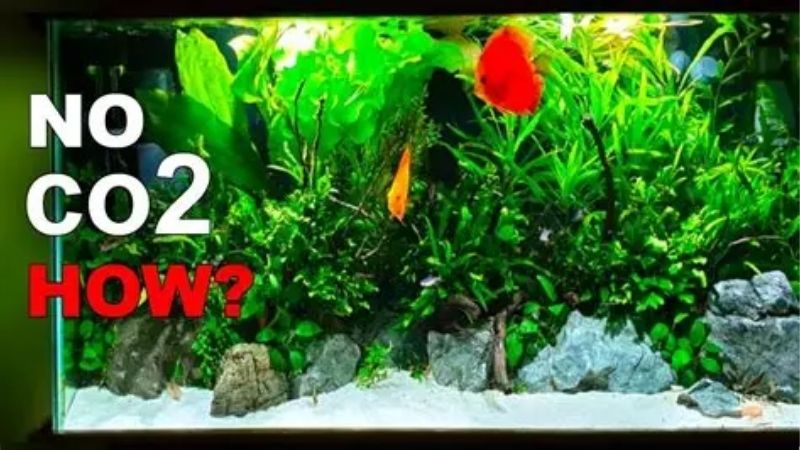
The decisive numbers behind a low-tech carbon budget
An uninjected tank typically holds carbon dioxide in the low single figures of parts per million, replenished from the atmosphere through the water surface. An injected tank commonly targets around 20–30 ppm, which is roughly an order of magnitude more carbon available to the plants.
That difference sets the light ceiling rather than the other way around. Low light means roughly 10–30 PAR at the substrate, and within that band plants can meet their carbon needs naturally, whereas above about 50 PAR the demand outruns that supply and algae takes the surplus light.
Photoperiod follows the same logic for aquarium plants without CO2 available. Six to eight hours on a timer is enough, and extra hours do not increase the carbon available at any moment, so a longer period simply widens the window in which algae can exploit whatever the plants leave unused.
The three carbon sources in an uninjected tank
Surface exchange is the largest source. Carbon dioxide moves from the air into the water wherever the surface is agitated, which is why a low-tech tank benefits from decent surface movement rather than being harmed by it, unlike an injected tank where agitation drives injected gas off.
Respiration is the second source. Fish, invertebrates and the bacterial colony all produce carbon dioxide continuously, and a moderately stocked tank generates a useful background level that a sparsely stocked one does not, which is part of why very lightly stocked planted tanks can stall.
Decomposition provides the third. Organic material breaking down in the substrate releases carbon dioxide at the root zone, which is the mechanism behind soil-based low-tech methods, and it is also why a mature tank with an established substrate often grows plants better than a new one.
What normal growth looks like, and when to act
Expect slow, steady growth rather than the weekly trimming that an injected tank demands. A new leaf every week or two is normal for these species, older leaves yellowing and being shed is part of how the plants renew themselves, and a tank can look barely changed month to month.
Act when stems stretch with long gaps between the nodes, when lower leaves drop faster than new ones appear, or when algae returns within days of cleaning the glass. The first two indicate too little light, and the third almost always means the light has outrun the carbon supply.
| Group | Without CO2 | Light needed | Typical outcome |
|---|---|---|---|
| Rhizome plants | Grows reliably | 10–30 PAR | Slow, steady, very forgiving |
| Cryptocoryne | Grows reliably | 10–30 PAR | Melts, then regrows and spreads |
| Vallisneria and hornwort | Grows quickly | 10–30 PAR | Spreads, needs thinning |
| Easy stem plants | Grows, often leggy | 30–50 PAR | Usable but needs more light |
| Carpets and red stems | Fails slowly | Above 50 PAR | Melts back over weeks |
What This Means for a Real Tank
The carbon budget is effectively fixed, so keeping aquarium plants without CO2 becomes a matter of choosing species that fit inside it. That is a narrower list than most retailers suggest, but it is wide enough to build a tank that looks established rather than obviously compromised.
Tank size, placement and physical fit
Depth changes the light reaching the substrate, and therefore the balance with carbon. A fixture giving 40 PAR on a 12 inch (30 cm) tank may deliver only 20 PAR at the bottom of a 21 inch (53 cm) tank, which usually suits a low-tech setup rather than working against it in any way.
Weight sets the wider limits here as well: a full tank runs near 10 lb per gallon (about 1 kg per L), so a 55 gallon (208 L) setup passes 600 lb (272 kg) and needs a purpose-built stand. Measure the tank length and the fixture span with a tape measure before ordering either of them.
The species that genuinely work
The reliable group here is java fern, anubias, cryptocoryne, vallisneria and the mosses, all of which grow at 10–30 PAR with no injection at all. Hornwort and other floating or fast stem plants also do well, and their speed makes them useful competitors against algae in a new tank.
Some of the stem plants sit right on the boundary here. Hygrophila and bacopa species will grow without injection, though usually at the upper end of the low band or into the medium band, and they do tend to look leggier than the same plants would in a tank with carbon dioxide available.
The species that will fail, and how they fail
Carpeting plants are much the clearest example of this. They need light reaching the substrate above 50 PAR plus injected carbon, and without both of those they thin out, lift off the substrate and melt back across several weeks in a way that looks like disease rather than a shortage.
Most of the red stem plants fail rather differently. They survive but stay green and leggy, because the colour that prompted the purchase develops under high intensity that a low-tech tank cannot supply, so the plant persists while never looking anything like the photograph that sold it.
The common thread here is a slow, ambiguous decline. Nothing here dies overnight, which makes diagnosis genuinely difficult, and beginners frequently respond by dosing more fertiliser or extending the photoperiod, both of which feed algae without addressing the missing carbon at all.
Myths About Growing Without Injection
Several beliefs about aquarium plants without CO2 circulate widely, and every one of them leads either to unnecessary spending or else to a slow failure. Replacing them with the underlying mechanism usually means changing the plant list rather than adding more equipment to the tank.
The myth that liquid carbon replaces injected CO2
Liquid carbon products are simply not carbon dioxide in a bottle. They are typically glutaraldehyde-based compounds with a well-documented algaecide effect, and while some keepers report improved growth, they do not supply carbon at anything close to the level injection provides.
They also carry one fairly specific risk along with them. Vallisneria and some of the mosses are noticeably sensitive to these products and can melt even at normal doses, so a tank built around exactly the species that suit low-tech keeping is the tank most likely to react badly to dosing them.
The myth that surface agitation should be avoided
This advice is correct for injected tanks and exactly backwards for low-tech ones. Agitation drives injected gas out of solution, which matters when you are paying to put it there, but in an uninjected tank the surface is the main route by which carbon dioxide enters the water at all.
Good surface movement also raises dissolved oxygen, which matters for the fish and for the biofilter, particularly in warmer water. In a tank without injection there is no reason at all to reduce agitation, and doing so on advice written for high-tech setups makes both problems worse.
The myth that more fertiliser compensates for missing carbon
Growth is limited by whichever input is scarcest, so adding nitrogen, phosphorus and potassium to a carbon-limited tank produces no additional growth. The surplus nutrients remain in the water column, where algae is considerably better placed to make use of them than the plants are.
The useful sequence here runs in the other direction entirely. Confirm nitrate sits at 20–40 ppm rather than being stripped to zero, keep the light inside the low band, and only then consider whether the plant list itself is asking for carbon the tank was never going to be able to supply.
Running a Low-Tech Planted Tank Long Term
The case for aquarium plants without CO2 really rests on the second and third year, when the tank has stabilised and the plants propagate themselves. What starts out as a compromise on species becomes a system that needs very little intervention and almost no recurring expenditure.
What to do periodically, and how often
Run the light on a plug-in timer at six to eight hours and review that schedule seasonally, since ambient daylight lengthens considerably from late spring into midsummer. Change 20–30 percent of the water weekly, dose a modest fertiliser, and keep decent surface movement year round.
Trim only what has genuinely died back, and thin the fast growers such as vallisneria and hornwort twice a year. Both will take over a tank if left alone, and hornwort in particular sheds needles when disturbed, so it is far easier to thin them regularly than to remove them in bulk later on.
What changes as the tank matures
The substrate becomes more productive over time as organic material accumulates and breaks down, releasing carbon dioxide at the root zone. This is why a three year old low-tech tank frequently grows plants that had failed in the very same tank during its first six months of running.
Stocking changes the picture here too. As fish are added and grow, respiration raises the background carbon level slightly, which is one reason that very lightly stocked planted tanks can look stalled while a moderately stocked tank of the same age and lighting fills in steadily.
The twelve month cost of running without injection
The costs stay low precisely because the equipment list is so short: a timer, a general liquid fertiliser, occasional root tabs, dechlorinator and an in-date test kit. There is no cylinder, no regulator, no diffuser and no drop checker at all to buy, refill or eventually replace.
Prices move constantly across retail and online sources alike, so check the figures at the time of purchase. The genuine saving here is not in any single item, but in the entire category of carbon dioxide equipment that a correctly chosen plant list makes unnecessary from the start.
Frequently Asked Questions
These questions come up repeatedly once people accept that particular carbon ceiling, because the practical limit on aquarium plants without CO2 is not effort or fertiliser but simply a supply of dissolved carbon that no amount of dosing or extra lighting hours can meaningfully increase.
Can I grow a carpet without injected CO2?
Realistically no, you cannot. Carpeting species need light above 50 PAR at the substrate along with injected carbon, and without both they thin out and melt back over several weeks. A moss attached to hardscape, or a low cryptocoryne, gives a similar effect without any of the equipment.
Is liquid carbon worth dosing?
It is entirely optional and it is not a substitute for injection. Some keepers find it useful in the medium band, but it does not supply carbon at anything like injected levels, and vallisneria and some mosses can melt at normal doses, which matters given they suit low-tech tanks.
Should I reduce surface agitation to keep CO2 in?
No, and that particular piece of advice applies to injected tanks only. In an uninjected tank the surface is the main route that carbon dioxide takes into the water, so reducing agitation lowers both the carbon available and the dissolved oxygen that fish and the biofilter depend on.
Does a soil substrate help?
It certainly can, since organic material breaking down releases carbon dioxide at the root zone. Soil-based methods are a genuine approach rather than a myth, though they do need careful capping and a slower stocking plan, and they suit patient keepers far more than impatient ones.
Why do my plants grow better now than a year ago?
Because the tank itself has matured a great deal. The substrate becomes more productive as organics accumulate, the stocking has usually increased, and the plants themselves have established root systems, so the same lighting and routine now support growth that was not possible at the start.
See More:
Conclusion
Keeping aquarium plants without CO2 works well whenever the plant list properly respects the carbon ceiling: java fern, anubias, cryptocoryne, vallisneria, the mosses and fast growers such as hornwort, all at 10–30 PAR with a six to eight hour photoperiod and good surface movement.
Carpets and red stem plants will fail slowly whatever you dose, because the limitation there is carbon rather than nutrients or effort. Keep light inside the low band, hold nitrate at 20–40 ppm, and let the tank mature, since substrate and stocking both improve matters over time.
Ready to decide? Our #1 pick for 2026 is the Rhizome plants.
Live price & availability on Amazon.
Related Reviews & Guides
How to Prepare Driftwood for Aquarium: Expert Trusted Guide
5 Best CO2 Regulators for Planted Tanks