Last Updated: October 21, 2026
- Top Pick: Tetra Complete 10 Gallon Fish Tank Kit for Freshwater & Saltwater Fish
- Best Value: 10 Gallon Aquarium Set Glass Fish Tank, Heater Self Cleaning System Filter with Media Bright Light Cleaning Tool, Leak-Proof Clear Rimless Betta Tropical Freshwater Fish
- Premium Choice: Vimvins 10 Gallon Glass Small Fish Tank with Filter Light and Lid, Aquarium Starter Kit
10 gallon fish tank setup guide starts with an uncomfortable fact: a small tank is not an easy tank. Ten gallons fits into almost any room and forgives almost nothing, so this guide explains how that volume behaves chemically, what equipment it actually needs, and exactly where the stocking limits sit.
As an Amazon Associate we earn from qualifying purchases.
As an Amazon Associate we earn from qualifying purchases at no extra cost to you.




By David Nguyen
What This 10 Gallon Fish Tank Setup Guide Is Built On
Small volume drives every decision here. This 10 gallon fish tank setup guide sizes equipment against roughly 8 gallons of actual water, because concentration rather than tank footprint is what decides whether the fish living in it stay safe from week to week.
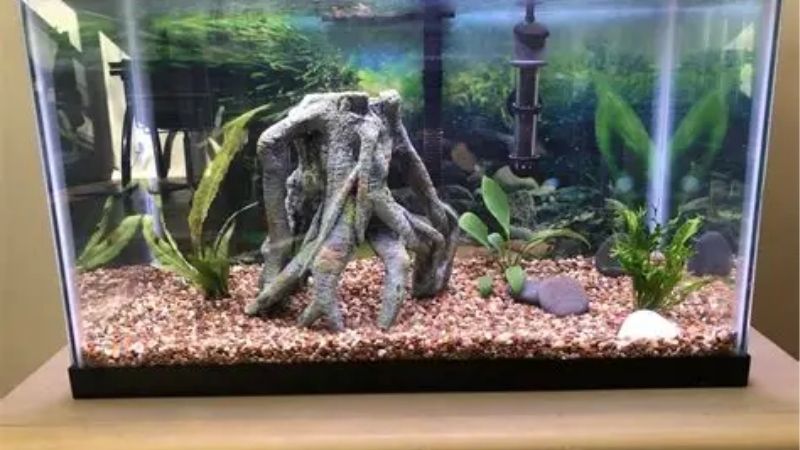
The numbers that define the build
A standard 10 gallon measures 20 x 10 x 12 in (51 x 25 x 30 cm) and weighs about 110 lb (50 kg) filled with water and substrate. That already exceeds what most bookshelves are rated to carry, so the stand question applies here as much as it does to larger tanks.
Real water volume is closer to 8 to 9 gallons (30 to 34 L) once 1 to 2 in (2.5 to 5 cm) of substrate and decor are in place. Dose medications, dechlorinator and fertiliser against that figure, since overdosing a small tank is much easier than overdosing a large one.
The required kit is a filter at 40 to 60 GPH (151 to 227 LPH), a 50 W heater, dechlorinator and a liquid test kit. A sponge filter driven by an air pump is often the better choice here, because it is gentle enough for bettas and long-finned fish.
Why 8 gallons of water swings so fast
Concentration is mass divided by volume, so one uneaten pellet in 8 gallons produces several times the ammonia reading it would in 29 gallons. The same applies to evaporation, which concentrates dissolved minerals faster in a shallow tank with a small surface volume.
Temperature follows the room within an hour or two rather than coasting overnight. A cold snap, an open window or direct afternoon sun all move the water measurably, which is why placement matters more here than in any larger build, and why a separate thermometer is essential.
The nitrogen cycle itself is identical to a large tank: ammonia to nitrite to nitrate, held by bacteria living in filter media and substrate. What differs is speed. The nitrogen cycle explainer covers the mechanism; here it simply arrives faster and hits harder.
Normal ranges and action thresholds
This 10 gallon fish tank setup guide targets 76 to 80 °F (24 to 27 °C) for tropical fish, a stable pH within whatever your tap water provides, and nitrate below 20 ppm. Holding a value steady is worth far more here than pushing it toward a textbook number with chemical adjusters.
Act immediately on ammonia above 0.25 ppm, any nitrite above 0 ppm, or nitrate past 40 ppm. Test weekly at minimum, and daily during cycling or after adding fish, because a reading that would take days to develop in a 40 gallon can appear here within a single afternoon.
| Item | Spec for a 10 gallon | Why this number | Common mistake |
|---|---|---|---|
| Real water volume | 8-9 gallons (30-34 L) | Substrate and decor displace water | Dosing against 10 gallons |
| Filled weight | 110 lb (50 kg) | About 10 lb per US gallon | Placing it on a bookshelf |
| Filter flow | 40-60 GPH (151-227 LPH) | Four to six turnovers per hour | Flow too strong for a betta |
| Heater | 50 W | 3-5 W per gallon at a 10 °F delta | Trusting the dial, not a thermometer |
| Water change | 2-3 gallons (8-11 L) weekly | 20-30% of volume | Changing 100% to clear cloudiness |
| Light | 6-8 hours daily | Longer periods feed algae | Leaving the light on all day |
Fitting a 10 Gallon Into a Real Room
Placement and stocking do most of the work in this build. A 10 gallon fish tank setup guide is really a guide to constraints, since the tank will fit almost anywhere in a home but tolerates very little of what people typically want to put inside it.
Tank size, placement and fit
Measure the surface, the gap behind the tank and the clearance above before ordering anything, because a hang-on-back filter needs 4 to 6 in (10 to 15 cm) of clear wall and the hood needs room to open. The heater must stay submerged at the lowest point of a water change.
Keep the tank out of direct sun, away from radiators and vents, and off any surface that flexes under 110 lb (50 kg). Proximity to an outlet allows a drip loop in every cord, and proximity to a tap turns a water change into a five minute job instead of a chore.
What actually fits in ten gallons
Stocking is where most small tanks fail, and the failure is rarely dramatic. It shows up as nitrate that never falls below 40 ppm between changes, algae that returns within days of scrubbing, and fish that hide far more than they swim in open water.
Realistic stocking is one betta with a few snails, a single school of six nano fish such as chili rasboras, or a shrimp colony on its own. Corydoras, most barbs, goldfish and anything reaching 3 in (7.6 cm) or more do not belong here, whatever the shop tank suggests.
Schooling species need their minimum group size before they need decoration, so six of one small species beats one each of six species. Adding one more fish is the most common way a working 10 gallon tips into a struggling one, since there is no spare capacity to absorb it.
Where the 10 gallon genuinely wins
Dormitories and rented rooms often cap aquariums at around 10 gallons (38 L) and restrict high-wattage equipment, which is why nano kits sell hardest from late July to early September. Within those rules this is the largest tank many students are allowed to run at all.
A 10 gallon fish tank setup guide also applies to quarantine and grow-out tanks run alongside a larger display, where the small volume becomes an advantage because medications and water changes are cheap. In that role the instability matters far less.
Myths That Sink Small Tanks
Small tanks attract advice that would be merely wrong in a larger volume and turns actively damaging at this scale. Three claims cause most of the losses in the first year of a 10 gallon fish tank setup guide, and each has a concrete number that replaces it.
Myth: small tanks are easier for beginners
The opposite is measurably true. Half the water of a 20 gallon means double the concentration from the same mistake and roughly double the speed of temperature drift. Ten gallons is a viable first tank, but it demands more frequent testing, not less attention.
Myth: a betta is fine in a bowl or under 5 gallons
Bettas breathe air at the surface but still live in the water, and unfiltered containers accumulate ammonia and swing in temperature through the day. Ten gallons with gentle filtration and a 50 W heater is a comfortable home; a 1 gallon (3.8 L) bowl is a maintenance problem.
Myth: change all the water to fix cloudiness
A full change strips the buffer, shocks the fish and does nothing about the cause, which is usually a bacterial bloom in a new tank or overfeeding in an established one. Change 20 to 30 percent, test the four numbers, and cut feeding rather than emptying the tank.
Running a 10 Gallon Past the First Year
The routine below is short precisely because the volume is small, and skipping a week costs more here than it would in any larger tank. This part of the guide covers what recurs, what wears out, and roughly when each item starts to show it.
The weekly and monthly routine
Nothing in this routine is unusual, and the value lies entirely in doing it on a schedule rather than in response to a visible problem. A cycle that never breaks is far cheaper in both time and livestock than one repaired after the readings climb.
Weekly: change 2 to 3 gallons (8 to 11 L) of water, match the new water to within 1 to 2 °F (about 1 °C), dechlorinate it, and vacuum part of the substrate each time. Test ammonia, nitrite and nitrate before deciding whether a second change is needed that week.
Monthly: rinse the sponge or floss in removed tank water, never under the tap, and check the impeller or airstone for clogging. Feed what is eaten in one to two minutes, once daily, since a small tank punishes overfeeding faster than anything else on this list.
What wears out and how it shows
Airstones clog gradually, producing coarser bubbles and weaker flow through a sponge filter, while air pump diaphragms stiffen over a few years. Small heaters drift out of calibration and can fail stuck on, which in 8 gallons raises temperature dangerously fast.
Winter is when most of this surfaces. A colder room forces a much higher heater duty cycle, dry heated air accelerates evaporation, and a falling water line can expose a heater or leave a hang-on-back intake sucking air. Check the water line more often once indoor heating starts.
The recurring cost and the upgrade path
Dechlorinator, food, filter floss and test reagents are the recurring items, and reagents expire whether used or not. Power draw is modest, dominated by the heater cycling against room temperature, with an air pump or small filter adding only a few watts continuously.
Many keepers move up to a 20 or 29 gallon within a year or two. Cycled filter media, the heater, the test kit and the siphon all transfer; the tank, hood and light usually do not. Keeping the old media wet during a move preserves the bacteria colony.
Frequently Asked Questions
These questions come up most often once the tank is set up, the filter is running and the first week of testing has started, which is usually the exact point at which an ambitious stocking plan gets quietly revised downward to fit the volume.
How many fish can a 10 gallon hold?
One betta with snails, or a school of six small nano fish, or a shrimp colony. Ignore the one inch per gallon rule, which counts body length while ignoring waste output, temperament and swimming space. Stock by adult size and by the minimum school size each species needs.
Sponge filter or hang-on-back?
A sponge filter suits bettas and shrimp because flow is gentle and there is no intake to trap them. A hang-on-back moves more water and holds more media, but usually needs a flow reducer or a baffle in this volume. Either way, aim for 40 to 60 GPH (151 to 227 LPH).
Do I still need to cycle a tank this small?
Yes, and the consequences of skipping it are worse. Plan on three to eight weeks, dosing ammonia to 2 to 4 ppm until a full dose clears to zero ammonia and zero nitrite within 24 hours with nitrate present. See how to cycle a fish tank for the process.
Can a 10 gallon go on a desk or bookshelf?
Only if the surface is rated for 110 lb (50 kg) and sits level. Most bookshelves and lightweight desks are not rated for it, and a surface that sags even slightly loads the seams unevenly. A low cabinet with a solid, level top is the safer choice for a tank of this weight.
Making the Small Volume Work
This 10 gallon fish tank setup guide comes down to accepting the constraint rather than fighting it: 8 to 9 gallons (30 to 34 L) of real water, 110 lb (50 kg) supported properly, 40 to 60 GPH (151 to 227 LPH) of gentle flow, and a 50 W heater checked against a thermometer.
Stock conservatively, test the water every week, and keep the maintenance routine short enough that you actually carry it out. If the space allows something larger, the tank size comparison is worth reading first, because ten more gallons buys real margin.
New Tank Syndrome Symptoms: Causes and How to Fix It Fast
20 Gallon Long Aquarium Dimensions Size Guide With Measurements (2026)