Last Updated: September 9, 2026
Aquarium turnover rate calculator tables answer one question: how many times per hour does your filter move the water in the tank, and is that enough for what lives in it. The two tables below give target ranges by tank size and the derating factors that separate a rated figure from real delivered flow.
As an Amazon Associate we earn from qualifying purchases.
By David Nguyen
Quick answer: Our top pick in 2026 is the 5 gallons (19 L) — our #1 rated choice. See the full ranked comparison, alternatives and buying advice below.
The Lookup Tables and the Formula Behind Them
Any aquarium turnover rate calculator rests on a single division, and the tables below do that arithmetic for common tank sizes. Read the target band for your stocking type first, then use the second table to work out what your filter actually delivers rather than what the box claims.
The decisive number: turnover per hour by stocking type
A general community tank wants 4–6 times its real water volume per hour. Goldfish and cichlid tanks want 8–10 times because of their heavier bioload, while low-stocked shrimp, betta and fry tanks work comfortably at 3–4 times, provided that surface agitation keeps gas exchange going properly.
| Tank size | Real water volume | Community 4–6× | Heavy bioload 8–10× | Low stock 3–4× |
|---|---|---|---|---|
| 5 gallons (19 L) | ~4 gal (15 L) | 16–24 GPH (61–91 LPH) | 32–40 GPH (121–151 LPH) | 12–16 GPH (45–61 LPH) |
| 10 gallons (38 L) | ~8 gal (30 L) | 32–48 GPH (121–182 LPH) | 64–80 GPH (242–303 LPH) | 24–32 GPH (91–121 LPH) |
| 20 gallons (76 L) | ~17 gal (64 L) | 68–102 GPH (257–386 LPH) | 136–170 GPH (515–643 LPH) | 51–68 GPH (193–257 LPH) |
| 29 gallons (110 L) | ~25 gal (95 L) | 100–150 GPH (379–568 LPH) | 200–250 GPH (757–946 LPH) | 75–100 GPH (284–379 LPH) |
| 40 gallons (151 L) | ~34 gal (129 L) | 136–204 GPH (515–772 LPH) | 272–340 GPH (1030–1287 LPH) | 102–136 GPH (386–515 LPH) |
| 55 gallons (208 L) | ~47 gal (178 L) | 188–282 GPH (712–1067 LPH) | 376–470 GPH (1423–1779 LPH) | 141–188 GPH (534–712 LPH) |
| 75 gallons (284 L) | ~64 gal (242 L) | 256–384 GPH (969–1454 LPH) | 512–640 GPH (1938–2423 LPH) | 192–256 GPH (727–969 LPH) |
The formula and a worked example
Turnover equals delivered flow in GPH divided by real water volume in US gallons. Reverse it to size a filter: multiply real volume by the target multiplier. A 29 gallon (110 L) tank holding about 25 gallons (95 L) of water at 5 times turnover therefore needs roughly 125 GPH (473 LPH) delivered.
Rated flow is not delivered flow, so apply the second table. A unit rated 200 GPH (757 LPH) with a full media basket and 2 feet (61 cm) of head loses in the region of 40 percent, leaving about 120 GPH (454 LPH) and giving 120 divided by 25, or roughly 4.8 times turnover on that tank.
| Factor | Typical effect on rated GPH | What to do about it |
|---|---|---|
| Media in the basket | Reduces by 20–35 percent | Size up, or use coarser mechanical media |
| Head height above water | Reduces with every foot lifted | Check the head curve before buying |
| Hose length and bends | Reduces by 5–15 percent | Shorten runs, avoid tight bends |
| Debris loading over weeks | Further 10–30 percent | Rinse mechanical media every 2–4 weeks |
| Substrate and hardscape | Cuts real volume by 10–20 percent | Calculate on real volume, not label size |
How to read the tables, units and margins of error
Real water volume in the first table assumes a normal substrate bed and moderate hardscape, so it sits roughly 10–15 percent below nominal capacity. Heavily aquascaped tanks lose more, and a tank packed with rock and thick substrate can hold a fifth less water than the label suggests.
Treat every figure as a band rather than a target. Turnover of 4.8 times and 5.2 times are indistinguishable in practice, and no aquarium turnover rate calculator can account for how the outflow is aimed, which matters as much as the total volume moved through the filter each hour.
Adjusting the Number for Real Situations
The tables above give a starting point, and the adjustments below move it up or down. An aquarium turnover rate calculator cannot see your stocking, your planting or the shape of your tank, and each of those shifts the useful figure by enough to matter when choosing between two filter sizes.
Adjusting for species and bioload
Bioload is species-specific rather than being a simple function of body length. Goldfish reaching 8 inches (20 cm) and large cichlids justify the 8–10 times band, while a school of small tetras in the same volume sits comfortably at 4–5 times, given regular water changes of 20–30 percent.
Swimming ability pulls in the other direction. Bettas and long-finned fish struggle above roughly 4 times turnover, and the answer is usually to keep the volume and spread the water using a spray bar or a baffle rather than to undersize the filter and lose biological capacity with it.
Adjusting for plants, substrate and layout
Densely planted tanks need circulation more than raw turnover. Thickets create dead zones where detritus settles, so aim towards the upper half of the community band and position the outflow to push water along the back glass and around the planting rather than straight across it.
Deep substrate and large hardscape reduce real volume, which raises effective turnover for the same filter. A tank with 3 inches (8 cm) of substrate and heavy rockwork may hold a fifth less water than nominal, so recalculate rather than reusing the figure from the original setup.
Tank size, placement and physical fit
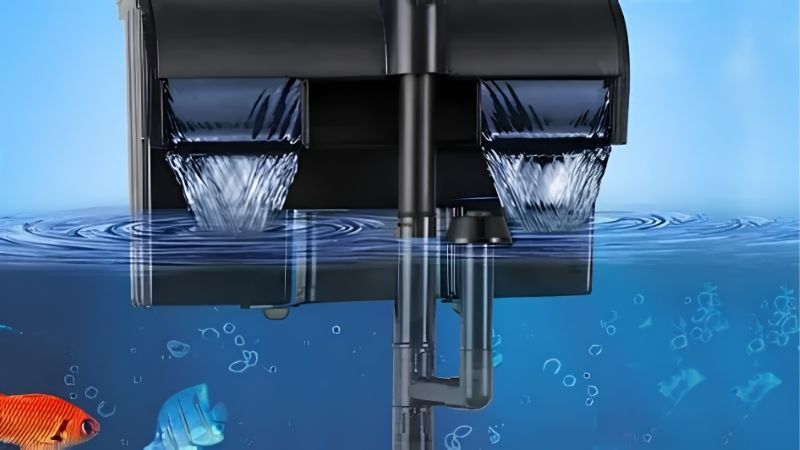
The filter has to physically fit before any of these numbers mean anything. Hang-on-back units need 4–6 inches (10–15 cm) of clearance behind the tank, and canisters need internal cabinet height for the body plus a hose bend radius that will not kink against the back panel of the stand.
Weight and position set the rest. A full tank runs near 10 lb per gallon (about 1 kg per L), so a 55 gallon (208 L) setup passes 600 lb (272 kg). Measure the gap behind the tank and the cabinet height with a tape before ordering, and expect higher evaporation in a heated winter room.
The Limits of This Number
Turnover is a useful summary and a poor complete answer. Every aquarium turnover rate calculator reduces a three-dimensional flow pattern to a single ratio, and there are several situations where the resulting figure is either misleading or simply the wrong thing to be optimising.
When the formula gives the wrong answer
Sumps and wet-dry systems break the arithmetic, because return pump output after head loss governs the tank while the sump adds volume that is not part of the display. Reef systems also separate filtration turnover from in-tank circulation, which runs far higher at somewhere near 20–40 times.
Very small tanks distort in the other direction. A 5 gallon (19 L) tank at 6 times turnover needs only 24 GPH (91 LPH), which is below the practical output of most filters sold for it, so the real task in that case becomes reducing velocity rather than meeting a calculated minimum.
Variables the table cannot capture
Outflow direction, tank footprint and hardscape density all shape where water actually goes. A long 40 gallon (151 L) tank and a tall 40 gallon of the same volume behave completely differently, because the tall one has more distance for the current to lose energy before returning.
Contact time inside the media matters too. Two filters delivering identical turnover can perform differently if one holds three times the media volume, since the biological stage depends on surface area and oxygenated contact rather than on how quickly the water passes through it.
When to ignore the table and watch the tank
Observation overrides calculation in two directions. Detritus collecting in corners that used to stay clean means circulation is too low regardless of the arithmetic, and fish held against décor or unable to feed in open water means velocity is too high, whatever the calculated ratio happens to say.
Water readings settle the argument. Ammonia and nitrite at 0 ppm with nitrate below 20–40 ppm indicates the filtration is adequate, and a rising nitrate trend at an unchanged feeding rate indicates it is not, both of which are far more informative than any single turnover figure on its own.
Verifying the Figure and Rechecking It
A number produced by an aquarium turnover rate calculator is an estimate until it is checked against the tank, and delivered flow falls steadily as media loads and parts wear. Verification is simple enough, and knowing how quickly the figure drifts tells you how often to repeat it.
How to measure delivered flow and how accurate it is
The practical method is timed collection: divert the outflow into a measuring jug for 15 seconds, multiply by four for the per-minute figure, then by 60 for GPH. Repeat three times and average, since starting and stopping the timer introduces an error of several percent on each individual attempt.
Take the measurement immediately after a media rinse to establish the clean baseline, then again just before the next service to see the loss. That pair of numbers is far more useful than a single reading, because it shows the range the tank actually experiences between services.
How often to recheck the figure
Recheck after any change to media, hoses or filter position, and otherwise every three months alongside the impeller service. A visual proxy works between measurements: note the width of the outflow or the movement of a plant leaf at the point when everything is clean and freshly serviced.
Seasonal conditions justify an extra check. Warm water in midsummer holds less dissolved oxygen, so a filter that has drifted 30 percent below its clean baseline matters far more in July than it did in February, particularly in tanks that are already running near the upper end of their stocking level.
Equipment that drifts away from its numbers
Impeller shafts groove at the tip and lose output before they rattle audibly. Canister hoses grow a biofilm that narrows the bore within a year, and lid gaskets harden and admit air, which reduces flow and produces the gurgling that signals a unit that is no longer running fully primed.
Media contributes its own drift. Fine floss packs within weeks, coarse sponge compresses over months, and sintered blocks eventually load with sediment that rinsing no longer clears. Rinsing every 2–4 weeks in used tank water is what keeps delivered flow near the calculated figure.
Frequently Asked Questions
These questions tend to follow on naturally from using the tables above, because any aquarium turnover rate calculator produces a single ratio while the tank itself presents a set of trade-offs between velocity, contact time and the amount of media that the filter can physically hold.
Should I use nominal or real water volume?
Always use real volume. A 20 gallon (76 L) tank typically holds only 17–18 gallons (64–68 L) after substrate and hardscape, and using the label figure overstates the water being moved by 10–15 percent, which is easily enough to push a borderline filter choice in the wrong direction.
Is higher turnover always better?
No, it is not. Above the band for your stocking, extra turnover adds velocity without adding any biological capacity, and it can leave fish unable to hold position or feed. Beyond that, higher flow shortens contact time inside the media, which does nothing useful for the nitrifying colony.
Does a second filter double my turnover?
Effectively yes, and it usually gives noticeably better coverage than one large unit does, because two moderate outflows placed at opposite ends of the tank spread the circulation far more evenly. The cost is two sets of consumables and two impellers to service every year rather than one.
Do air-driven sponge filters have a turnover rating?
Not in any directly comparable way, since their output depends on air pump pressure, tube diameter and water depth. Judge them by direct observation and by water readings instead, and expect a single sponge filter to suit only lightly stocked tanks rather than heavy bioload species.
See More:
Conclusion
Used properly, an aquarium turnover rate calculator gives a band rather than a target: 4–6 times real volume for a community tank, 8–10 times for goldfish and cichlids, and 3–4 times for lightly stocked setups. Apply the derating factors from the second table, then verify the result with a jug and a stopwatch.
Ready to decide? Our #1 pick for 2026 is the 5 gallons (19 L).
Live price & availability on Amazon.
Related Reviews & Guides


Best Energy Efficient Canister Filter: Top Reliable Guide
Best Canister Filter for 100 Gallon Aquarium: Expert Picks