Last Updated: October 21, 2026
- Top Pick: Aquarium Maintenance Logbook: Document & Track Feeding, Tank Conditions, Water Test Readings & Other Important Information | Fish Keeping Record Book for Aquarists of All Levels
- Best Value: The Fish Keeping Log Book: Record & Track Aquarium Maintenance Activities | Aquarist's Journal for Documenting Feeding, Tank Conditions, Water Test Readings & Other Important Information
- Premium Choice: Aquarium Test Strips for Freshwater Fish: 7 in 1 Fish Tank Water Testing Kit for Aquarium Pond – Accurate Testing Nitrate Nitrite Hardness Free Chlorine pH Carbonate Total Alkalinity-100 Strips
Weekly fish tank maintenance checklist work should take about twenty minutes on a 20 gallon tank, in a fixed order, with a target number attached to each step. The first table is the list itself. The second covers the kit needed for it, and the sections underneath explain how to adjust both of them to your own tank.
As an Amazon Associate we earn from qualifying purchases.
As an Amazon Associate we earn from qualifying purchases at no extra cost to you.


By David Nguyen
The Weekly Fish Tank Maintenance Checklist
The order matters as much as the tasks, since testing before a change gives a reading that reflects the peak the fish actually live in. Work down the table, then use the sections below to adjust the quantities to suit your own tank and stocking.
The numbers each step is measured against
Three readings and one percentage carry the whole list: ammonia at 0 ppm, nitrite at 0 ppm, nitrate under 40 ppm, and a change of 20 to 30 percent of real water volume. Everything else on the list is a check that takes under a minute to complete.
| Order | Step | Time | Target number |
|---|---|---|---|
| 1 | Count fish, look for behaviour changes | 1 min | All present, none gasping or hiding |
| 2 | Check temperature on a separate thermometer | 1 min | 76-80 °F (24-27 °C), steady |
| 3 | Test ammonia, nitrite and nitrate | 5 min | 0 ppm, 0 ppm, under 40 ppm |
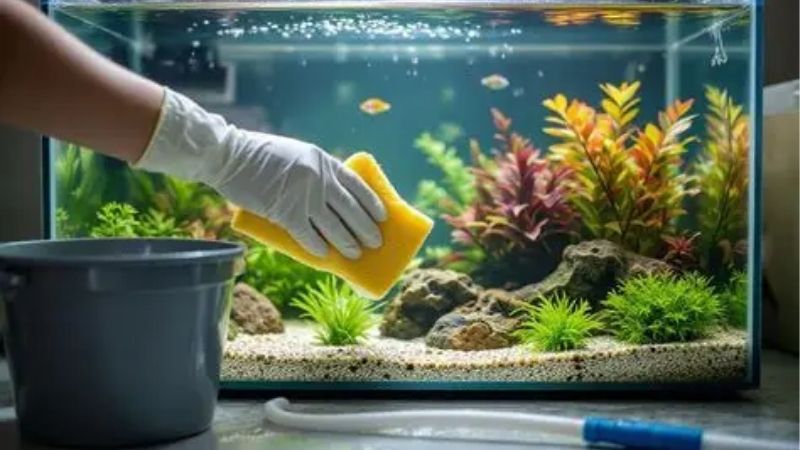
| 4 | Scrape algae from the front glass | 2 min | Before the water change, not after |
| 5 | Unplug the heater, then siphon and vacuum | 7 min | 20-30%, one third of the substrate |
| 6 | Refill with matched, treated water | 3 min | Within 1-2 °F (about 1 °C) |
| 7 | Restart equipment, check flow and glass | 1 min | Normal outflow, heater submerged |
Why the weekly fish tank maintenance checklist runs in this order
Each step is placed where it is because doing it earlier or later either wastes effort or creates a risk. Three of the seven depend on the step before them, and those are the three worth not rearranging on the day.
Testing comes before the change because a post-change reading measures the new water rather than the conditions the fish have been living in all week. Scraping algae before siphoning means the debris leaves with the water rather than settling back down.
Unplugging the heater before draining prevents the single most common equipment failure during maintenance, which is a glass heater cracking when it runs while exposed to the air. Restarting it only once the water covers it again closes that loop.
How to read the times
The times in the table are honest rather than optimistic, and they assume the kit is already to hand rather than being hunted for. Two of the seven steps account for most of the variation between tanks.
The times assume a 20 gallon (76 L) tank with a bucket and siphon. A 55 gallon (208 L) tank moving 11 to 17 gallons (42 to 64 L) takes considerably longer with buckets, which is exactly where a faucet-connected changer earns its place in the kit.
Treat five minutes for testing as the honest figure rather than the optimistic one. Liquid kits need timed waits and vigorous shaking of the nitrate reagent, and rushing that step is what produces readings that quietly disagree with the tank.
Adjusting the Weekly Fish Tank Maintenance Checklist
The steps stay the same across most freshwater setups while the quantities and the kit around them change. The second table lists what each item on the list is actually for and when it needs replacing.
| Item | What it does | Replace or service when |
|---|---|---|
| Liquid test kit | Reference readings for three parameters | On the printed expiry date |
| Separate thermometer | Checks the heater is honest | If it disagrees with a second unit |
| Gravel vacuum | Removes water and trapped waste together | When flow drops or the tube cracks |
| Dedicated bucket | Carries treated water, never detergent | If used for anything else, ever |
| Dechlorinator | Neutralises chlorine and chloramine | Keep a spare bottle at all times |
| Algae scraper | Clears glass before siphoning | When the blade or pad scratches |
| Mechanical floss | Traps particles before the bio media | Quarterly, or when disintegrating |
Adjusting for stocking and species
The list itself does not change between tanks, and the quantities attached to it do. Two variables account for nearly all of the variation, and both are easy enough to establish once rather than reconsidering them weekly.
Heavily stocked tanks and high-waste species need the upper end of the range, at 30 to 40 percent weekly for goldfish or cichlids. Shrimp tanks go the other way at 10 to 20 percent, since dissolved solids and hardness swing less at smaller volumes.
Nano tanks under 10 gallons (38 L) keep the same percentage and lose all margin for skipping. Half the water means twice the concentration from the same mistake, so the weekly slot on a small tank is easily the least skippable item on this whole list.
Adjusting for plants and substrate
Planted tanks change the vacuuming step rather than the schedule. Work around root zones, clean open areas only, and accept that a heavily planted tank traps less waste in the first place, simply because very little of the substrate is left bare.
Sand needs a different technique entirely. Hover the tube about 1 in (2.5 cm) above the surface so that debris lifts while the sand itself stays put, rather than pushing the tube down in as you would with coarse gravel.
Tank size, placement and fit
Measure the distance from the tank to the tap and the clearance behind the stand before buying a hose or a changer, since equipment that does not reach gets abandoned within a month. This is the step that decides whether twenty minutes is realistic.
Check the heater position while the tank is drained to the working line. A heater that sits partly exposed at 30 percent down is either too high or the change is simply too large, and both of those are far easier to fix before it cracks.
Where the Checklist Falls Short
A weekly fish tank maintenance checklist assumes a cycled, stable tank with nothing unusual happening. Three situations need something different rather than a faster run through the same seven steps.
When the tank is cycling
During a fishless cycle, skip the water change entirely unless ammonia passes 5 ppm or pH falls below 6.5, because removing ammonia starves the colony. With fish present, test daily and change on the thresholds rather than on the weekly slot.
When a reading is out of range
The list assumes three readings come back where they should. When one does not, the correct response is to stop working through the checklist and deal with that reading before anything else happens at all.
Any ammonia above 0.25 ppm or any nitrite turns the checklist into a response. Change 25 to 50 percent, reduce feeding, and repeat daily until both clear, then look for the cause in stocking, feeding or recent filter maintenance.
What the list does not cover
Monthly and quarterly tasks sit outside it: rinsing mechanical media in removed tank water, checking the impeller, replacing floss and inspecting seals. Doing the filter in the same week as a thorough vacuum is the one combination to avoid.
Checking That the List Is Working
The point of a weekly fish tank maintenance checklist is a stable set of readings, so the readings themselves are the verification of whether it works. Two of the three move slowly enough to act as a genuine long-term signal of drift.
Tools and their accuracy
Liquid kits are the reference and strips lose accuracy quickly once the container is opened in a humid room. The nitrate reagent needs vigorous shaking for 30 seconds or more, since an under-shaken bottle reads low and hides a rising trend.
A second thermometer is worth owning purely to check the first. Heaters drift, thermometers drift, and two devices disagreeing is the cheapest early warning available for a failure that can otherwise cost an entire tank in a single night.
How often to reconfirm
Testing has its own rhythm, separate from the cleaning itself. The aim is to catch a trend rather than to record a number every week indefinitely once the tank has settled into a reasonably predictable pattern.
Test nitrate before every change for the first month to establish the plateau, then monthly once it is known. Reconfirm after any stocking change, since new fish raise production immediately and a heavier feeding habit usually follows within a fortnight.
Review the whole list twice a year. Winter changes the practical side rather than the intervals, with colder tap water needing more mixing, and dry indoor air accelerating evaporation in between the changes.
Equipment that quietly drifts
The kit degrades in ways that show up as a failed session rather than as an obviously broken tool. Checking it takes a minute a month and prevents most of the problems that later get blamed on the method.
Siphons clog and lose flow, buckets pick up residue from other jobs, and scrapers develop grit that scratches acrylic. The most consequential drift is a heater left unplugged after a change, which shows as a temperature drop several hours later.
Reagents expire on a date rather than on use, and the nitrate bottles fail first. Note the purchase date on the box, because a kit reading low turns a genuine problem into a checklist that keeps cheerfully reporting that everything is fine.
Frequently Asked Questions
These come up once the list has been run a few times and either the timings or the quantities start to feel wrong for the particular tank and stocking it is being used on.
How long should a weekly fish tank maintenance checklist take?
About twenty minutes on a 20 gallon (76 L) tank with a bucket and siphon, of which five is testing. If it regularly runs past an hour, then the equipment rather than the method itself is usually what needs changing.
Can I test after the water change instead?
It gives a less useful number. Testing before the change measures the peak conditions the fish lived in all week, while testing afterwards mostly measures the new water going in, and it hides a rising plateau.
Does the weekly fish tank maintenance checklist include the glass?
Only the viewing panes, and only if algae is visible. Leaving the back and side glass alone gives grazing species something to work on, and scraping before the siphon means the loosened debris leaves along with the water.
Should the filter be part of the weekly list?
No. Rinse mechanical media monthly in removed tank water and keep it in a separate week from the substrate vacuum, since doing both together removes colony sites at once and it can produce a small ammonia reading a day or two later.
See More:
Running the List
A weekly fish tank maintenance checklist works because it is short, ordered and measured: three readings, one percentage, a third of the substrate, and matched water going back into the tank within 1 to 2 °F (about 1 °C) of it.
Nano Aquarium Setup Guide: How It Works and What to Watch
29 Gallon Aquarium Dimensions Size Guide With Measurements (2026)