Last Updated: October 4, 2026
Quick answer: Our top pick in 2026 is the Inert aquarium gravel — our #1 rated choice. See the full ranked comparison, alternatives and buying advice below.
The Short Answer
Yes—aquarium soil is worth it if you are setting up a planted freshwater tank and want rooted plants to establish more easily. It is not automatically the best choice for every aquarium, however. Soil costs more than gravel or sand, can alter water chemistry, and may create extra maintenance during the first few weeks. For a simple fish-only aquarium, a basic inert substrate is usually the smarter buy.
In 2026, aquarium soil is best viewed as a planting and water-conditioning tool rather than a decorative upgrade. The right product can make a planted tank easier to grow, but it will not replace adequate light, fertilizer, carbon dioxide, or regular maintenance.
As an Amazon Associate we earn from qualifying purchases at no extra cost to you.

What You Actually Get
Aquarium soil is a baked, porous substrate made from materials such as volcanic ash or clay. Unlike ordinary gravel, it contains fine particles and has a chemically active surface. Many products are designed to support beneficial bacteria and provide some nutrients to plant roots. Some also soften water by lowering pH and consuming part of the water’s carbonate hardness, commonly called KH.
That chemistry is a major difference between “soil” and inert gravel. A new layer can initially reduce pH and KH, sometimes noticeably. The effect depends on the brand, how much substrate you use, and the hardness of your tap water. Active soil gradually loses its buffering effect, but there is no universal replacement schedule. Testing your water is more reliable than assuming the bag will behave the same way in every tank.
Most planted aquariums use a soil depth of roughly 2 to 3 inches. A shallow 10-gallon aquarium may need about 8 to 12 pounds, while a 20-gallon tank often needs approximately 15 to 25 pounds, depending on the footprint and desired slope. A deeper rear section looks attractive and gives stem plants more room, but it also increases the amount you must purchase. Measure the tank’s length and width, then check the manufacturer’s coverage guidance before ordering.
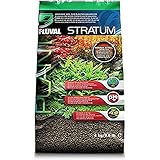
For example, Fluval Plant and Shrimp Stratum is sold in an 8.8-pound bag listed around $30, while Fluval Volcanic Soil Bio-Stratum comes in a 4.4-pound bag listed around $15. Those package sizes may be enough for a nano aquarium or a thin layer, but a larger tank can require multiple bags. The total cost—not the price of one bag—is the number that matters.
Pros
- Better support for rooted plants. Fine particles surround roots more closely than large gravel, and many soils contain nutrients or have a high cation-exchange capacity. Cryptocoryne, Amazon swords, vallisneria, and other root-feeding plants can benefit.
- Useful water chemistry for certain livestock. The pH-lowering and softening effect can suit some shrimp and soft-water fish. It may help keep parameters closer to the range preferred by species such as crystal shrimp, rasboras, and many South American community fish.
- Natural appearance. Dark brown or black soil makes green plants and brightly colored fish stand out. It also resembles a planted stream bed more closely than bright-colored gravel.
- Easy planting. Fine, lightweight granules are generally simple to work around with tweezers. They also let you create slopes, although slopes may flatten over time.
- Porous surfaces for bacteria. The texture provides places for beneficial bacteria to colonize. This supports biological filtration, though soil is not a substitute for a properly sized filter and established nitrogen cycle.
- Less reliance on root tabs at the beginning. Nutrient-rich soil can reduce the need to immediately add fertilizer under heavy root feeders. You will still likely need liquid fertilizer for plants that feed from the water column.
Cons
- Higher upfront cost. A small aquarium may require $30 to $70 of soil, while a medium planted tank can easily reach $60 to $120 before plants, lighting, filtration, and hardscape are added.
- It can change pH and KH. This is helpful only when it matches your fish and water. In a tank with hard-water species, an active soil can create an unsuitable or unstable environment. Test pH, KH, and ammonia during setup.
- Initial ammonia is possible. Some nutrient-rich substrates release ammonia as they settle. Follow the product directions, cycle the aquarium before adding livestock, and do not treat a new tank as instantly safe.
- It is easy to damage with cleaning. Deep vacuuming can pull up granules and disturb plant roots. A gentle siphon held just above the surface is usually safer than pushing a gravel vacuum into the bed.
- Granules break down over time. Handling, fish activity, and repeated maintenance can turn soil into smaller particles. Fine debris may cloud the water or compact around roots.
- It is not ideal for every fish. Large cichlids, goldfish, and species that constantly dig may scatter soil, uproot plants, or create cloudy water. Soil is also a poor match for aquariums intended to be frequently rearranged.
- It does not solve plant-growth problems by itself. Low light, insufficient nutrients, poor circulation, or algae can still prevent healthy growth. A dependable light in the approximate 15-40 watt range may be suitable for many small to medium planted tanks, but actual needs depend on tank depth, light type, and plant selection.
Who Should Buy It
Buy aquarium soil if your main goal is a planted freshwater aquarium with several rooted plants, especially if you want a dark natural base and keep soft-water fish or shrimp. It is also a good choice when you are starting from an empty tank and can establish the aquarium carefully before adding animals.
Soil makes particular sense for a 5- to 30-gallon planted setup where you can control water parameters and perform smaller, regular water changes. If you use tap water, measure its pH and KH first. If your water is very hard, active soil may be exhausted more quickly as it works against the minerals in the water.
Choose a bag size based on the footprint, not the tank’s advertised volume. A long, shallow 20-gallon tank can require more substrate than a tall 20-gallon tank if you want a 2- to 3-inch planting bed.
Who Should Skip It
Skip aquarium soil if you are keeping a fish-only tank, want the lowest possible startup cost, or prefer a substrate that does not influence water chemistry. It is also a poor choice if you cannot test water during cycling or if your livestock requires consistently alkaline, hard water.
Consider skipping it for tanks with messy, digging fish or for temporary quarantine aquariums. In those situations, bare bottom, sand, or inert gravel is easier to clean and replace. Soil is also unnecessary for plants that mostly attach to rocks and wood, such as anubias, java fern, and many mosses.
Cheaper Alternatives
| Option | Cost | Trade-off |
|---|---|---|
| Inert aquarium gravel | About $10-$30 for a small to medium tank | Affordable and chemically stable, but provides little nutrition for roots. Pair with root tabs for heavy root feeders. |
| Play sand or aquarium sand | About $5-$25 | Clean, inexpensive appearance; can compact and does not provide built-in nutrients. Use a thin layer and avoid burying debris. |
| Inert gravel with root tabs | About $20-$45 initially | Often cheaper than active soil and easier to control chemically, but tabs need periodic replacement, commonly every 3-6 months. |
| DIY mineralized soil capped with sand | About $15-$40 in materials | Can be economical for large tanks, but requires preparation, drying time, and careful setup. It is less convenient for beginners. |
| Fluval Plant and Shrimp Stratum, 8.8 lb | About $30 | A convenient active-soil option, but one bag may not provide a 2- to 3-inch bed in a medium aquarium. |
| Fluval Volcanic Soil Bio-Stratum, 4.4 lb | About $15 | A smaller entry price, though multiple bags can make the total cost similar to larger soil systems. |
FAQ
Is aquarium soil better than gravel?
It is better for many planted tanks, but not universally better. Soil offers finer support and may provide nutrients or water-conditioning effects. Gravel is cheaper, more stable, and easier to clean. For an aquarium with undemanding plants or fish that prefer hard water, gravel with root tabs can be the better choice.
How long does aquarium soil last?
There is no fixed lifespan. Its physical structure may remain usable for several years, while its pH- and KH-buffering effect can weaken sooner. Water hardness, maintenance, depth, and how often the substrate is disturbed all matter. Replace it when it has significantly collapsed, become heavily compacted, or no longer performs the role you need—not simply because a certain number of months has passed.
Can I put fish in a tank with new aquarium soil?
Not immediately. Set up the tank, test for ammonia and nitrite, and complete a fishless cycle before adding livestock. Follow the substrate maker’s setup guidance and perform water changes if ammonia rises. Shrimp and sensitive fish should be added only after the parameters are stable.
Do I need fertilizer with aquarium soil?
Usually, eventually. Soil can supply nutrients to roots, but water-column feeders such as anubias, java fern, and many stem plants still benefit from liquid fertilizer. As the substrate matures, root feeders may also need root tabs or another nutrient source. Start conservatively and adjust based on plant growth and algae rather than adding the maximum dose.
Ready to decide? Our #1 pick for 2026 is the Inert aquarium gravel.
Live price & availability on Amazon.
Related Reviews & Guides
Best 8 Gallon Aquarium Kit: Best Proven Well-Researched Guide
Best Transparent Fish Pond With Observation Window: Reliable