Last Updated: October 4, 2026
- Decide These 3 Things First
- Size: Match the Footprint to Swimming Room and Placement
- Material: Glass, Acrylic, and the Surface Beneath It
- Construction: Inspect Seams, Trim, Lids, and Access
- Comfort and Performance: Prioritize Stable Water and Easy Maintenance
- Price Tiers: Compare the Complete Setup
- Warranty: Protect the Glass and the Equipment
- Delivery and Assembly: Plan for Weight and Access
- Spec Checklist
- Red Flags
- FAQ
- Top Pick: ToLanbbt 2PCS Aquarium Leveling Mat for Under Tank, 30" x 15" x 0.2" Neoprene Foam, Non-Slip Shockproof Self Leveling Fish Tank Mat, Easy to Cut, Water Compressible Mat for Uneven Surfaces, Black
- Best Value: Oubest Fish Tank Decorations Rocks Little Glow in The Dark Aquarium Stones Fish Turtle Tank Pebbles Gravel Garden Rocks 300Pc 1.4cm
- Premium Choice: 3.5 Gallon Betta Fish Tank, Plastic, All in One Aquarium Starter Kit
Choosing the right aquarium is not just a matter of picking the number of gallons you can fit on a shelf. The tank’s footprint—its length and front-to-back depth—determines where it can go, how much swimming room fish have, how stable it is, and whether maintenance feels manageable. A tall 5-gallon aquarium can hold the same volume as a wider design, but the two tanks will behave very differently in your home.
Common mistakes include measuring only the tabletop, ignoring the filter and cord clearance, placing a glass tank on an unsuitable surface, and assuming a small aquarium is automatically easier to maintain. Buyers also overlook filled weight. Water weighs about 8.34 pounds per gallon, before adding gravel, rocks, décor, glass, equipment, and a stand. This guide explains how to choose aquarium tank footprint with practical dimensions, safety margins, and price expectations for 2026.
As an Amazon Associate we earn from qualifying purchases at no extra cost to you.



Decide These 3 Things First
- Measure the complete location. Record usable length and depth, then subtract at least 2 inches from each measurement for cords, filter access, and cleaning. Check nearby windows, radiators, vents, and doors.
- Choose the livestock and layout. Fish that swim horizontally generally benefit more from a long footprint than from extra height. A planted layout, turtle platform, or large internal filter also needs usable floor area.
- Confirm the supporting furniture. The stand or cabinet must support the aquarium’s full filled weight across the correct contact points. A tank should not overhang a stand unless the manufacturer specifically permits it.
As a rough planning rule, a filled aquarium often weighs 10 to 12 pounds per gallon after accounting for the tank, substrate, and décor. A 5-gallon setup can therefore approach 60 pounds, while a 20-gallon setup may reach 220 to 250 pounds. Treat those as planning estimates, not certified load ratings.
Size: Match the Footprint to Swimming Room and Placement
Gallons describe volume; footprint describes usable floor space. For many community fish, a longer aquarium is preferable to a narrow, tall one because it provides more horizontal swimming distance and a larger bottom area for plants and décor.
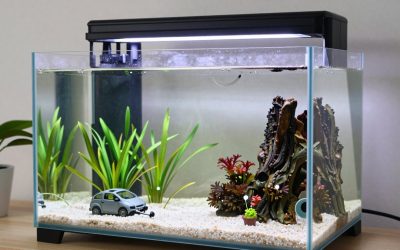
Typical compact footprints include approximately 16 by 8 inches for some 3.5-gallon kits and about 16.5 by 10 inches for many 5-gallon rectangular or portrait-style tanks. A 10-gallon aquarium is commonly close to 20 by 10 inches, while a standard 20-gallon long model may be about 30 by 12 inches. Actual dimensions vary, so use the manufacturer’s exterior measurements rather than nominal capacity.
Leave at least 2 to 3 inches behind the tank for hoses, filter removal, and airflow. Leave several inches above it if the lid, light, or filter needs to be lifted vertically. Measure the tank’s widest point, including trim, not just the glass panel.
For a small betta setup, a wider 5-gallon footprint can make heating, filtration, and decoration easier than a very narrow container. A 3.5-gallon all-in-one plastic kit priced around $70 may suit a limited space, but its smaller water volume gives you less margin for temperature and water-quality swings.
Material: Glass, Acrylic, and the Surface Beneath It
Glass is scratch-resistant, rigid, and generally stays clear, but it is heavy and can crack if a corner is struck or the tank is placed on an uneven surface. Glass tanks typically require firm, level support over the entire base or the specific support points stated by the manufacturer.
Acrylic is lighter and more impact-resistant than glass, which can be useful for portable or child-accessible setups. It scratches more easily, so use acrylic-safe cleaning tools. Acrylic tanks may also flex slightly; follow the maker’s instructions for support and lid use.
The surface under the tank matters as much as the tank material. Some rimless aquariums require a leveling or cushioning mat, while framed aquariums may be designed to sit directly on a stand. Do not automatically add a foam pad beneath every model: compressible material can create an unstable support pattern if the tank was not designed for it.
When a mat is approved, a product such as a 30-by-15-inch, 0.2-inch neoprene aquarium mat can be trimmed to fit. Check that the mat is at least as large as the tank base, remains flat, and is not folded or bunched. A mat helps accommodate minor surface variation; it does not correct a warped or weak cabinet.
Construction: Inspect Seams, Trim, Lids, and Access
Look for even silicone seams, square corners, smooth edges, and a frame or base that sits flat. On a rimless tank, inspect the glass thickness and manufacturer’s support requirements. On a framed tank, make sure the bottom frame is not cracked, twisted, or separated.
The footprint should include functional access, not just the glass box. A rear-mounted filter may add 3 to 6 inches to the required depth. A canister filter may need space beside or below the aquarium. Hinged lids and LED fixtures can add 2 to 6 inches above the tank when opened.
Built-in filtration can save counter space, but it may reduce interior swimming area. A 5-gallon Marineland Portrait kit, for example, uses a tall footprint with hidden filtration and LED lighting and is listed around $100. That clean profile can work well in a narrow room, but compare its actual interior dimensions and access openings with a wider standard tank before buying.
Comfort and Performance: Prioritize Stable Water and Easy Maintenance
A larger footprint does not automatically make an aquarium healthier, but a wider water surface can improve gas exchange and provide more room for a filter outlet to circulate water. Horizontal floor area also gives fish more usable territory and makes it easier to create open swimming lanes.
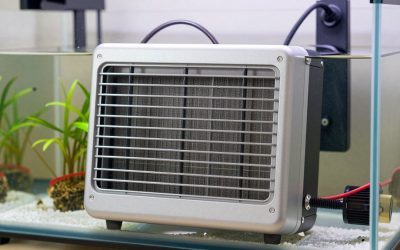
For small tanks, look for a filter rated for at least the aquarium’s stated capacity, with adjustable flow if the fish prefer gentle movement. A heater may need roughly 3 to 5 watts per gallon in a typical indoor room, though room temperature, tank lid, and local climate affect the correct choice. Never choose a heater solely by wattage; use the heater maker’s tank-size range and include a thermometer.
Lighting is commonly listed in watts, but LED brightness and spectrum vary widely. For a basic fish-only tank, an integrated 5- to 15-watt LED may be adequate. A planted aquarium may need a brighter, plant-specific fixture and a timer. Keep about 1 to 2 inches of clearance around ventilation openings and avoid placing the aquarium in direct sunlight, which can encourage algae and cause temperature swings.
Choose décor that preserves swimming space. Small rounded stones can be inexpensive—300-piece glow-in-the-dark aquarium pebble sets may cost about $5—but verify that decorations are aquarium-safe, smooth, and free of coatings that can flake. Avoid packing a compact footprint with rocks until fish still have an unobstructed route through the tank.
Price Tiers: Compare the Complete Setup
Budget, $40 to $90: Expect small plastic or basic glass kits, simple lights, and entry-level filtration. A tank may be included, but a heater, thermometer, water conditioner, substrate, and test kit can add $30 to $80. Budget kits are attractive for tight spaces, yet replacement filters and limited access can affect long-term cost.
Midrange, $90 to $200: This tier commonly includes 5- to 20-gallon glass aquariums, better LED fixtures, quieter filters, and more finished trim. A 5-gallon integrated glass kit around $100 fits this category. Confirm whether the price includes a heater and whether replacement cartridges are readily available.
Premium, $200 to $500 or more: Larger rimless tanks, low-iron glass, reinforced cabinets, advanced lighting, and canister filtration can push the total higher. The aquarium itself may be only part of the cost; a dedicated stand can add $100 to $400 or more.
Budget at least 10% to 20% of the tank and equipment cost for substrate, plants, water treatment, test supplies, and replacement parts. A cheap tank with expensive proprietary filters may cost more over several years than a slightly pricier model using standard media.
Warranty: Protect the Glass and the Equipment
Check whether the warranty covers the aquarium, silicone seams, frame, filter, heater, and light separately. Tank warranties commonly range from 90 days to several years, while electrical components may have shorter or different coverage.
Read exclusions for improper support, moving a filled tank, modifications, accidental impact, and water damage. Photograph the box, tank, seams, and serial label when it arrives. Keep the receipt and packaging until the aquarium has been filled and inspected.
A warranty does not replace a careful leak test. Before adding substrate or livestock, place the tank on its final support, fill it with water, and monitor it for at least 24 hours if the manufacturer permits this procedure. Never move a filled aquarium.
Delivery and Assembly: Plan for Weight and Access
Measure doorways, stairwells, elevators, and the route from delivery point to the stand. A 20-gallon glass aquarium can weigh roughly 50 to 70 pounds empty and more than 200 pounds filled. Larger tanks should be carried by at least two adults using the manufacturer’s recommended technique.
Inspect the carton before signing for delivery. Photograph crushed corners or punctures, then inspect the glass immediately for chips, cracks, and separated seams. Do not assemble a stand on an uneven floor. Use a level in both directions, and correct the furniture or floor before placing the tank.
Allow time for setup. Rinsing substrate, installing equipment, filling slowly, and arranging décor can take one to three hours for a small kit. Cycling the aquarium before adding fish takes considerably longer. A footprint that is easy to reach from three sides will make water changes and filter cleaning less frustrating.
Spec Checklist
| Spec | Budget | Mid | Premium |
|---|---|---|---|
| Typical capacity | 3.5–5 gallons | 5–20 gallons | 20–75+ gallons |
| Common footprint | 16 × 8 to 20 × 10 in. | 16.5 × 10 to 30 × 12 in. | 24 × 12 to 48 × 18 in. |
| Likely empty weight | 5–12 lb. | 10–35 lb. | 35–100+ lb. |
| LED lighting | 5–10 watts | 8–20 watts | 15–60+ watts |
| Planning price | $40–$90 | $90–$200 | $200–$500+ |
| Rear clearance | 2–3 in. | 3–6 in. | 4–8 in. |
Red Flags
- The listed footprint excludes a rear filter, overflow box, lid hinge, or light mount.
- The tank has no clear support instructions or requires an overhanging stand.
- Silicone seams look uneven, cloudy, separated, or excessively thin.
- The stand is narrower than the tank or has a visibly bowed top.
- The heater lacks a stated tank-size range, temperature control, or safety instructions.
- The filter rating is based on a much larger tank but has no flow adjustment for a small aquarium.
- Decorations have sharp edges, loose paint, unknown coatings, or metallic parts.
- The seller provides no return policy for cracked glass or shipping damage.
- The aquarium is marketed as “small and easy” without explaining maintenance, cycling, or equipment replacement costs.
FAQ
Is a long or tall aquarium better?
For many fish, a longer aquarium is the better choice because it provides more horizontal swimming space and a larger bottom area. A tall aquarium can work when floor space is limited, but check that the fish can comfortably reach the surface and that the light, filter, and heater provide adequate coverage.
How much space should I leave around an aquarium?
Leave at least 2 to 3 inches behind a compact tank and 3 to 6 inches when the filter or hoses need more room. Allow enough height to remove the lid and equipment. Keep the aquarium away from direct sun, heat sources, and high-traffic areas where it could be bumped.
Do I need a leveling mat under my aquarium?
Only use one if the aquarium manufacturer recommends it. Rimless tanks often require a purpose-made mat, while some framed tanks are designed to sit directly on a stand. A mat can cushion minor irregularities, but it cannot make an uneven or undersized stand safe.
What is the safest way to choose a footprint for a small tank?
Measure the complete space, subtract clearance for equipment, confirm the stand’s load rating, and prioritize a stable rectangular footprint over an unusually tall shape. Then add the weight of water, glass, substrate, décor, and equipment before deciding whether the furniture and floor can support it.
Ready to decide? Our #1 pick for 2026 is the Typical capacity.
Live price & availability on Amazon.
Related Reviews & Guides
Best Upgrades for an All in One Saltwater Tank: Top Proven
Best Aquarium For Small Apartment: Best Well-Researched Guide