Last Updated: October 4, 2026
- Top Pick: AQQA Aquarium Air Pump, 3W Powerful Dual Outlet Adjustable Oxygen Aerator
- Best Value: Uniclife 64 GPH Aquarium Air Pump with Dual Outlets Adjustable Quiet Fish Tank Air Pump with Air Stone Airline Tubing Check Valve and Connector Accessories for 10-100 Gallon Fish Tank
- Premium Choice: Tetra Whisper Air Pump for Aquariums Up to 60 Gallons, Non-UL
The Short Answer
For most 55-gallon aquariums, choose an adjustable air pump rated for at least 60 gallons, with roughly 2–4 liters per minute (L/min) of total airflow and two outlets. A 3–8 watt pump is usually sufficient for one or two air stones, a sponge filter, or gentle surface agitation. If the tank is heavily stocked, tall, densely planted, or located deep below the pump, consider an adjustable 6–12 watt model with approximately 4–8 L/min of total output.
The right answer to “what size air pump for 55 gallon tank” depends on what the pump will operate. An air stone needs less airflow than multiple sponge filters, a protein skimmer, or several ornaments. Buy an adjustable pump rather than choosing the largest available model: excessive bubbling can stress fish, disturb plants, and create unnecessary noise.
As an Amazon Associate we earn from qualifying purchases at no extra cost to you.

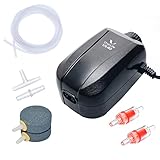
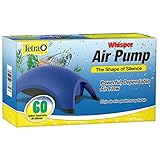

For a typical freshwater community aquarium, a dual-outlet pump with independent or overall airflow control is the most flexible choice. Example products in this category include the 3-watt AQQA dual-outlet pump, the Uniclife 64 GPH dual-outlet pump rated for 10–100 gallon tanks, and the Tetra Whisper model rated for aquariums up to 60 gallons. Listed prices for comparable pumps commonly range from about $15 to $35. The 4-watt version of the adjustable hygger pump is another reasonable size for moderate aeration; higher-wattage versions are better suited to deeper or more demanding setups.
Standard Sizes
Air pumps are generally sized by recommended aquarium capacity, airflow, outlet count, and the depth at which they must push air. Wattage alone is not a reliable size rating. A low-wattage pump can be perfectly adequate if it produces enough airflow, while a high-wattage unit may be unnecessarily forceful.
| Tank or pump category | Typical aquarium dimensions | Recommended total airflow | Typical pump size | Best use |
|---|---|---|---|---|
| 10 gallons | 20 x 10 x 12 in (50.8 x 25.4 x 30.5 cm) |
0.5–1.5 L/min | 1–3 W; one outlet | One small air stone or sponge filter |
| 20 gallons | 24 x 12 x 16 in (61.0 x 30.5 x 40.6 cm) |
1–2 L/min | 2–4 W; one or two outlets | Light to moderate aeration |
| 29 gallons | 30 x 12 x 18 in (76.2 x 30.5 x 45.7 cm) |
1.5–3 L/min | 3–5 W; one or two outlets | Community tank or sponge filter |
| 55 gallons | 48.25 x 12.75 x 21 in (122.6 x 32.4 x 53.3 cm) |
2–4 L/min | 3–8 W; two outlets | Typical community aquarium |
| 55 gallons, demanding setup | 48.25 x 12.75 x 21 in (122.6 x 32.4 x 53.3 cm) |
4–8 L/min | 6–12 W; two or more outlets | Multiple filters, heavy stocking, or deep water |
| 75 gallons | 48.5 x 18.5 x 21.1 in (123.2 x 47.0 x 53.6 cm) |
3–6 L/min | 5–12 W; two or more outlets | Large aquarium with several air devices |
These are practical starting ranges, not mandatory specifications. Aquarium shape, water depth, tubing length, air-stone resistance, and the pump’s published airflow rating all affect performance. A 55-gallon tank that is 21 inches tall creates more back pressure than a shallow tank holding the same volume.
How to Measure Your Space
- Measure the aquarium’s actual water depth. Measure from the location of the air stone or sponge-filter intake to the water surface. Do not use the tank’s outside height alone. A filled 55-gallon aquarium commonly has about 18–20 inches of water depth.
- Count every air-powered device. List air stones, sponge filters, bubble walls, breeding boxes, and ornaments. One pump may need to supply all of them at the same time.
- Measure the tubing route. Include the distance from the pump to the tank and the vertical drop into the water. A longer line—particularly one over 6 feet—can reduce delivered airflow.
- Check the outlet requirement. Select one outlet for one device and two outlets for two separate devices. A splitter can add outlets, but it does not increase the pump’s total airflow.
- Compare the manufacturer’s rating. Look for a gallons-per-hour or liters-per-minute figure, plus a maximum operating depth. Prefer a model rated for at least 60 gallons when using it on a standard 55-gallon aquarium.
- Leave adjustment room. A pump with a control dial lets you reduce bubbling if the water surface becomes turbulent. For a demanding setup, choose a model with extra capacity and turn it down rather than running a small pump at its limit.
By Room or Use Case
Living Room Community Aquarium
A 3–5 watt dual-outlet pump producing about 2–4 L/min is a sensible choice for a normally stocked 55-gallon community tank. Use one outlet for a medium air stone and the second for a small sponge filter, or split the airflow between two stones. Place the pump on a stable surface above the waterline when possible, and use a check valve to prevent back-siphoning during a power outage.
Bedroom or Quiet Office
Choose an adjustable, low-vibration pump rather than simply buying the highest-output model. A 3–4 watt unit can work well when the aquarium already has a powered filter that moves the surface. Run the air stone gently; vigorous bubbling does not automatically mean better oxygenation. A soft silicone pad beneath the pump can help reduce vibration transferred to furniture.
Heavily Stocked or Warm-Water Tank
Warm water holds less dissolved oxygen, and a heavily stocked aquarium consumes oxygen more quickly. In this situation, use a 6–12 watt adjustable pump rated around 4–8 L/min, preferably with two independently controlled outlets. Keep the surface visibly moving without creating a strong current that prevents fish from resting.
Multiple Sponge Filters or Breeding Setup
Each sponge filter has its own airflow requirement. For two medium sponge filters, start with a dual-outlet pump in the 3–8 watt range and adjust each line separately. Fry and slow-swimming fish usually benefit from gentle, steady flow, so an oversized pump should be throttled down with a control valve rather than forcing bubbles through the filters.
Hydroponics, Quarantine, or Emergency Aeration
For a quarantine tank or temporary holding container, select a pump based on the container’s actual volume rather than the full 55-gallon rating. A 1–3 watt pump may be enough for a small hospital tank. For hydroponic reservoirs or emergency oxygenation, a dual-outlet 4–8 watt pump provides useful flexibility, but verify that all air stones and tubing are compatible with the pump’s pressure.
Common Sizing Mistakes
- Buying by wattage alone: Wattage indicates electrical consumption, not guaranteed airflow. Compare L/min, GPH, outlet count, and maximum depth.
- Choosing a 10-gallon pump for a 55-gallon tank: Small pumps may move bubbles but fail to provide enough airflow through a deep tank or multiple devices.
- Assuming a splitter creates more power: A splitter divides existing airflow. It cannot turn a one-outlet pump into a higher-capacity system.
- Ignoring water depth: Air stones become harder to drive as they go deeper. Fine-pore stones generally require more pressure than coarse bubblers.
- Over-aerating the aquarium: Excessive flow can stress fish, uproot plants, and splash water. Start low and increase output gradually.
- Skipping the check valve: Without a check valve, water can travel backward through the airline if the pump stops.
- Forgetting the existing filter: A hang-on-back, canister return, or spray bar already creates surface movement. The air pump may only need to supplement oxygenation or run a sponge filter.
FAQ
Is a 3-watt air pump enough for a 55-gallon tank?
It can be enough for light aeration if it is rated for at least 55–60 gallons and produces approximately 2–4 L/min. It is most suitable for one air stone or a lightly loaded sponge filter. For several devices, deep water, or heavy stocking, choose a larger adjustable pump.
Should a 55-gallon tank use one or two air outlets?
Two outlets are usually more practical. They allow you to run two air stones, operate a pair of sponge filters, or balance airflow across a long 48-inch aquarium. One outlet is adequate if a single air stone is all you need.
Can an air pump be too powerful for a 55-gallon aquarium?
Yes. Excessive bubbling can create strong currents, disturb fish, and cause salt or water spray around the tank. A larger adjustable pump is acceptable, but reduce its output with the built-in control or separate valves. If the pump has no adjustment, select a closer match.
Where should I place the air pump?
Place it on a dry, level surface above the aquarium’s waterline when practical. If it must sit below the waterline, install a check valve in the airline. Keep the pump ventilated, avoid enclosed cabinets unless they have airflow, and leave enough tubing to make gentle bends rather than sharp kinks.
Ready to decide? Our #1 pick for 2026 is the 10 gallons.
Live price & availability on Amazon.
Related Reviews & Guides

Quick Picks: Best Aquarium Substrates for Planted Tanks
11 Best Aquarium Plants for Beginners: Top Picks for a Thriving Tank