Last Updated: October 4, 2026
Fine bubbles look impressive, but they demand more from your pump and do not by themselves prove better oxygenation. The best aquarium air stone for fine bubbles is a diffuser matched to a pump with enough pressure, because smaller pores raise resistance, deeper placement adds backpressure, and gas exchange still depends on surface agitation, not bubble size alone.
As an Amazon Associate we earn from qualifying purchases.
By David Nguyen
Quick answer: For most people in 2026, the best aquarium air stone for fine bubbles is the Ziss Adjustable Air Stone — our #1 rated choice. See the full ranked comparison, alternatives and buying advice below.
How to Choose a Fine-Bubble Air Stone
Choosing well means recognizing that fine bubbles need enough pressure, that depth adds backpressure, that clogging changes the bubbles, and that oxygenation ultimately depends on surface agitation. These four points matter because a fine diffuser starved of pressure disappoints, and bubble appearance is not a measurement of dissolved oxygen.
Fine Bubbles Need Enough Pressure
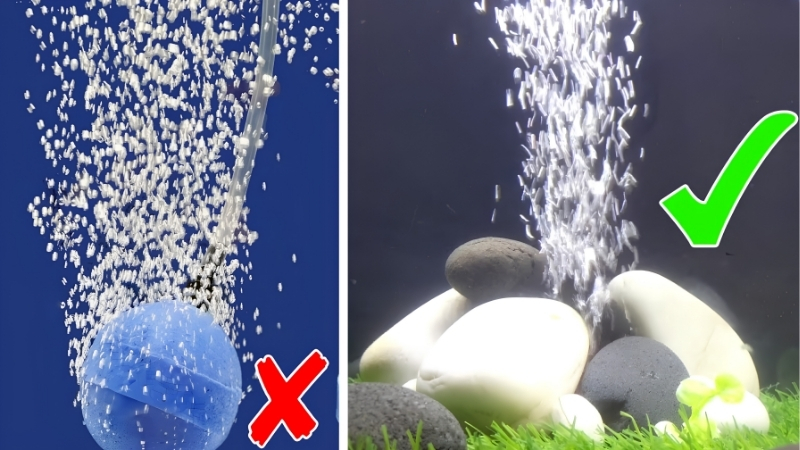
Smaller pores produce finer bubbles but also resist airflow more, so a fine diffuser needs a pump with enough pressure to drive it. This is why bubble size is not independent of pump pressure, and an underpowered pump will produce weak output or none through a restrictive stone.
Manufacturers reflect this with minimum pump requirements, such as the hygger HG291 needing more than 3 to 7 watts by length, the HG049 recommending over 2 watts, and the ceramic disc wanting at least 2 watts at around 1 liter per minute. Match the pump to the diffuser rather than assuming any pump drives any stone.
Depth Increases Backpressure
Placing a diffuser deeper adds the pressure of the water column on top of the pore resistance, so the same stone is harder to drive near the substrate of a tall tank. Delivered airflow falls as this backpressure rises, which can turn a lively fine mist into a trickle at depth.
So account for placement when sizing the pump, giving yourself pressure headroom for deep installations. A diffuser that mists nicely near the surface may need a stronger pump to perform at the bottom, which is another reason to choose the stone and pump together rather than separately.
Clogging Changes the Bubbles
Fine pores clog over time with mineral deposits and biofilm, which changes the bubble pattern and raises resistance further. This is why maintainability matters, so diffusers like the Ziss, which disassembles with replaceable pads, and the HG049, which wipes clean, are easier to keep performing.
Ceramic discs often suggest monthly cleaning, and cotton or felt elements benefit from periodic soaking and purging. So factor cleaning into your choice, since a diffuser you can service keeps producing fine bubbles, while a sealed one that clogs may need replacing rather than reviving.
Oxygenation Depends on Surface Agitation
The most important reality is that fine bubbles do not guarantee more dissolved oxygen, because oxygenation happens mainly through surface agitation and circulation, not bubbles dissolving as they rise. So tiny bubbles do not automatically double the oxygen, and more restriction does not automatically improve it.
What fine bubbles do well is create gentle, even circulation and a pleasing look, which supports gas exchange at the surface. So value them for circulation and aesthetics, and judge oxygenation by surface movement and the tank’s overall conditions rather than assuming finer is always better for dissolved oxygen.
Top Picks
Four diffusers cover adjustable stones, a mist wall, a hidden nano diffuser, and a conventional ceramic disc, with the overall pick going to the most tunable and serviceable. Prices are relative and current as of 09/2026, and because no common micron bubble-size dataset exists, do not rank one as a set percentage finer than another.
| Model | Best For | Type / Pump | Watch Out For |
|---|---|---|---|
| Ziss Adjustable Air Stone | Best overall adjustable fine bubbles | Felt-pad compression; disassembles | Pump requirement not published |
| hygger HG291 Fine Mist Strip | Fine-mist bubble wall | Micro-pressure cotton; >3-7 W by size | Match watts to strip length |
| hygger HG049 Invisible Nano | Hidden nano diffuser | EVA double-ring; >2 W recommended | Adjustable compression to tune |
| hygger 2-in Ceramic Disc | Conventional fine disc | Ceramic; >=2 W; ~1 L/min | Suggest monthly cleaning |
Ziss Adjustable Air Stone – Best Overall Adjustable Fine Bubbles
The Ziss Adjustable Air Stone is the overall pick, using felt-pad compression to control bubble size, disassembling for cleaning with replaceable pads and three spares included, at $2.99 as of 09/2026. Its adjustability and serviceability make it easy to dial in and keep performing.
Its pump requirement is not numerically published, so pair it with a capable adjustable pump and tune from there. The combination of low cost, adjustable bubble size, and replaceable pads earns the overall label, since it lets you fine-tune the mist and clean it rather than replacing a clogged sealed stone.
hygger HG291 Fine Mist Strip – Fine-Mist Bubble Wall
The hygger HG291 is a fine-mist bubble wall using micro-pressure cotton to produce a dense mist along its length, for under $20 to under $40 across sizes as of 09/2026, with tubing and a check valve included. It suits keepers who want a long curtain of fine bubbles.
Its minimum pump requirement scales with length, from over 3 watts for the 9.8-inch up to over 7 watts for the 31.5-inch, so match the watts to the exact size rather than reusing the smallest figure. Soak and purge it as directed to keep the mist even across the full strip.
hygger HG049 Invisible Nano – Hidden Nano Diffuser
The hygger HG049 is a discreet nano diffuser, an EVA double-ring design with adjustable compression that tucks out of sight, for under $20 to under $30 as of 09/2026, with a recommended pump of more than 2 watts. It suits small tanks where you want fine bubbles without visible hardware.
Its adjustable compression lets you tune the bubble size, and it disassembles to wipe clean, which helps with the clogging fine pores are prone to. Choose it for a tidy nano look with serviceable fine bubbles, pairing it with a modest but adequate pump.
hygger 2-in Ceramic Disc – Conventional Fine Disc
The hygger 2-inch ceramic disc is the conventional fine-disc option, running on a 4-millimeter tube at 2 watts or more and around 1 liter per minute, from under $20 as of 09/2026. Ceramic discs are a classic way to produce a broad patch of fine bubbles.
It suggests monthly cleaning, since ceramic pores clog with deposits and biofilm over time, so build that into your routine. It is a straightforward choice for a familiar fine-bubble disc, provided you drive it with at least the recommended pump and keep it clean for consistent output.
Frequently Asked Questions
Fine-bubble questions focus on whether smaller bubbles mean more oxygen, clogging, needing a stronger pump, and cleaning. Each answer leads with the direct call, then the mechanism that changes it for your particular diffuser, pump, and tank depth.
Do Smaller Bubbles Add More Oxygen?
Not automatically, because oxygenation happens mainly through surface agitation and circulation, not bubbles dissolving as they rise. So tiny bubbles do not guarantee twice the oxygen, and finer is not simply better for dissolved oxygen, even though a fine mist looks like it should be.
What fine bubbles do well is create gentle, even circulation and an appealing look, which supports gas exchange at the surface. So value them for circulation and aesthetics, and judge oxygen by surface movement and overall conditions rather than assuming a finer bubble stream means a higher dissolved-oxygen level.
Why Does My Air Stone Clog?
Fine pores accumulate mineral deposits and biofilm over time, which is normal, so clogging changes the bubble pattern and raises airflow resistance. A partially clogged stone produces weaker, uneven bubbles and demands more pressure, which is why regular cleaning keeps it performing.
Serviceable designs help here, since the Ziss disassembles with replaceable pads and the HG049 wipes clean, while ceramic discs suggest monthly cleaning. So expect some clogging and choose a diffuser you can maintain, cleaning or replacing the element before the bubbles degrade too far.
Do I Need a Stronger Pump for Fine Bubbles?
Often yes, because smaller pores resist airflow more, so a fine diffuser needs adequate pump pressure to drive it. Bubble size is not independent of pump pressure, and an underpowered pump produces weak output or none through a restrictive stone, especially at depth where backpressure adds up.
So check the diffuser’s minimum pump requirement and give yourself headroom for deep placement, as with the HG291’s watt figures that scale by length. Match the pump to the diffuser and its depth rather than assuming a small pump can push a fine stone at the bottom of a tall tank.
How Do I Clean an Air Stone?
It depends on the type, so follow the diffuser’s method: soak and purge cotton or felt elements, wipe down designs like the HG049, and clean ceramic discs on roughly a monthly schedule. Regular cleaning removes the deposits and biofilm that clog fine pores and weaken the bubbles.
Serviceable stones like the Ziss make this easiest, since they disassemble and take replaceable pads. So build cleaning into your routine, replace worn elements when soaking no longer restores flow, and treat maintenance as part of keeping fine bubbles consistent rather than a sign the stone has failed.
Final Thoughts
The best aquarium air stone for fine bubbles is a diffuser matched to a pump with enough pressure, which is why the tunable, serviceable Ziss leads while the hygger HG291 mist wall, HG049 nano diffuser, and ceramic disc suit specific looks. Match the pump to the diffuser and its depth, expect fine pores to clog and plan to clean them, and remember bubble size is not a measure of dissolved oxygen, which depends on surface agitation.
As an Amazon Associate we earn from qualifying purchases at no extra cost to you. Prices and availability are accurate as of the date shown and are subject to change.
Ready to decide? Our #1 pick for 2026 is the Ziss Adjustable Air Stone.
Live price & availability on Amazon.
Related Reviews & Guides


Best Pond Pump Maintenance Kit: Well-Researched Top Picks

Freshwater Aquarium Light Buying Guide: What to Check First