Last Updated: October 4, 2026
Quick answer: Our top pick in 2026 is the Angle the existing filter outlet upward — our #1 rated choice. See the full ranked comparison, alternatives and buying advice below.
The Short Answer
Do you need an air pump aquarium setup? Usually, no—provided your filter already creates steady surface movement and your tank is not overcrowded. An air pump is helpful, but it is not automatically required for every aquarium.
Fish get oxygen from water that exchanges gases at the surface. A filter that ripples the surface, a spray bar aimed slightly upward, or a properly sized hang-on-back filter may provide all the circulation your fish need. An air pump becomes more valuable when the surface is unusually still, the aquarium is heavily stocked, the water is warm, or you want to run equipment such as a sponge filter or air-powered ornament.
As an Amazon Associate we earn from qualifying purchases at no extra cost to you.

The practical answer for 2026 is to judge the tank rather than buy an air pump by default. Look for sluggish fish, rapid gill movement, fish gathering near the surface, or a tank with little visible surface movement. Those signs can indicate an oxygen or water-quality problem, although testing ammonia, nitrite, temperature, and other conditions should come first.
What You Actually Get
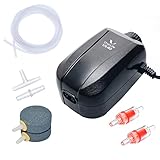
An aquarium air pump sits outside the tank and pushes air through flexible airline tubing. The tubing typically connects to an air stone, sponge filter, or bubbler. An air stone breaks the air into smaller bubbles, but the bubbles themselves are not the main source of oxygen. Their movement helps circulate water and disturb the surface, where oxygen enters the aquarium.
A basic kit commonly includes the pump, one or two airline outlets, tubing, an air stone or stones, connectors, and check valves. A check valve is an important small accessory: it helps prevent water from flowing backward into the pump if the power fails or the pump is positioned below the aquarium. Install it with the airflow arrow pointing toward the tank.
Most compact aquarium pumps are small enough to fit behind a tank or in a cabinet. As a general buying range, expect roughly 4 to 6 inches in length, 2 to 4 inches in width, and about 1 to 2 pounds, depending on the number of outlets and housing design. Many small models use approximately 1 to 4 watts, so their electricity cost is modest. Check the product label for the exact wattage rather than assuming every pump is equally efficient.
Two common budget examples illustrate the category. The Pawfly Aquarium Air Pump is listed for about $10 and is intended for 10- to 60-gallon tanks. It includes dual outlets, adjustable airflow, tubing, air stones, connectors, and check valves. The Uniclife 64 GPH model is listed for about $15, includes dual outlets and similar accessories, and is marketed for 10- to 100-gallon tanks. Those gallon ratings are useful starting points, not guarantees that either pump will fully aerate every heavily stocked aquarium.
Airflow also depends on water depth, tubing length, clogged air stones, and the device attached to the tubing. A pump can sound powerful while delivering less air through a restrictive sponge filter. Adjustable output is useful because excessive bubbling can create splashing, stress some fish, or cause water loss from evaporation.
Pros
- Improves surface agitation. Rising bubbles move water and can help prevent a stagnant surface, especially in aquariums with weak filtration.
- Provides backup aeration. During a filter failure or hot-weather period, a battery-powered or spare air pump can keep water moving while you address the main problem.
- Runs sponge filters. Air-driven sponge filters are gentle, inexpensive, and useful in quarantine tanks, fry tanks, shrimp tanks, and aquariums where strong current is undesirable.
- Supports warm-water setups. Warmer water holds less dissolved oxygen than cooler water, so extra circulation can be useful in tropical tanks—particularly when stocking and filtration are already demanding.
- Helps with multiple accessories. Dual-outlet models can operate two air stones or a sponge filter and an air stone, provided the pump has enough output.
- Low operating cost. Small pumps generally consume only a few watts and can operate continuously without adding much to an electric bill.
- Affordable entry point. Basic kits commonly cost about $10 to $25, making aeration one of the less expensive aquarium upgrades.
Cons
- It adds noise. Even a quiet pump produces vibration and a low hum. Hard surfaces can amplify that sound, especially in a bedroom or office.
- It does not replace filtration. An air pump cannot remove ammonia, nitrite, waste, or suspended debris unless it powers a filter designed to do so.
- Too much flow can stress fish. Bettas, fry, long-finned fish, and other weak swimmers may struggle in vigorous currents. Use an airflow control valve or a gentler air stone.
- It increases evaporation. More surface movement can accelerate water loss and may leave mineral deposits around the rim.
- Accessories wear out. Air stones can clog, tubing can harden, and check valves may need replacement. A weak bubble stream does not always mean the pump has failed.
- It can create salt creep and splashing. Marine aquariums and tanks filled close to the rim need extra attention to water movement and electrical safety.
- It consumes an outlet. The pump must be placed where a drip loop is possible, with the electrical connection higher than the tank and away from accidental splashes.
Who Should Buy It
Buy an air pump if your filter produces little or no visible surface ripple, your aquarium is heavily stocked, or you keep fish in a warm tank where oxygen demand is higher. It is also a sensible purchase for a sponge-filter setup, quarantine aquarium, breeding tank, hospital tank, or backup kit.
A pump is particularly useful if you experience frequent power interruptions. In that case, choose a battery-backup air pump or keep a battery-operated unit ready. A normal plug-in pump stops when the electricity goes out, so it is not a complete emergency solution by itself.
For a small community aquarium, a dual-outlet adjustable pump in the roughly $10 to $20 range is often enough to run a modest air stone or sponge filter. Confirm the manufacturer’s tank range, but prioritize adjustable output, check valves, replacement accessories, and a reputation for manageable vibration over a large gallon number printed on the box.
Who Should Skip It
Skip an air pump if your existing filter creates consistent, gentle surface movement, your stocking level is appropriate, and your fish show normal behavior. Adding equipment simply because bubbles look attractive is not necessary.
You may also skip it when your aquarium houses fish that prefer calm water and your filter already provides adequate gas exchange. Instead of adding an air stone, redirect the filter outlet slightly upward if you need more surface movement. If fish are gasping, test the water and check the temperature rather than relying on bubbles to conceal a maintenance or cycling problem.
Cheaper Alternatives
| Option | Cost | Trade-off |
|---|---|---|
| Angle the existing filter outlet upward | $0 | Free and often sufficient, but it may increase current or filter noise. |
| Use a small air stone with a basic single-outlet pump | About $8–$15 | Lower cost, but usually less flexibility and no second outlet. |
| Run a compact sponge filter | About $10–$25 for filter and pump | Gentle and useful for quarantine, but it provides less mechanical polishing than some powered filters. |
| Pawfly dual-outlet kit | About $10 | Includes useful accessories and adjustable airflow, but budget pumps may transmit noticeable vibration. |
| Uniclife 64 GPH dual-outlet kit | About $15 | More airflow capacity and a broader stated tank range, but paying more does not guarantee a silent setup. |
| Battery-powered emergency air pump | About $10–$30 | Excellent during outages, but battery life and output are limited compared with a continuously powered unit. |
FAQ
Can an air pump replace an aquarium filter?
No. An air pump only moves air unless it is connected to an air-driven filter, such as a sponge filter. It does not remove fish waste or detoxify ammonia and nitrite on its own. If you use an air stone, you still need appropriate biological and mechanical filtration, regular water changes, and sensible stocking.
Do fish need bubbles to survive?
Fish do not need bubbles specifically. They need adequately oxygenated water, and bubbles are one way to create surface agitation. A filter outlet, spray bar, or circulation pump can accomplish the same basic gas-exchange function. If the surface is visibly moving and water-quality readings are healthy, a bubble stream may be optional.
Should an aquarium air pump run all the time?
Usually, yes, if it powers your primary sponge filter or if your aquarium benefits from continuous aeration. Running it intermittently can reduce filtration performance and allow oxygen levels to fluctuate. Use an adjustable valve to reduce output rather than repeatedly switching the pump on and off. Always follow the instructions for the specific pump and equipment.
Where should I place an air pump?
Place it on a stable surface above the aquarium’s water level when possible. If it must sit below the water level, use a correctly installed check valve to reduce backflow risk. Add a drip loop to the power cord, keep the pump dry, and place a rubber pad underneath to reduce vibration. Do not seal the pump inside an airtight cabinet, because it needs access to room air and may overheat in a cramped space.
Ready to decide? Our #1 pick for 2026 is the Angle the existing filter outlet upward.
Live price & availability on Amazon.
Related Reviews & Guides


6 Best Filter Pads For Aquarium 2026

How to Clean a Canister Aquarium Filter (2026): Step-by-Step