Last Updated: October 21, 2026
- Top Pick: Tetra No More Algae Tablets for Aquariums, 8 Count
- Best Value: MICROBE-LIFT Algaway 5.4 Algae Remover for Aquariums, Algaecide for Freshwater and Saltwater Tanks, Aquarium Algae Control and Fish Tank Cleaner, Safe for Fish and Plants, 8 Ounces (ALGAA08)
- Premium Choice: Seachem Flourish Excel 500 ml
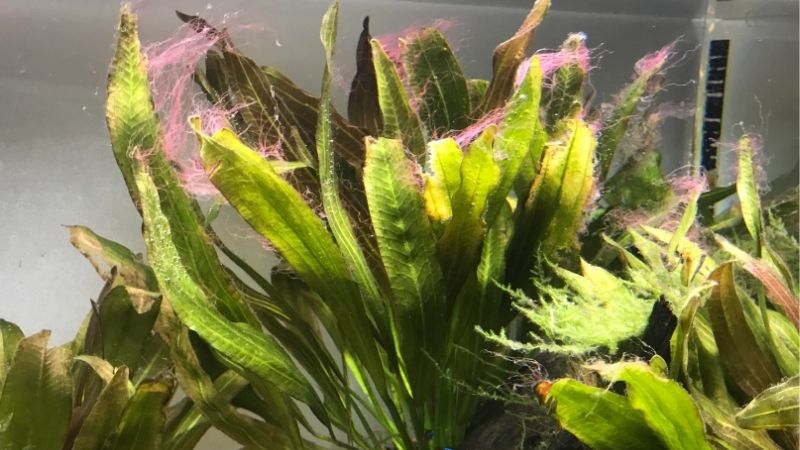
Staghorn algae aquarium outbreaks send a fairly specific message: there is ammonia in the water that should not be there, and the carbon supply is inconsistent. Those grey-green branching strands are a red algae relative, and they respond to stability in the tank rather than to any amount of scrubbing.
As an Amazon Associate we earn from qualifying purchases.
As an Amazon Associate we earn from qualifying purchases at no extra cost to you.


By David Nguyen
Grey Branching Strands and What They Signal
Staghorn is named for its shape: stiff strands branching like antlers, usually grey-green rather than bright green. A staghorn algae aquarium problem is almost always a young or recently disturbed tank, and the readings usually confirm it before you finish looking.
The Deciding Numbers: Ammonia, Carbon Stability and Flow
Test ammonia first, because trace ammonia is the association most consistently reported with this algae. Any reading above 0 ppm on a liquid kit matters, and it points at an incomplete cycle, a disturbed filter or a substrate that was recently dug through.
Carbon stability is the second factor. Inconsistent CO2 injection, a clogged diffuser or a cylinder running low all produce the fluctuation staghorn exploits, and in a low-tech tank the equivalent is light too strong for the carbon naturally available.
Flow is the third. A baseline turnover of 4-6 times tank volume per hour suits community stocking, and printed GPH drops 30-50% once media and hoses load. Staghorn establishes on filter intakes and leaf edges where flow is uneven rather than absent.
The Biology: A Red Algae in Disguise
Staghorn belongs to the same broad group as black beard algae, which is why the two behave similarly and respond to similar corrections. Both attach firmly, both resist grazers, and both appear when plants lose the carbon competition.
The identification trick follows from that relationship. Red algae pigments break down on contact with alcohol or hydrogen peroxide, so a strand removed from the tank and dipped in either turns red then white within minutes, which distinguishes it from green filamentous types.
Trace ammonia is thought to trigger the initial attachment, which explains why staghorn appears in new tanks, in tanks where filter media was replaced, and in tanks where a deep substrate clean released organics. Established, undisturbed tanks rarely produce it.
Where it grows follows the same logic. Leaf edges, filter intakes and the tips of slow-growing plants catch it first, because those are the surfaces water passes over constantly and where any brief chemical event reaches soonest.
Ranges Against Action Thresholds
The table pairs each pattern with what it indicates. Take an ammonia reading before consulting it, since that number separates the two most common causes.
| Pattern | Readings and inputs | What it indicates | First action |
|---|---|---|---|
| Appeared in a tank under 3 months | Ammonia or nitrite above 0 | Cycle incomplete | Finish the cycle, change 50% |
| Appeared after filter maintenance | Ammonia above 0.25 ppm | Nitrifying colony disrupted | Change water, leave media alone |
| On leaf edges in a CO2 tank | Drop checker not green, bubble count varies | Carbon fluctuating | Stabilise injection, check diffuser |
| On filter intakes and outflow | Turnover under 4x, media loaded | Uneven flow with organics | Clean media, restore flow |
| Appeared after a rescape | All readings normal now | Disturbance released ammonia and organics | Hold routine steady for a month |
What This Means in a Real Tank
A staghorn algae aquarium problem is a disturbance issue more than a nutrient one. Tanks that get it are usually new, recently rebuilt, or running equipment that has drifted, rather than tanks that are simply overfed.
Tank Size, Placement and Fit
Small tanks show trace ammonia sooner. A 10 gallon (38 L) tank can register 0.25 ppm from a single disturbance that a 55 gallon (208 L) tank absorbs entirely, so nano setups produce staghorn after events that larger tanks shrug off.
CO2 stability is harder in small volumes. A 5 gallon (19 L) tank swings concentration quickly when a diffuser partially clogs, while a larger tank buffers the same fault for days, which is why nano high-tech setups need closer monitoring.
Measure before you order: cabinet height for a CO2 cylinder plus regulator and the hose bend above it, diffuser position against tank depth, 4-6 in (10-15 cm) behind the tank for a hang-on-back filter, and stand capacity against roughly 10 lb/gallon (about 1 kg/L) filled.
How This Differs Across 10, 20 and 55 Gallon Tanks
Larger tanks take longer to circulate evenly. A long 55 gallon (208 L) tank often has strong flow at one end and very little at the other, and staghorn appears in that transition zone rather than in the completely stagnant corners where cyanobacteria goes.
Substrate disturbance scales with neglect. A deep clean of a 55 gallon tank that has not been vacuumed for months releases far more organics and ammonia at once than a weekly section-by-section routine in a 10 gallon tank ever will.
Filter capacity relative to bioload sets the baseline. Community tanks want 4-6 times turnover per hour, goldfish and cichlid tanks 8-10 times, and a filter running below that struggles to hold ammonia at zero when anything disturbs it.
Real water volume matters for the same reason. A 20 gallon (76 L) tank holds roughly 17-18 gallons (64-68 L) after substrate and hardscape, so a filter chosen against the printed figure is already sized about 12% generously and then loses flow from there.
How Plants, CO2 and Season Change the Picture
A high-tech staghorn algae aquarium gets it from injection faults rather than from injection itself. A drop checker sitting green at roughly 30 ppm dissolved CO2 through the whole photoperiod is the check that matters, and bubble count alone does not confirm it.
Low-tech tanks get it from light exceeding available carbon. A strong fixture over slow-growing plants with no injection gives more light than the plants can use, and staghorn takes the leaf edges while black beard takes the hardscape.
Winter contributes in a way people miss. Cooler water slows both plant growth and bacterial activity, so a tank running a few degrees below its usual range in January holds trace ammonia longer after any disturbance and gives staghorn a longer window to establish.
Common Mistakes and Myths to Retire
Three responses waste weeks in a staghorn algae aquarium. Each treats the strands as the problem rather than as evidence of an ammonia event or a carbon fault.
Myth: Algae Eaters Will Deal With It
Almost nothing eats established staghorn. Amano shrimp occasionally graze very young growth, and no fish clears it reliably, which puts it alongside black beard as one of the types where grazers are close to irrelevant.
Adding livestock during an outbreak also works against you. More fish means more bioload on a filter that has already shown it cannot hold ammonia at zero, which is the condition that produced the algae in the first place.
Siamese algae eaters get suggested for this as often as they do for black beard, with the same caveats. They are frequently misidentified in shops, they reach around 6 in (15 cm) and need a tank of 55 gallons (208 L) or more, and they eat staghorn inconsistently at best.
Myth: Cutting Nutrients Will Starve It
Staghorn is associated with ammonia traces and carbon instability rather than with nitrate surplus, so cutting fertiliser starves the plants without touching the driver. Tanks that reduce dosing during an outbreak commonly end up with weaker plants and the same algae.
The replacement approach: get ammonia to a stable 0 ppm, make carbon consistent, and keep plants growing. In a staghorn algae aquarium the plants are your main tool, and starving them removes it.
Myth: Scrub Everything and Restart
A teardown removes the biological filter, and an ammonia spike afterwards is exactly what staghorn responds to. Tanks stripped down during an outbreak frequently get a worse one four weeks later while cycling again.
Rinsing filter media under the tap belongs in the same category. Chlorine and chloramine kill nitrifying bacteria on contact, and the resulting trace ammonia is the trigger you were trying to remove.
Clearing and Preventing It Long Term
Clearing a staghorn algae aquarium takes two to four weeks once ammonia is stable at zero and carbon is consistent. Existing strands do not fall off, so mechanical removal or spot treatment runs alongside the correction rather than instead of it.
What to Do on a Schedule
Test ammonia weekly for the first three months and after any filter or substrate work. Keep changes at 20-30% weekly adjusted by measured nitrate, and vacuum a third of the substrate at a time rather than the whole bed.
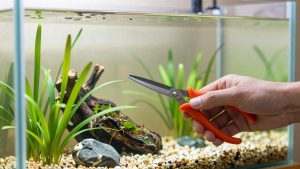
Trim affected leaves rather than trying to clean them, and remove hardscape for treatment outside the tank where a piece is badly covered. Spot treatment with a liquid carbon product works, and several plants including vallisneria react badly to it, so treat small areas at a time.
Keep everything else fixed while the correction runs. Changing light, dosing, flow and CO2 in the same week leaves you unable to tell what helped, and at a two to four week response time that ambiguity costs a month of guessing.
Gear That Degrades and How It Shows Up
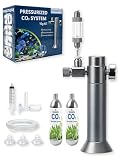
CO2 equipment drifts invisibly. Diffusers clog and reduce dissolved concentration with no change in bubble count, regulators can creep, and a cylinder near empty delivers inconsistent output through the last week of its life.
Filters lose 30-50% of rated flow as media loads and impellers wear, which reduces both circulation and the colony’s oxygen supply. A unit that lost prime after a power interruption can produce a trace ammonia reading within a day.
Test reagents expire and read low with age, which is the worst failure here because ammonia is the deciding number. Every powered device beside water belongs on a GFCI outlet with a drip loop and a UL or ETL mark.
LED fixtures lose PAR gradually across their life while still appearing bright to the eye. In a low-tech tank that slow decline weakens the plants competing for carbon, which is the same imbalance staghorn exploits from the other direction.
The Twelve-Month Running Cost
For a low-tech tank: dechlorinator, mechanical media, test reagents, fertiliser and continuous power. For an injected tank add CO2 refills, drop checker fluid and diffuser replacement, which together make carbon stability an ongoing commitment rather than a one-time purchase.
Equipment prices move constantly, so check at the time of purchase rather than relying on any figure quoted elsewhere. What matters more is the twelve-month cost of keeping a CO2 system consistent, since inconsistency is what grows this algae.
A liquid ammonia test kit is the cheapest item on the list and the most useful one here. Strips read in increments too coarse to catch the trace levels that matter, which makes them close to useless for the number this algae actually responds to.
Frequently Asked Questions
These five come up most often once the grey branching strands have been identified and the tank keeps producing more of them.
How do I confirm it is staghorn and not hair algae?
Remove a strand and dip it in alcohol or hydrogen peroxide outside the tank. Staghorn is a red algae and turns red then white within minutes, while green filamentous algae does not. The branching, stiff structure is the other clue.
How long does it take to clear?
Two to four weeks after ammonia is stable at 0 ppm and carbon is consistent. Existing strands need removing by hand or spot treating, since correcting conditions prevents new growth without clearing what has already attached.
Does staghorn harm fish or plants?
Not fish. It smothers leaf edges and blocks light on slow-growing plants, and the trace ammonia associated with it is the genuine concern rather than the algae. Test and address the reading rather than focusing on appearance.
Can I get it in a tank without CO2?
Yes. In low-tech tanks the equivalent trigger is light exceeding the carbon naturally available, usually after a light upgrade. Reducing intensity or photoperiod to match the plants addresses it as effectively as stabilising injection does in a high-tech setup.
Why did it appear after I cleaned the filter?
Because cleaning released organics and probably knocked back the nitrifying colony, producing exactly the trace ammonia staghorn responds to. Clean one part of the filter at a time, in tank water, on a rotation.
See More:
The Bottom Line on Staghorn Algae
A staghorn algae aquarium outbreak is telling you about ammonia and carbon rather than about cleanliness. Test ammonia and get it to a stable 0 ppm, make dissolved CO2 consistent through the whole photoperiod or reduce light to match a low-tech tank, and restore even flow at 4-6 times volume per hour. Remove strands by hand and spot treat hardscape outside the tank. Give it two to four weeks, and do not tear the setup down, because a fresh cycle produces exactly the trigger this algae wants.

Best Canister Filter for Planted Tank Setups: Flow and CO2
CrystalClear PondAir 2 Complete Aeration Kit vs Aquascape Pond Replacement Aeration Disc 4-inch: Which Should You Buy?