Last Updated: September 25, 2026
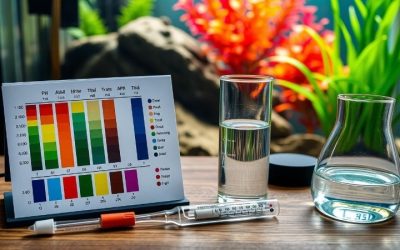
Shrimp tank water parameters split by species group rather than sitting on one universal range. Neocaridina want GH 6-12 dGH and TDS 150-250 ppm; Caridina bee shrimp want GH 4-6 dGH and TDS 100-150 ppm. The chart below carries both groups and Amano, plus the corrections to apply when a reading drifts out of range.
As an Amazon Associate we earn from qualifying purchases.
As an Amazon Associate we earn from qualifying purchases at no extra cost to you. Prices and availability are accurate as of the date shown and are subject to change.

The Neocaridina Shrimp Handbook: A complete guide to Cherry Shrimp
Selected for "Shrimp Tank Water Parameters: Chart, Numbers and Limits": this listing is aquarium equipment (The Neocaridina Shrimp Handbook: A complete guide to Cherry Shrimp), matching the equipment this article covers.
View on Amazon
AAwipes 8-in-1 Aquarium Test Kit for Fish Tanks - Quick & Accurate Water Testing Strips for Aquariums & Ponds. Tests pH, Ammonia, Alkalinity, Hardness, Chlorine, etc. (K02-50)
Selected for "Shrimp Tank Water Parameters: Chart, Numbers and Limits": this listing is tanks (AAwipes 8-in-1 Aquarium Test Kit for Fish Tanks - Quick & Accurate Wat), matching the equipment this article covers.
View on Amazon
Crystalpro Shrimp Minerals 4.2 Oz – Liquid Aquarium Salt & Trace Elements for Freshwater Shrimp Tanks – Supports Caridina & Neocaridina – Molting & Breeding Additive – Invertebrate Tank Conditioner
Selected for "Shrimp Tank Water Parameters: Chart, Numbers and Limits": this listing is tanks (Crystalpro Shrimp Minerals 4.2 Oz – Liquid Aquarium Salt & Trace Eleme), matching the equipment this article covers.
View on Amazon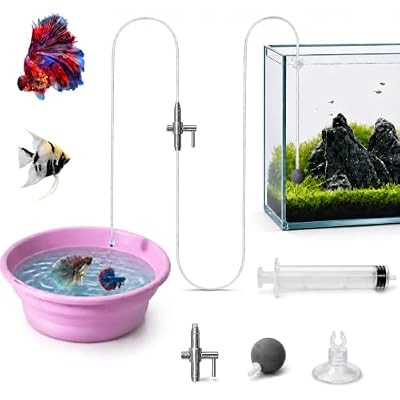
Drip Acclimation Kit for Shrimp and Fish, Slow Drip Aquarium
Selected for "Shrimp Tank Water Parameters: Chart, Numbers and Limits": this listing is aquarium equipment (Drip Acclimation Kit for Shrimp and Fish, Slow Drip Aquarium), matching the equipment this article covers.
View on AmazonBy David Nguyen
Two Species Groups, Two Sets of Numbers
This is a lookup rather than an explanation. The first table gives the shrimp tank water parameters by species group with action thresholds; the second gives the corrections to apply when a reading sits outside range. Both belong here rather than at the end.

The Decision Numbers: GH, TDS, Temperature and Copper
GH is the number that decides moult success, because the calcium and magnesium for each new exoskeleton come from the water rather than from food. TDS is the number that decides stability, since it moves first and fastest when anything drifts in a small tank.
| Parameter | Neocaridina | Caridina bee | Amano | Action threshold |
|---|---|---|---|---|
| GH | 6-12 dGH (107-215 ppm) | 4-6 dGH (72-107 ppm) | 6-10 dGH (107-179 ppm) | Under 4 dGH (72 ppm) |
| KH | 2-8 dKH (36-143 ppm) | 0-2 dKH (0-36 ppm) | 1-8 dKH (18-143 ppm) | KH 0 with drifting pH |
| pH | 6.5-7.8 | 5.8-6.8 | 6.5-7.5 | Daily swing over 0.3 |
| TDS | 150-250 ppm | 100-150 ppm | 150-250 ppm | Change over 20 ppm per day |
| Temperature | 70-74 °F (21-23 °C) | 68-74 °F (20-23 °C) | 68-78 °F (20-26 °C) | Above 80 °F (27 °C) |
| Ammonia | 0 ppm | 0 ppm | 0 ppm | Any detectable reading |
| Nitrite | 0 ppm | 0 ppm | 0 ppm | Any detectable reading |
| Nitrate | Under 20 ppm | Under 20 ppm | Under 20 ppm | Above 20 ppm |
| Copper | None detectable | None detectable | None detectable | Any suspected source |
Copper has no working range on that chart deliberately. It is lethal to invertebrates far below concentrations tolerated in drinking water, where the US EPA Lead and Copper Rule, first set in 1991, applies an action level of 1.3 mg/L for human supply.
The Rule Behind the Ranges
Two ideas generate every row. First, hardness is a mineral supply for the exoskeleton, so it has a floor below which moults fail and a ceiling above which the new shell hardens too fast. Both bounds are real rather than conventions.
Second, rate of change matters more than absolute value across most of the range. A colony held at 280 ppm TDS does better than one moved between 180 and 240 ppm weekly, which is why the action thresholds refer to daily movement rather than to a number.
Reading the Chart, Units and Margin of Error
Degrees of hardness and ppm both appear because kits differ; 1 dGH is roughly 17.9 ppm as calcium carbonate. TDS meters read total dissolved solids rather than hardness specifically, so a tank can show correct TDS while GH sits low if remineralisation is unbalanced.
| Situation | Effect | Adjustment |
|---|---|---|
| GH under 4 dGH (72 ppm) | Failed moults, white ring | Raise 1 dGH per day, not in one dose |
| TDS climbing week on week | Evaporation topped up with tap water | Top up with pure water only |
| TDS moves over 20 ppm in a change | Deaths one to two days later | Drip the new water in over an hour |
| KH 0 with active soil substrate | pH unstable, suits Caridina only | Move Neocaridina to inert substrate |
| Any detectable ammonia | Toxic well below the fish threshold | 10% change, stop feeding 48 hours |
| Nitrate above 20 ppm | Breeding slows before deaths occur | Cut feeding, raise change frequency |
| Temperature above 80 °F (27 °C) | Lower oxygen, shorter lifespan | Add surface agitation, shade the tank |
| Fertiliser or medication added | Possible copper exposure | Check the label before dosing, not after |
Work the second table after the first. The chart tells you where the reading should sit; the adjustments tell you how fast you are allowed to move it, and that speed limit is what most keepers get wrong rather than the target itself.
Adjusting for Your Actual Tank
A chart of shrimp tank water parameters describes species. Your tank has a specific volume, a specific substrate and a specific water source, and all three shift how the numbers behave week to week rather than what the targets are.
Adjusting for Species and Stocking
Neocaridina and Caridina are not compatible in one tank at the parameter level, since one wants KH 2-8 dKH and the other wants effectively zero. Keeping both means choosing a compromise that suppresses breeding in both groups rather than suiting either.
Amanos tolerate the Neocaridina range comfortably, which makes that the workable mixed tank. Bear in mind that amanos dominate feeding, so a cherry colony sharing the tank grows more slowly even though the water suits both species equally well.
Adjusting for Substrate and Plants
Active soil substrates strip KH and pull pH down, which is exactly what Caridina need and exactly wrong for Neocaridina. Inert sand or gravel leaves your source water chemistry intact, which is why substrate choice effectively decides which group the tank can hold.
Dense planting stabilises everything else. Moss and slow growers carry the biofilm shrimp graze continuously, and a well planted tank buffers nitrate between changes, which is why a heavily planted 10 gallon (38 L) holds parameters better than a sparse 20 gallon.
Tank Size, Placement and Fit
Measure the lid gap against every cable and airline entry before ordering, since a close-fitting lid is what slows evaporation, and evaporation is the main driver of TDS drift. Larger shrimp also climb tubing and leave through gaps of a centimetre.
Volume decides how fast the numbers move. A 5 gallon (19 L) tank holds roughly 4 gallons (15 L) of water and can drift 20 ppm TDS in a week in a heated room, while a 20 gallon (76 L) tank in the same room barely registers those conditions at all.
Where This Chart Stops Working
Any table of shrimp tank water parameters is a generalisation taken across many tanks. Three situations override it entirely, and recognising them early is worth considerably more than adding further decimal places to the ranges themselves.
When the Numbers Are Right and the Colony Still Fails
Correct readings with steady deaths almost always mean a contaminant that no standard kit detects. Copper from plumbing, residue from a treated second-hand tank, or a fertiliser dosed at the wrong rate are the three usual candidates in that order.
Test your tap water separately from the tank, and if the tank was bought used, assume it may have held a copper-based treatment at some point. Neither situation shows up on a GH, KH or TDS reading, which is why the chart cannot catch it.
Variables the Chart Cannot Hold
Source water composition varies between two tanks reading the same TDS, since TDS measures total solids rather than which minerals they are. Remineralised RO water at 200 ppm and hard tap water at 200 ppm are not equivalent for moulting.
Acclimation history matters too. Shrimp bought from a supplier running very different parameters need drip acclimation over one to two hours, and animals that arrive from soft water into hard water frequently die a week later rather than on arrival.
When to Stop Reading and Start Watching
Behaviour outruns the chart. Shrimp grazing constantly and moulting cleanly is a colony in range, while animals sitting still, clustered at the surface or repeatedly failing to shed indicate a problem the readings may not yet show clearly.
Breeding is the earliest signal of all. A colony that stops producing berried females has usually detected a drift weeks before nitrate, GH or TDS have moved far enough to look alarming, so treat that pause as a prompt to test rather than to wait.
Verifying and Re-Testing
Shrimp tank water parameters are only useful if they are checked on a schedule rather than after something has gone wrong. This section covers which tools are accurate enough, how often to repeat each test, and what drifts quietly across a year of uneventful maintenance.
Tools and How Accurate They Are
A TDS meter is the single most useful instrument here, since it reads in seconds and catches drift before anything else does. Calibrate it against a known solution twice a year, because an uncalibrated meter is worse than no meter at all.
Use liquid kits for GH, KH, ammonia, nitrite and nitrate. Test strips drift quickly once the container has been opened to humidity, and in a shrimp tank the difference between 0 and 0.25 ppm ammonia is a difference the strip cannot reliably show.
How Often to Re-Test
TDS and temperature weekly, at the water change, taken in both the tank and the replacement water. GH, KH and nitrate monthly. Ammonia and nitrite weekly for the first three months after setup, then monthly once the tank has proved stable.
Re-test everything after any change to the system: a new substrate, a different remineraliser batch, a filter swap or a move to a different room. Each of those resets the assumptions the previous readings were built on, sometimes by a surprising margin.
What Drifts Over Time
TDS climbs whenever evaporation is replaced with tap water instead of pure water, and that is the most common slow failure in this hobby. Remineraliser powder cakes in humid storage and then doses inconsistently by volume, which shifts GH without any obvious cause.
Season pushes in one direction. Heating in winter raises evaporation and concentrates the tank, while rooms above 80 °F (27 °C) in midsummer lower dissolved oxygen and shorten lifespans. Check the thermometer and the meter at both ends of the year.
Shrimp Tank Water Parameters: Questions
These follow from the chart rather than replacing it. Every answer about shrimp tank water parameters stays with a measurable figure, since impressions of water quality are unreliable at the concentrations that actually matter to invertebrates.
Do I need RO water?
Only when tap water sits outside the target range or carries copper from household plumbing. Where tap water reads GH 6-12 dGH (107-215 ppm) with no copper, use it. Caridina bee shrimp are the exception and almost always need remineralised RO.
What matters more, GH or TDS?
GH decides whether moults succeed; TDS decides whether the tank is stable. Use GH to set the target and TDS to monitor it, since TDS takes seconds to read and shows a drift developing long before a monthly GH test would ever catch it.
How fast can I change parameters?
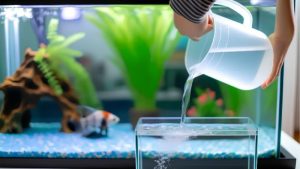
Slowly. Move GH by no more than 1 dGH per day and TDS by no more than 20 ppm, and drip new water in over an hour during larger changes. Animals mid-moult have almost no osmotic protection, which is why speed rather than direction causes losses.
Is pH worth adjusting directly?
No. pH follows KH, so adjusting it with an additive produces a rise that collapses within days and a swing that is worse than the original reading. Set KH correctly for the species group instead, and treat pH as an output you monitor rather than a number you set.
See More:
Conclusion
Working shrimp tank water parameters come down to four figures per group: GH 6-12 dGH with TDS 150-250 ppm for Neocaridina, GH 4-6 dGH with TDS 100-150 ppm for Caridina, ammonia and nitrite at 0 ppm, and no detectable copper in either case.
Set the target from the chart, then respect the speed limits in the second table, since rate of change causes more losses than a slightly wrong number ever does. Read TDS weekly, run liquid kits monthly, and treat a pause in breeding as the first warning.
Related Reviews & Guides
How Much Water to Change in Aquarium: Percentages That Work
6 Best Magnet Cleaners For Fish Tank 2026