Last Updated: October 21, 2026
- Top Pick: Tetra No More Algae Tablets for Aquariums, 8 Count
- Best Value: MICROBE-LIFT Algaway 5.4 Algae Remover for Aquariums, Algaecide for Freshwater and Saltwater Tanks, Aquarium Algae Control and Fish Tank Cleaner, Safe for Fish and Plants, 8 Ounces (ALGAA08)
- Premium Choice: EcoBio-Block Aquarium Water Clarifier (Small, 8–16 gal)
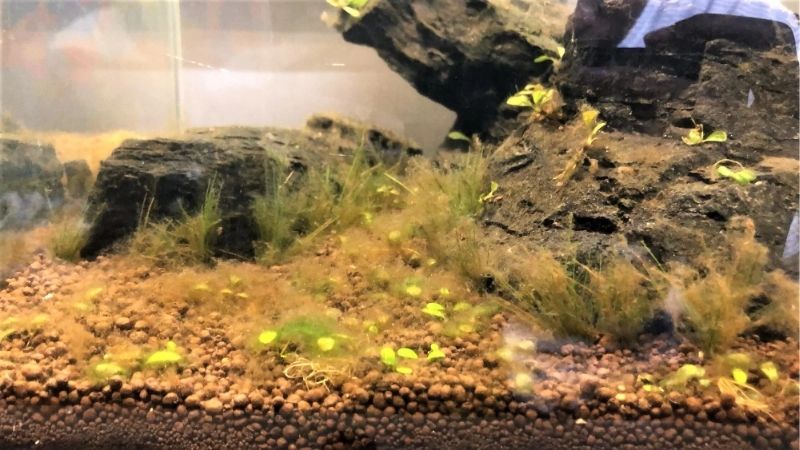
Brown algae in new aquarium tanks is diatoms, and it sits a great deal closer to a rite of passage than to an actual problem. That dusty brown coating across glass, substrate and leaves appears in most new tanks somewhere during the first three months, and it fades away on its own as the system matures.
As an Amazon Associate we earn from qualifying purchases.
As an Amazon Associate we earn from qualifying purchases at no extra cost to you.




By David Nguyen
Tank Age Decides Everything Here
Diatoms are single-celled algae with silica cell walls, which is why they behave differently from every other type. Brown algae in new aquarium setups is best understood as a maturation stage, and the number that decides your response is the tank’s age in weeks.
The Deciding Number Is Tank Age, Not the Test Kit
A brown dusty coating in a tank under three months old is normal and expected. It typically appears somewhere between week two and week eight, peaks over a fortnight, and fades on its own as the biological and chemical balance settles.
The same coating in a tank over six months old means something changed: new substrate, new hardscape, a filter disruption, or a switch in source water. That version needs investigating rather than waiting out, because an established tank does not usually produce it.
Test ammonia, nitrite, nitrate and temperature regardless. Ammonia above 0 ppm confirms the tank is still cycling, which frequently coincides with the diatom phase, and the cycle is the more urgent of the two situations by a wide margin.
The Biology: Why Silica and Immaturity Matter
Diatoms build their cell walls from silica, which enters a tank through tap water, new sand and some substrates. New silica-bearing materials release it steadily at first and much less later, which largely explains the timing of the phase.
They also exploit an empty field. A new tank has no established plant mass, no mature biofilm and no competing green algae, so diatoms colonise surfaces that will later be occupied by something else or by nothing at all.
The phase ends through competition rather than through anything running out completely. As plants establish and other organisms colonise the same surfaces, diatoms lose their advantage and retreat to the low-light areas where they persist harmlessly.
This is also why the coating never disappears entirely. Most mature tanks carry a light diatom presence in shaded corners and behind equipment, which is normal and requires nothing, and it only becomes visible again when conditions shift back in its favour.
Ranges Against Action Thresholds
The table separates the version to wait out from the versions worth investigating. Tank age is the first column for a reason, since it changes the meaning of everything after it.
| Situation | Readings and inputs | What it means | Action |
|---|---|---|---|
| Brown dust, tank 2-8 weeks old | Ammonia and nitrite above 0 | Normal, tank still cycling | Finish the cycle, wipe glass weekly |
| Brown dust, tank under 3 months | All four readings normal | Normal maturation phase | Wipe glass, wait it out |
| Brown dust in an established tank | New sand or hardscape added | Fresh silica source introduced | Expect several weeks, then it fades |
| Brown dust returning after months | Nitrate above 40 ppm, low light | Organic load with weak competition | Change 30%, review light and plants |
| Brown coating with plants melting | Light too low for the species | Plants losing, diatoms filling the gap | Match light to plant demand |
What This Means in a Real Tank
How long the phase lasts, and how heavy it looks, depends on what the tank is made of and what is growing in it. Brown algae in new aquarium setups is heavier in some builds than others for entirely predictable reasons.
Tank Size, Placement and Fit
Substrate choice is the strongest influence on how heavy brown algae in new aquarium tanks looks. New silica sand and some inert sands release silica for weeks, while established gravel or an aged soil substrate contributes far less, which is why identical tanks set up differently produce different levels of coating.
Volume affects concentration rather than presence. A 5 gallon (19 L) tank concentrates released silica and nutrients four times more than a 20 gallon (76 L) tank, so nano setups often look heavily coated while a larger tank of the same age shows only a light film.
Measure before you order: substrate depth against tank height and the volume of sand you actually need, fixture length against tank length, 4-6 in (10-15 cm) behind the tank for a hang-on-back filter, and stand capacity against roughly 10 lb/gallon (about 1 kg/L) filled.
How This Differs Across 10, 20 and 55 Gallon Tanks
Larger tanks take longer to mature and often run a longer diatom phase. A 55 gallon (208 L) tank builds bacterial and biofilm populations across far more surface area, so the transition out of the phase can take several weeks longer than in a 10 gallon (38 L) setup.
Plant mass shortens it in any volume. A tank planted heavily on day one moves through the phase faster than a bare one, because established plants occupy surfaces and consume nutrients before diatoms can make full use of them.
Stocking has little effect either way. Unlike hair algae or green water, the diatom phase is driven mainly by silica and by the absence of competition, so a lightly stocked tank goes through much the same window as a fully stocked one.
Flow spreads the coating rather than preventing it. A baseline turnover of 4-6 times tank volume per hour suits community stocking, and printed GPH drops 30-50% once media and hoses are loaded. Low-flow areas hold the heaviest film.
How Light, Plants and Source Water Change the Picture
Diatoms tolerate lower light than most green algae, which is why they dominate early and why they persist in shaded corners long afterwards. A tank running light too weak for the plants in it tends to keep them well past the normal window.
Source water contributes silica in some supply areas. Your water utility publishes an annual water quality report with figures for your supply, which is the place to check rather than assuming, and RO water sidesteps the question entirely at a cost.
August is when this arrives in volume. Back-to-college season fills dorm rooms and first apartments with nano tanks and 5-10 gallon kits, and those tanks reach weeks two to eight during the autumn term, which is exactly the diatom window.
Common Mistakes and Myths to Retire
Three responses to brown algae in new aquarium tanks turn a harmless phase into a real setback. Each treats the coating as an emergency when the correct response is a cloth and a calendar.
Myth: Brown Algae Means You Set the Tank Up Wrong
Almost every new tank goes through this, including carefully planned ones with good equipment. Brown algae in new aquarium tanks is a stage rather than a verdict, and its presence says nothing about whether the setup was done well.
The replacement expectation: plan for it. Wipe the glass at each weekly water change, leave the substrate and hardscape alone, and expect the phase to fade somewhere between week six and week twelve without any intervention at all.
Myth: Strip the Tank and Start Over
Replacing substrate and scrubbing everything removes the biological filter along with the coating, and the fresh substrate releases a new pulse of silica. The result is a tank that cycles again and produces the same brown film four weeks later.
Rinsing filter media under the tap belongs in the same category. Chlorine and chloramine kill nitrifying bacteria on contact, and the resulting ammonia reading is a nutrient source that extends the phase rather than ending it.
The same logic applies to replacing hardscape or substrate mid-phase. Every new inert material introduces a fresh silica source, so a tank rebuilt in week four restarts the clock and produces the coating again through week twelve.
Myth: Dose Something to Get Rid of It
Algaecides work poorly on diatoms and carry the usual costs: a die-off that consumes oxygen, and copper in many products which is lethal to shrimp and snails at very low concentrations. Silicate-removing resins exist and are aimed mainly at marine systems.
The replacement approach: mechanical removal and time. Wiping glass takes a minute and removes the visible portion, and the underlying phase ends on its own schedule regardless of what goes into the water.
Getting Through the Phase
The phase ends when the tank matures, and a few habits shorten it. None involve buying anything, and all of them help the tank in other ways at the same time.
What to Do on a Schedule
Wipe the glass at every weekly water change, keep changes at 20-30% adjusted by measured nitrate, and run the light on a timer at six to eight hours. Siphon the coating off the substrate surface while you vacuum rather than stirring it around.
Plant heavily and early if the tank is planted. Fast-growing stems and floating species establish competition quickly, and they are the single most effective way to move a tank out of this phase sooner than it would manage alone.
Resist the urge to change several things at once. Adjusting light, adding grazers, changing substrate and increasing water changes in the same week leaves you unable to tell what helped, and in most cases the phase would have ended anyway.
Gear That Degrades and How It Shows Up
Filter flow drops 30-50% as media loads and impellers wear, and reduced circulation leaves heavier film in the corners. In a new tank this is rarely the cause, but it becomes the reason diatoms persist in an older one.
LED fixtures lose PAR across their life while still looking bright, which weakens the plants that would otherwise take over those surfaces. Timers get reset by power interruptions, leaving lights running longer than intended.
Test reagents expire and read low with age, which matters most in the first three months when the ammonia reading is doing real work. Every powered device beside water belongs on a GFCI outlet with a drip loop and a UL or ETL mark.
The Twelve-Month Running Cost
For a new tank the recurring items are dechlorinator, test reagents, mechanical media, food and continuous power for light, filter and heater. None of them relate specifically to diatoms, which is the point: this phase costs patience rather than money.
Where it is worth spending is plants. A generous initial planting shortens the phase, suppresses later algae types and continues working for years, which makes it better value than any product marketed at brown film.
A liquid test kit is the other worthwhile purchase in the first three months. The ammonia and nitrite readings during this window are doing far more important work than anything the brown coating is telling you, and strips are not accurate enough for it.
Frequently Asked Questions
These five come up most often around week three, when every surface in the tank has gone dusty brown at once.
How long does the diatom phase last?
Commonly two to eight weeks, fading somewhere in the first three months. Larger tanks and heavily silica-bearing substrates run longer. If it persists past six months, the cause is no longer maturation and is worth investigating properly.
Is brown algae harmful to fish or plants?
Not to fish. It coats leaves and blocks light, which slows plants and can weaken delicate species over time, so wiping and siphoning it off plants during water changes is worth the effort even though the water itself is fine.
Will otocinclus or snails clear it?
Nerite snails and otocinclus both graze diatoms effectively, which makes them one of the few genuinely useful grazers for this type. Otocinclus need an established tank with biofilm to survive, so adding them to a very new setup often goes badly.
Does using RO water prevent it?
It removes one silica source and reduces the phase in some cases. It does not eliminate it, since new substrate and hardscape contribute silica as well, and RO brings its own cost in cartridges, waste water and remineralising.
My tank is a year old and it came back. Why?
Look for a new silica source or lost competition: fresh sand, new hardscape, plants that died back, or a light that has weakened. Brown algae in new aquarium tanks is expected, but in an established tank it points to a specific change.
See More:
The Bottom Line on Brown Diatoms
Brown algae in new aquarium tanks is diatoms working through a maturation phase, and the correct treatment is a cloth, a siphon and two to eight weeks of patience. Wipe glass at each weekly water change, siphon the coating off substrate and leaves, keep light on a timer at six to eight hours, and plant heavily to build competition. Do not strip the tank down, do not rinse media under the tap, and do not dose anything, because none of those shorten a phase that ends on its own.

Shrimp in Freshwater Tank
Tetra Whisper vs Aqueon Quietflow Filters: Top Compared Pick