Last Updated: September 25, 2026
Reef tank auto top off system sizing starts from evaporation, which runs 1-2% of system volume a day. The unit exists because salt does not evaporate, so every litre lost raises salinity rather than simply lowering the water line. That distinction is the whole reason the unit exists, and it is why a missed day matters more here than in fresh water.
As an Amazon Associate we earn from qualifying purchases.
As an Amazon Associate we earn from qualifying purchases at no extra cost to you. Prices and availability are accurate as of the date shown and are subject to change.
By David Nguyen
Why Automatic Top-Off Is Equipment Rather Than Convenience
A reef tank auto top off system protects the parameter corals tolerate least well. Evaporation concentrates the salt already present, so a tank losing water for three days is a tank whose salinity has moved outside the band it was set to.
The Decision Numbers: Daily Loss, Reservoir Size and Shutoff
Calculate daily evaporation first. A system holding 80 gallons (303 L) losing 1.5% a day needs roughly 1.2 gallons (4.5 L) replaced daily, and a 5 gallon (19 L) reservoir therefore covers about four days before refilling.
Size the reservoir for how long you need to be away rather than for how neat it looks in the cabinet. Three days is the practical minimum, five to seven is better, and anything beyond a week usually runs into the space actually available.
Dry-run protection is the third figure and the one that prevents damage. A pump running dry burns out within minutes, so choose a system with a low-level cutoff in the reservoir or fit a separate float for that purpose.
Why Salinity Moves and the Water Line Barely Does
A 20 gallon (76 L) nano losing 2% a day loses roughly 0.4 gallons (1.5 L), which is a visible drop in the return chamber and a small change in the display. Salinity meanwhile rises by around 0.0005 SG per day.
Across three days that reaches 0.0015 SG, which moves a tank from 1.025 to 1.0265 and outside the range corals hold well. That is why a missed top-off matters more in a reef than the water line would suggest.
Target Figures and Action Thresholds
The table below sets out the numbers a reef tank auto top off system has to hit, alongside the point at which each needs attention. Most are set once at installation, with reservoir refilling as the recurring task.
| Measurement | Target | Action threshold | First action |
|---|---|---|---|
| Daily evaporation | 1-2% of system volume | Sudden change either way | Check room humidity and lid coverage |
| Reservoir capacity | 3-7 days of evaporation | Under 2 days | Upsize, or refill on a fixed day |
| Sensor location | Return chamber only | Anywhere with a fixed level | Move it, the float will never trigger |
| Salinity drift | Under 0.001 SG per day | Over 0.001 SG per day | Check the float for salt creep |
| Pump run time per cycle | Seconds to a minute | Running for many minutes | Stop it, suspect a stuck sensor |
| Dry-run protection | Low-level cutoff fitted | None fitted | Add a second float in the reservoir |
| Redundancy | Second switch as backup | Single point of failure | Fit a backup at a higher level |
| Float cleaning | Monthly | Salt visible on the mechanism | Rinse in fresh water, check movement |
The run-time row is worth setting up deliberately. Many controllers allow a maximum run time per cycle, and setting that to slightly longer than a normal top-off means a stuck sensor stops the pump rather than emptying the reservoir into the tank.
Installing It in a Real Cabinet
A reef tank auto top off system is a small amount of hardware with a large consequence if placed wrongly. This section covers where the sensor goes, how reservoir size works out in practice, and what the alternatives are.
Tank Size, Placement and Fit
Measure the cabinet floor against the reservoir footprint before ordering, since a 5 gallon (19 L) container needs roughly 12 x 12 in (30 x 30 cm) plus room to lift the lid and fill it without dismantling anything.
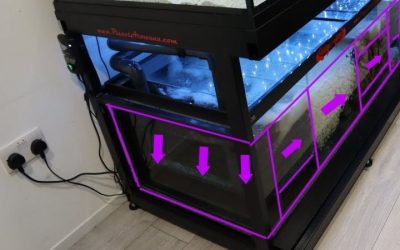
The sensor belongs in the return chamber and nowhere else. Every other sump chamber sits at a level fixed by its baffles, so a float placed there reads full permanently and the system quietly does nothing while salinity climbs.
Mount the sensor where it cannot be knocked. A float bumped out of position during a water change is the most common cause of a top-off that stops working, and it is invisible unless you check the mechanism directly.
Route the tubing so it cannot kink behind the cabinet door. A pinched line means the pump runs its full cycle and delivers nothing, which looks identical to a working system until the salinity reading moves.
How System Size Changes the Answer
Under 30 gallons (114 L), a top-off moves from helpful to essential, since 1-2% daily loss represents a proportionally larger salinity change at that volume and manual top-up depends on being home every single day.
Above 125 gallons (473 L), the same percentage means several gallons a day, so reservoir size becomes the constraint rather than the sensor. Many larger systems run a 10-20 gallon (38-76 L) reservoir plumbed from a storage container.
Sensor Types and Their Trade-Offs
Mechanical float valves need no power and fail closed, which is genuinely safe, but they stick with salt creep and cannot be monitored. Electronic float switches are cheap, reliable enough and easy to fit redundantly.
Optical sensors have no moving parts to stick and are the most consistent, though they read wrongly when coated with film. Whichever type is chosen, a second sensor at a higher level as a cutoff matters more than the type does.
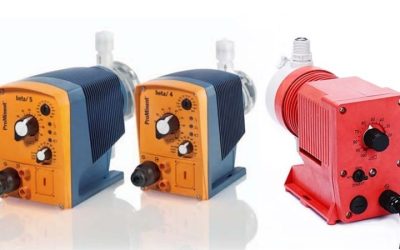
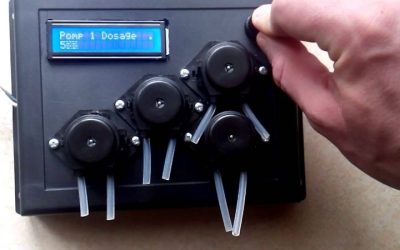
Peristaltic pumps suit small systems because they meter precisely and cannot siphon when switched off. Standard submersible pumps move more water faster, which is useful on larger tanks and less forgiving if a sensor sticks.
Myths About Top-Off Systems
Three assumptions cause most of the top-off failures in reef keeping, and each one has either a measurement or an inexpensive component that replaces it. All three are worth settling before the first coral goes in.
Myth: One Float Switch Is Enough
A single switch is a single point of failure with the whole reservoir behind it. Stuck closed, it dumps fresh water into the system and drops salinity within hours; stuck open, it stops topping up and salinity climbs instead.
Fit a second switch slightly higher as a backup cutoff, wired to interrupt the pump. That redundancy costs very little and turns the worst-case outcome from a livestock loss into an inconvenience discovered at the next check.
Myth: Top-Off Water Can Be Anything
Top-off replaces evaporated water, which contained nothing, so the replacement must contain nothing either. Tap water adds phosphate, silicate and sometimes copper continuously, in a slow accumulation that no export system removes.
Use RO/DI water verified at 0 ppm TDS with a meter. Because top-off runs every single day, this is the input that most consistently determines whether nuisance algae has a source, considerably more so than the weekly water change does.
Myth: A Bigger Reservoir Is Always Better
Reservoir size sets how much water a failure can deliver. A 20 gallon (76 L) reservoir behind a stuck-open sensor will drop salinity in a 50 gallon (189 L) system far enough to kill corals before anyone notices.
Match the reservoir to a few days of evaporation rather than to the largest container that fits, and add the backup cutoff. Convenience and consequence pull in opposite directions here, and the cutoff is what lets you have both.
Running It Past the First Year
A reef tank auto top off system is invisible when working correctly, which is exactly why its failures tend to be found late. This section covers the routine that catches them, what degrades over time, and what the arrangement costs to run.
The Routine That Catches Failures Early
Daily: glance at the reservoir level. A reservoir that has not dropped is a system that has not run, and noticing that on day one rather than day four is the difference between an adjustment and a salinity event.
Monthly: lift the sensor out, rinse it in fresh water and check it moves freely. Salt creep builds on float mechanisms steadily, and a float that has become stiff is the most common precursor to one that sticks entirely.
What Fails and What It Does
Float switches stick in either position, optical sensors develop a film that reads as water when dry, and pump tubing kinks where it passes a cabinet edge. All three fail without any noise or visible change in the tank.
Small pumps also wear, and a pump that has run dry once often has a damaged impeller even if it still runs. Check that the pump primes quickly when the reservoir is refilled, since a slow prime indicates wear.
Reservoirs also grow biofilm over months, particularly in a warm cabinet. Empty and rinse the container two or three times a year, since anything growing in there is being pumped into the display a little at a time.
The 12-Month Running Cost
Recurring spend is minimal: an occasional sensor or pump, plus the RO/DI water itself, which is already part of the system cost. The controller draws almost nothing, since the pump runs for seconds at a time.
On timing, top-off units and sensors see their deepest discounts in late June and again in late November, which suits fitting a backup. A sale changes nothing about placement, and prices move constantly, so check at the moment of purchase.
Reef Tank Auto Top Off System Questions
These arrive once evaporation becomes a daily chore. Every answer about a reef tank auto top off system points at placement or redundancy, since those two account for nearly every failure that causes real damage.
How big should the reservoir be?
Three to seven days of evaporation. Calculate 1-2% of system volume per day, multiply by the days you want covered, and size the container to that figure rather than to the largest one the cabinet will accept.
Where exactly does the sensor go?
In the return chamber of the sump, or in the rear chamber of an all-in-one tank holding the return pump. Any chamber with a level set by baffles will read full indefinitely and the system will never trigger.
Do I need a backup switch?
Yes. A single sensor is a single point of failure with the entire reservoir behind it, and both failure directions move salinity. A second switch at a higher level, wired to cut the pump, is inexpensive insurance.
Can I use a gravity float valve instead?
You can, and it needs no power, which is genuinely appealing. The trade is that mechanical valves stick with salt creep and give no warning, so they suit smaller systems where the reservoir volume limits the consequences.
What if I go away for two weeks?
Size the reservoir for the trip, or plumb it from a larger storage container with its own float. Ask someone to check the reservoir level rather than to top the tank up manually, since the check is the part that matters.
See More:
Conclusion
A reef tank auto top off system is sized from evaporation at 1-2% of system volume daily, with a reservoir covering three to seven days, a sensor placed in the return chamber, and dry-run protection on the pump.
Fit a second switch as a backup cutoff, use RO/DI water verified at 0 ppm TDS, and rinse the float monthly to clear salt creep. The reservoir level checked daily is the simplest early warning any reef keeper has.
Best Budget All in One Saltwater Tank: Top Smart Shortlist
Best All in One Saltwater Tank with a Built in Sump: Top