Last Updated: October 4, 2026
Picking the best automatic dosing pump for reef tanks starts with how many separate liquids you dose, because a four-head unit and a single-channel pump are not competing products. Accuracy at small volumes and tubing maintenance decide the rest.
As an Amazon Associate we earn from qualifying purchases.
As an Amazon Associate we earn from qualifying purchases at no extra cost to you. Prices and availability are accurate as of the date shown and are subject to change.
By David Nguyen
Quick answer: For most people in 2026, the best automatic dosing pump for reef tanks is the Red Sea ReefDose 4 — our #1 rated choice. See the full ranked comparison, alternatives and buying advice below.
How to Choose an Automatic Dosing Pump
Four factors decide this purchase: how many independent channels your regimen needs, how accurately each one delivers a small dose, the flow range available, and what calibration and tubing replacement will demand from you over time. Head count is where most budget comparisons go wrong.
Count the Channels You Actually Need
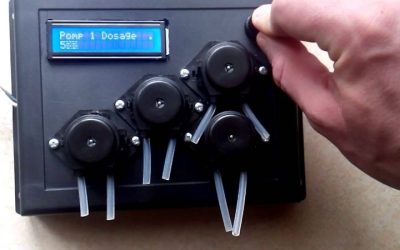
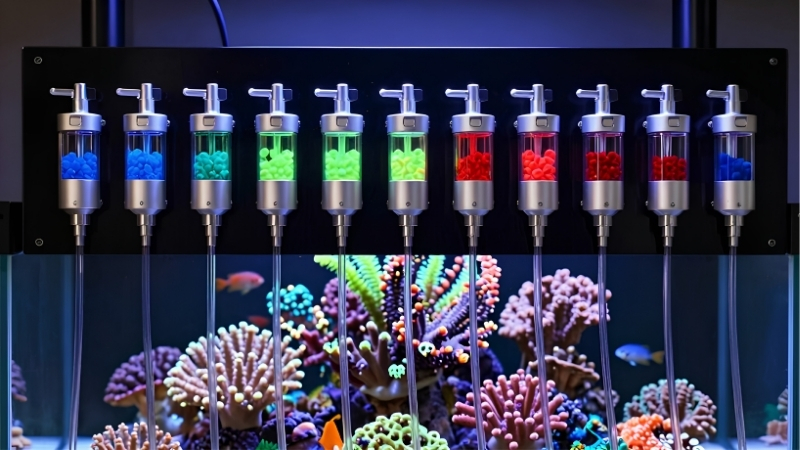
Head count drives price more than anything else. The Red Sea ReefDose 4 provides four independent heads, the Neptune DOS QuietDrive offers two, while the EcoTech Versa and Kamoer X1 PRO T are single-channel pumps. Each head needs its own tube, container and calibration record.
That makes direct price comparison misleading. A two-part calcium and alkalinity regimen needs two channels minimum, and adding trace elements or amino acids pushes you toward four, so total the channels before comparing any device prices. Two single-channel pumps can cost less than one four-head unit if two channels is all you need.
Check Accuracy at Small Doses
Reef dosing happens in millilitres, so precision at the low end matters more than top speed. Red Sea quotes plus or minus 0.05 mL on the ReefDose 4 with 0.1 mL increments, while Kamoer states better than plus or minus 2% for the X1 PRO T. Dose sizes on a mid-size reef often sit in single-digit millilitres per event. Neptune quotes a flow range rather than a per-dose accuracy figure for the DOS.
Those two figures describe accuracy differently, one as an absolute volume and one as a percentage, so they cannot be ranked against each other directly. Both also assume calibrated conditions with a particular fluid and head pressure. Viscous supplements meter differently from thin solutions, which is why calibration is per liquid.
Match the Flow Range to the Job
Flow ranges vary enormously here. The EcoTech Versa spans 6 microlitres to 300 mL per minute, the Kamoer X1 PRO T exceeds 70 mL per minute, the Neptune DOS runs 0.1 to 250 mL per minute with 24 feet of lift, and the ReefDose offers speeds of 15, 30 and 45 mL per minute. Lift matters too, since the Neptune DOS quotes 24 feet for elevated reservoirs.
Very wide ranges suit pumps handling two roles, such as water changes alongside dosing. For pure two-part dosing the low end matters far more, since you are delivering small amounts spread across many doses each day. Red Sea’s three fixed speeds are aimed squarely at supplement dosing rather than transfers.
Plan for Calibration and Tubing Wear
Peristaltic tubing is a wear item that compresses and loses accuracy over time. EcoTech specifies lubricating the Versa every 3,000 gallons or six months and replacing tubing every 6,000 gallons or twelve months, whichever comes first. Tubing is inexpensive, which makes this the easiest maintenance item to stay ahead of.
Recalibrate after any tubing change, since a fresh tube meters differently from a worn one. This routine maintenance affects long-term reliability far more than app features, and skipping it slowly drifts your dosing out of specification. Log calibration dates so drift is caught before parameters move.
Top Picks
Four pumps covering one to four channels. Each entry lists manufacturer specifications, a relative price position as of 09/2026, and one genuine drawback, so you can match head count to your regimen rather than to a sticker price.
| Product | Best For | Key Spec | Watch Out For |
|---|---|---|---|
| Red Sea ReefDose 4 | Best multi-channel option | 4 heads; plus/minus 0.05 mL; up to 24 doses/day/head | Highest price, but four heads included |
| EcoTech Versa | Best flow flexibility | 1 channel; 6 uL to 300 mL/min; Mobius control | Single channel needs multiples |
| Kamoer X1 PRO T | Best value | 1 channel; over 70 mL/min; better than plus/minus 2% | One channel per unit |
| Neptune DOS QuietDrive | Best for Apex owners | 2 heads; 0.1-250 mL/min; 24 ft lift | Requires an A2 or A3 Apex |
Red Sea ReefDose 4: Best Multi-Channel Option
At roughly $450 as of 09/2026, the ReefDose 4 delivers four independent heads using direct-drive planetary gear mechanisms, quoting plus or minus 0.05 mL accuracy in 0.1 mL increments, a daily range of 0.2 to 1,000 mL per head, three speeds and up to 24 individually set doses per day per head. Splitting a daily total across many small doses keeps parameters more stable than one large dose.
Per channel it is the cheapest option here, though the headline price is the highest. If you only need one or two channels, that capacity sits unused, so the value depends entirely on whether your regimen fills all four. Red Sea’s app ecosystem handles scheduling without requiring a separate controller.
EcoTech Versa: Best Flow Flexibility
Near under $250 as of 09/2026, the Versa is a single-channel peristaltic stepper spanning 6 microlitres to 300 mL per minute under Mobius control. That enormous range lets one pump handle tiny trace doses or larger transfers. That low end is unusually fine, which suits precise trace element dosing.
Being single channel, a two-part regimen needs two units, which changes the maths against multi-head pumps. Factor in its stated maintenance schedule of lubrication every 3,000 gallons or six months and tubing replacement at 6,000 gallons or twelve months. Mobius handles scheduling and logging across compatible EcoTech hardware.
Kamoer X1 PRO T: Best Value
At roughly $175 as of 09/2026 this is the cheapest entry, about 34.0% below the Versa, a gap near under $90. It uses a stepper KFS head exceeding 70 mL per minute with accuracy better than plus or minus 2%, a 0.1 to 9,999 mL range and WiFi app control. Its 0.1 to 9,999 mL range covers everything from trace doses to larger transfers.
It runs from a 12V 2A supply, which caps the adapter at 24W rather than describing constant pump draw. Like the Versa it is single channel, so a full two-part regimen means buying two units and managing two app entries. Standalone WiFi control means no controller purchase is required.
Neptune DOS QuietDrive: Best for Apex Owners
Around $450 as of 09/2026, essentially the same price as the four-head ReefDose, the DOS QuietDrive provides two heads running 0.1 to 250 mL per minute with 24 feet of lift on 24VDC power. QuietDrive refers to the mechanism, which runs noticeably quieter than older designs. Its 24 feet of lift also suits reservoirs kept in a basement or cabinet below.
It requires an A2 or A3 Apex to operate, so it is only sensible for existing Apex owners. For anyone outside that ecosystem the controller requirement makes the effective price considerably higher than the sticker suggests. Within an Apex system, logging and alerting integrate without extra configuration.
Frequently Asked Questions
Four questions decide most dosing purchases: how many heads a typical reef needs, what accuracy figures really mean, how often tubing needs changing, and whether these pumps can also serve as water change hardware.
How many dosing heads do I need?
Two at minimum for a standard two-part calcium and alkalinity regimen, since each solution needs its own dedicated line to avoid precipitation. Mixing them in one line causes precipitation and blocks the tube.
Adding magnesium, trace elements or amino acids pushes you to three or four. Count your intended solutions first, because that number decides whether a four-head unit or two single-channel pumps is the cheaper route. Buying one extra channel now is cheaper than replacing the pump later.
What does plus or minus 0.05 mL mean?
It describes how close each delivered dose lands to the requested volume under calibrated conditions with a particular fluid and head pressure. Accuracy claims also assume the pump has been calibrated for that specific liquid.
That absolute figure cannot be compared directly against a percentage specification like Kamoer’s better than plus or minus 2%, since the two express accuracy differently. Both depend on calibration staying current as tubing ages. Verify delivered volume with a graduated cylinder after installation.
How often does tubing need replacing?
EcoTech gives the clearest guidance for the Versa: lubricate every 3,000 gallons or six months and replace tubing every 6,000 gallons or twelve months, whichever arrives first. Those figures use whichever milestone arrives first.
Other manufacturers phrase this differently, but the principle holds across peristaltic pumps. Keep spare tubing on hand and recalibrate immediately after fitting it, since a new tube meters differently from a compressed one. Worn tubing tends to under-deliver, which shows up as slowly falling alkalinity.
Can these pumps run water changes?
The DOS and Versa are commonly used that way, since both meter precisely and the Versa’s range reaches 300 mL per minute. Automatic water changes need two metered lines working in matched pairs. Overflow protection becomes essential once pumps move water rather than supplements.
That means two Versa units, or the DOS with its two heads, plus appropriate overflow protection. Dedicated dosing pumps like the ReefDose are aimed at supplements rather than moving water change volumes. Match the architecture to the job rather than assuming one pump covers both.
Final Thoughts
The best automatic dosing pump for reef tanks is decided by channel count, accuracy at the doses you actually run, and your willingness to keep tubing and calibration current. Kamoer’s X1 PRO T near under $200 is the value entry, while the ReefDose 4 costs least per head at roughly $450.
Ready to decide? Our #1 pick for 2026 is the Red Sea ReefDose 4.
Live price & availability on Amazon.
Related Reviews & Guides

How to Choose Reef LED Light: Top Smart Guide for Real Tanks
Best Controllable Return Pump for Sump: Top Top Picks