Last Updated: October 4, 2026
A nano reef swings temperature fast because its small volume has little thermal buffer, so summer heat and pump-and-light load push it up quickly. The best aquarium chiller for a nano reef tank is the one whose verified pulldown matches your gallons, uses reef-safe wetted materials, and gets the feed flow it needs to cool at all.
As an Amazon Associate we earn from qualifying purchases.
By David Nguyen
Quick answer: For most people in 2026, the best aquarium chiller for a nano reef tank is the JBJ Nano E10G — our #1 rated choice. See the full ranked comparison, alternatives and buying advice below.
How to Choose an Aquarium Chiller
Sizing a nano-reef chiller starts with your true volume and the temperature drop you actually need, then the feed flow the unit requires and reef-safe compatibility. Because a small tank heats fast in summer, the goal is a chiller matched to your gallons and heat load, not the largest cooling class you can find.
Match Verified Pulldown to Volume
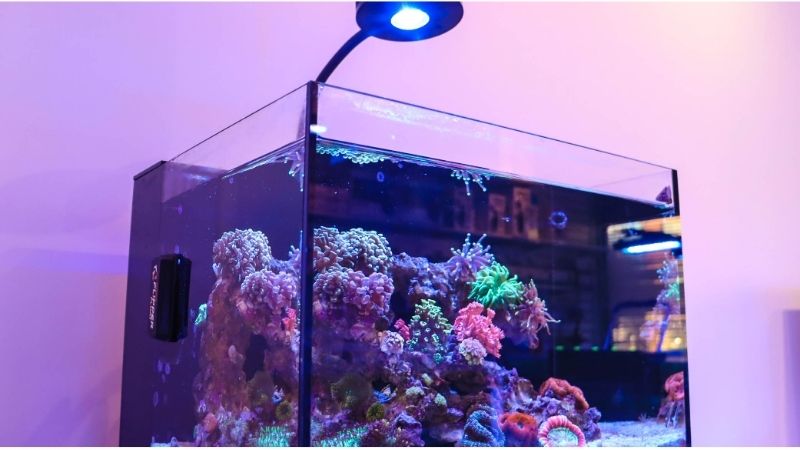
Nano chillers are rated for a volume and a temperature drop, so read both. The JBJ Nano E10G is specified for tanks up to about 10 gallons with a roughly 9-to-11 degree Fahrenheit pulldown below ambient, while the E20G covers up to about 20 gallons, so match the rating to your actual reef volume.
Remember pulldown is relative to room temperature, not a fixed setpoint. On a hot summer day a chiller can only hold water a certain number of degrees below the surrounding air, so a unit rated for your gallons still needs a realistic ambient; size to your volume first, then check the drop against your room.
Give the Chiller Enough Flow
Every chiller needs water moving through it to cool, and the feed rate is model-specific. The Nano E10G is built around roughly 78 GPH and the E20G around 118 GPH through the unit, so the included or matched pump must sustain that flow, since too little can cut cooling and risk internal freezing.
On a reef, that flow also has to fit your existing circulation. Pulling too much through a chiller loop can starve other equipment, so plan the plumbing so the chiller gets its rated GPH without robbing the display, and keep the loop short to limit the head the small feed pump has to fight.
Confirm Reef-Safe Materials
Saltwater is corrosive, so wetted materials matter more on a reef than on freshwater. Titanium heat exchangers, as on the larger Arctica class, resist salt corrosion, and JBJ’s nano units are specified for reef and freshwater use, so confirm any chiller you consider lists saltwater or reef compatibility explicitly.
Avoid running a freshwater-only exchanger on salt water. A material not rated for salt can corrode and leak metals into a sensitive reef, so treat compatibility as a hard requirement, not a preference, and favor titanium or manufacturer-stated reef-safe construction for a tank full of corals and invertebrates.
Weigh Power Class, Not Just PSU Labels
Compare cooling classes honestly, because thermoelectric and compressor units are not measured the same way. A nano thermoelectric unit’s pulldown-by-volume is not comparable to a compressor’s gallon class, so do not rank a Nano E against a Mini Arctica on a single number; judge each against your own load.
Be careful with power-supply figures too. The Nano manual lists PSU nameplate capacities, such as a 12-volt, 10-amp supply, which is the supply’s ceiling, not the chiller’s actual draw, and one retailer’s voltage listing for the larger nano conflicts with the manual, so verify the exact variant before buying.
Top Picks
These four span nano thermoelectric units to a larger compressor class, matched to volume and heat load rather than ranked on one number. The right nano-reef chiller depends on your gallons, the summer drop you need, and whether a simple included-pump unit or a higher-capacity compressor suits your setup.
| Product | Best For | Key Spec | Watch Out For |
|---|---|---|---|
| JBJ Nano E10G | Best Overall for a sub-10-gallon reef | <=10 gal; 9-11 F drop; 78 GPH; ~under $400 | Drop shrinks in hot rooms |
| JBJ Nano E20G | Best for a nano up to 20 gallons | <=20 gal; 118 GPH; ~under $450 | PSU voltage listing conflicts |
| JBJ Mini Arctica 1/15 | Best small compressor step-up | <=40 gal; 100-200 GPH; ~under $600 | Needs external pump and venting |
| JBJ Arctica 1/10 DBA-075 | Best for cooling headroom | 240-960 GPH; titanium; ~under $800 | Overkill and costly for nano |
JBJ Nano E10G: Best Overall for a Sub-10-Gallon Reef
For a true nano reef up to about 10 gallons, the Nano E10G leads because its roughly 9-to-11 degree Fahrenheit pulldown is verified for that volume, it feeds at about 78 GPH, and it is rated reef-safe, all for around $400. That match of drop to small volume is exactly what a nano needs in summer.
Its lead is conditional on staying within its class. Above 10 gallons or in a very hot room the drop shrinks, and its thermoelectric cooling is not comparable to a compressor’s capacity, so do not expect compressor-class performance. For a genuine sub-10-gallon reef, though, it is the right-sized, corrosion-aware choice.
JBJ Nano E20G: Best for a Larger Nano up to 20 Gallons
When a nano reef runs closer to 20 gallons, the E20G carries the same roughly 9-to-11 degree pulldown to that volume with about 118 GPH of feed flow for around $450. It suits the many all-in-one reef tanks in the mid-teens that outgrow the 10-gallon unit but do not need a compressor.
Verify the variant before ordering. The manual and one retailer disagree on the E20G’s power-supply voltage, and the listed PSU capacity is a nameplate ceiling, not actual draw, so confirm the exact model. Keep its 118 GPH feed satisfied as well, since low flow can hurt cooling on this unit.
JBJ Mini Arctica 1/15: Best Small Compressor Step-Up
If your reef load exceeds nano thermoelectric limits, the Mini Arctica 1/15 is a compressor unit rated for tanks up to about 40 gallons, taking roughly 100 to 200 GPH of feed flow at about 39 decibels for around $600. It offers cooling headroom a nano thermoelectric simply cannot reach.
It changes the install, though. As a compressor it needs an external feed pump you supply, more space, and ventilation for its exhaust heat, and its gallon class is not comparable to a nano’s pulldown rating. Choose it when a hot room or higher load pushes a sub-40-gallon reef past what a Nano E can hold.
JBJ Arctica 1/10 DBA-075: Best for Cooling Headroom
For the largest nano-adjacent systems or a hot climate, the Arctica 1/10 DBA-075 is a titanium-exchanger compressor accepting roughly 240 to 960 GPH of feed flow for around $800. Its titanium wetted path suits salt water, and its higher class holds temperature where smaller units run continuously in summer heat.
It is overkill for a small reef. The extra capacity, cost, feed-flow demand, and footprint make sense only when volume or ambient genuinely require it, and its class cannot be compared directly to a nano’s pulldown spec. Reserve it for the upper edge of nano-plus builds that need real cooling margin.
Frequently Asked Questions
Nano-reef chiller questions usually come down to matching a small, fast-swinging volume to the right cooling class. These answers cover sizing a 10-gallon reef, a 20-gallon build, whether a fractional-HP compressor is needed, and why the feed pump matters as much as the chiller itself.
What Chiller Suits a 10-Gallon Reef?
A nano thermoelectric unit like the Nano E10G fits, since it is rated for up to about 10 gallons with a roughly 9-to-11 degree Fahrenheit pulldown and reef-safe construction. On such a small volume, that drop is usually enough to counter summer warming from lights and a return pump in a reasonable room.
Check your ambient before assuming it is enough. Because pulldown is measured below room temperature, a very hot space can leave even a correctly sized nano unit running constantly, so confirm your summer room temperature and keep the unit’s roughly 78 GPH feed flow steady for the rated cooling to hold.
Can One Chiller Cool a 20-Gallon Nano?
Yes, the Nano E20G is rated to about 20 gallons with the same roughly 9-to-11 degree pulldown and about 118 GPH of feed flow. It is the natural step up from the 10-gallon unit for the larger all-in-one reef tanks that sit in the mid-teens to twenty-gallon range without needing a compressor.
Mind the variant and the flow. The listed power-supply voltage differs between the manual and one retailer, and the PSU figure is a ceiling rather than actual consumption, so confirm the exact model, and keep the 118 GPH feed satisfied, since insufficient flow can reduce cooling or risk internal freezing.
Do I Need a 1/15 HP Compressor?
Only if a nano thermoelectric unit cannot hold your temperature. The Mini Arctica 1/15, rated to about 40 gallons, offers headroom a Nano E cannot, which matters in a hot room or a heavily lit reef, but a small, cool-room nano usually does not need it. Match the class to your real load, not to fear.
Weigh the trade-offs before stepping up. A compressor needs an external feed pump, ventilation for its exhaust, and more space, and its gallon class is not comparable to a nano’s pulldown rating, so choose it when volume or ambient genuinely demand more cooling than a thermoelectric unit can deliver.
How Important Is the Feed Pump?
Very. A chiller only cools the water actually flowing through it, so the feed pump must sustain the unit’s rated GPH, roughly 78 for the E10G and 118 for the E20G. Too little flow reduces cooling and can even risk internal freezing, so the pump is as critical as the chiller’s rating itself.
Plan the loop so flow is reliable and does not starve the display. Keep the plumbing short to limit head on a small feed pump, and size circulation so the chiller loop gets its rated flow while the reef keeps its own turnover. Steady feed flow is what turns a correctly rated chiller into real cooling.
Final Thoughts
The best aquarium chiller for a nano reef tank is the one whose verified pulldown matches your small volume, whose wetted materials are reef-safe, and whose rated feed flow you can reliably supply. Size to your gallons and summer ambient first, keep the flow steady, and verify the exact variant before buying.
Ready to decide? Our #1 pick for 2026 is the JBJ Nano E10G.
Live price & availability on Amazon.
Related Reviews & Guides

Neptune Apex Jr vs Full Apex Which Controller: Best Compared
Calcium Reactor Setup and Tuning Guide: Top Compared Handbook