Last Updated: September 25, 2026
Nano aquarium setup guide numbers start with an uncomfortable fact: a tank under 10 gallons (38 L) is harder to keep stable than a larger one, not easier. Small volumes swing faster, forgive less, and need the weekly routine to actually happen rather than mostly happen. The numbers below explain why, and what to do about it.
As an Amazon Associate we earn from qualifying purchases.
As an Amazon Associate we earn from qualifying purchases at no extra cost to you. Prices and availability are accurate as of the date shown and are subject to change.

NICREW 2.5 Gallon Nano Nature Aquarium Kit Betta Fish Tank, Complete, Black
Selected for "Nano Aquarium Setup Guide: How It Works and What to Watch": this listing is tanks (NICREW 2.5 Gallon Nano Nature Aquarium Kit Betta Fish Tank, Complete, ), matching the equipment this article covers.
View on Amazon
Marineland Portrait Glass LED Aquarium Kit, 5 Gallons, Hidden Filtration,Black
Selected for "Nano Aquarium Setup Guide: How It Works and What to Watch": this listing is lighting (Marineland Portrait Glass LED Aquarium Kit, 5 Gallons, Hidden Filtrati), matching the equipment this article covers.
View on Amazon
NICREW 2.5 Gallon Nano Nature Aquarium Kit Betta Fish Tank, Basic, Black
Selected for "Nano Aquarium Setup Guide: How It Works and What to Watch": this listing is tanks (NICREW 2.5 Gallon Nano Nature Aquarium Kit Betta Fish Tank, Basic, Bla), matching the equipment this article covers.
View on AmazonBy David Nguyen
How a Small Volume Actually Behaves
A nano aquarium setup guide has to begin by correcting the marketing. These tanks are sold as beginner products because they are cheap and small, but the physics of a small water volume works against a new keeper in three specific and measurable ways.
The Decision Numbers: Real Volume, Weight, Heater and Turnover
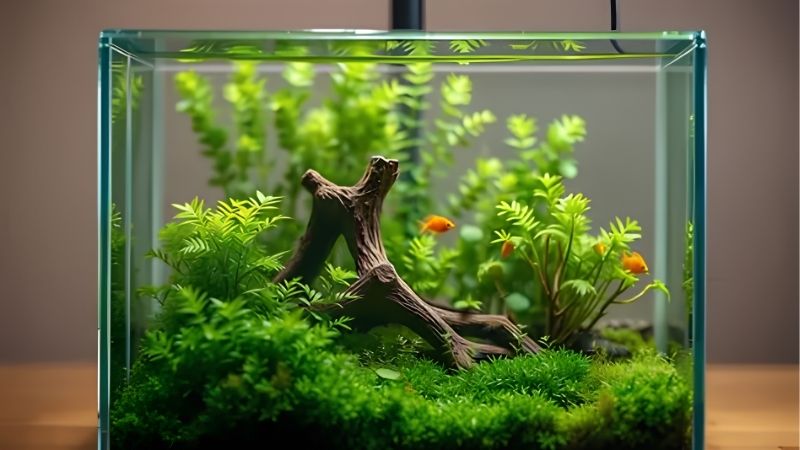
Nano means under 10 gallons (38 L), usually 3-10 gallons (11-38 L). A 5 gallon at 16 x 8 x 10 in (41 x 20 x 25 cm) holds roughly 4-4.5 gallons (15-17 L) of actual water once substrate, hardscape and the surface gap are subtracted.
Filled weight runs near 10 lb per US gallon (about 1.2 kg per litre), so a 5 gallon sits around 50 lb (23 kg) and a 10 gallon near 110 lb (50 kg). Heater sizing is 3-5 W per gallon, giving 25-50 W at 5 gallons, and turnover targets 4-6 times per hour.
Why Small Volumes Swing Faster
Every input is proportionally larger in a small tank. A pinch of food that is negligible in 40 gallons (151 L) represents a measurable ammonia load in 4 gallons (15 L) of actual water, and the same applies to evaporation, waste and temperature.
Temperature follows the room almost exactly. A 5 gallon tank in a room moving 6 °F (3 °C) across a day moves nearly the same amount, while a 40 gallon barely registers it. That swing is the hidden stressor behind most unexplained nano tank losses.
Normal Ranges and Action Thresholds
The table below gives the working ranges alongside the point where action is needed. The thresholds are the same as in any freshwater tank; what differs is how quickly a nano tank crosses them once something goes wrong, and how little warning you get beforehand.
| Measurement | Target | Action threshold | First action |
|---|---|---|---|
| Ammonia | 0 ppm | Above 0.25 ppm | 25% change, stop feeding 24 hours |
| Nitrite | 0 ppm | Any reading above 0 ppm | 25% change, check filter flow |
| Nitrate | Under 20 ppm | Above 40 ppm | Raise change frequency, cut feeding |
| Temperature | Species dependent | Daily swing over 2 °F (1 °C) | Add a heater to hold it steady |
| Turnover | 4-6x per hour | Under 3x loaded | Clean impeller, upsize the filter |
| Water level | Within 0.5 in (1.3 cm) | Drop over 1 in (2.5 cm) | Top up with pure water, fit a lid |
| Weekly change | 20-30% | Missed two weeks running | Two smaller changes, days apart |
| Stocking | Species dependent | Nitrate rising weekly | Reduce stock or feeding, not both |
Evaporation deserves its own line because it is the failure most specific to this size. A 5 gallon tank in a heated room can lose an inch of water in a week, which concentrates everything dissolved and drops the water line below a filter intake.
Building It in a Real Room
A nano aquarium setup guide is mostly about placement, because a small tank carries almost no thermal or chemical inertia of its own. Where the tank sits determines how much work the equipment has to do simply to hold the numbers steady week to week.
Tank Size, Placement and Fit
Measure the lid gap against your filter and heater cable runs before ordering, because a close-fitting lid is what slows evaporation, and a nano tank without one needs topping up two or three times a week rather than once, which is how most water lines end up below an intake.
Keep it away from windows, radiators and exterior doors. Direct sun on a 5 gallon (19 L) tank can add several degrees across an afternoon and reliably produces algae, and a desk beside a window is exactly where most nano tanks end up being placed.
How 3, 5 and 10 Gallon Builds Differ
At 3 gallons (11 L) there is no realistic margin for error, and the tank suits a single betta or a small shrimp colony with disciplined weekly maintenance. Heater options are limited at that volume, and most are barely adjustable.
Five gallons (19 L) is the practical floor for most people, and 10 gallons (38 L) is where the tank starts behaving predictably. Moving from 5 to 10 gallons costs very little and roughly doubles the time available to notice a problem before it matters.
Stocking a Small Volume Honestly
A nano tank holds one betta, or a shoal of 8-10 fish under 1 in (2.5 cm) at 10 gallons (38 L), or a shrimp colony. It does not hold a mixed community, and it does not hold anything sold small in a shop that grows past 2 in (5 cm) as an adult.
Plants change the arithmetic more than filtration does. A heavily planted nano exports nitrate continuously and buffers the swings that make this size difficult, which is why planted nano tanks succeed far more often than bare ones at the same volume.
Myths That Sink Nano Tanks
Three claims cause most of the failures this nano aquarium setup guide is meant to prevent. All three come from marketing rather than from how a small volume of water actually behaves across a week, and each has a number that replaces it.
Myth: Smaller Tanks Are Easier
Smaller tanks are cheaper and lighter, which is not the same thing. Parameters move faster, temperature tracks the room, and a single missed water change is visible in the nitrate reading rather than absorbed by volume as it would be at 40 gallons (151 L).
The replacement measure is time to failure. In a 40 gallon tank a stalled filter gives you most of a day; in 4 gallons (15 L) of actual water it gives you hours. Judge the size by that margin rather than by the price of the kit.
Myth: A Small Tank Does Not Need a Heater
Room temperature is not water temperature, and it is not stable. A tank tracking a room that runs 74 °F (23 °C) by day and 65 °F (18 °C) overnight subjects its occupants to a daily swing far outside anything they tolerate well.
Fit a 25-50 W heater at 5 gallons (19 L) and verify it against an independent thermometer. The heater is there to hold a steady number rather than to raise the temperature, which is exactly why it matters even in a home that already feels warm.
Myth: The Kit Filter Is Enough as Supplied
Most nano kits ship with a filter running a single proprietary cartridge, which cannot be staged mechanically, biologically and chemically, and which discards the bacterial colony every time it is replaced. That is the usual cause of repeated small ammonia spikes.
Replace the cartridge approach rather than the filter. Cut a piece of coarse sponge to fit the cartridge slot, add a small bag of ceramic media behind it, and rinse rather than replace. The pump is usually adequate; the media arrangement is not.
Running It Past the First Six Months
A nano tank rewards routine more than equipment, so this nano aquarium setup guide would be incomplete without the maintenance pattern. This section covers the weekly work, what degrades quietly, and the recurring cost across a year.
The Weekly and Monthly Routine
Weekly: a 20-30% change with dechlorinated water matched within 1-2 °F (about 1 °C), a light substrate vacuum, and a glass wipe. Top up evaporation separately with pure water, since evaporation leaves every dissolved mineral behind in the tank.
Monthly: rinse mechanical media in old tank water, check the heater against an independent thermometer, and inspect the impeller. Quarterly, check test reagent dates, because expired reagent in a tank this reactive hides a problem developing over days rather than months.
What Fails and What It Does
Small heaters fail in both directions and a 5 gallon (19 L) tank responds within hours either way. Accuracy also drifts 2-4 °F (1-2 °C) across a year, which at this volume is enough to move a species out of its comfortable range unnoticed.
Filter intakes draw air once evaporation drops the water line, which stalls the pump and kills the colony inside it within a day. That single failure, caused by nothing more than a missed top-up, accounts for a large share of sudden nano tank losses.
The 12-Month Running Cost
Recurring spend is small but constant: dechlorinator, filter media, food, test reagents and electricity for a heater and filter running continuously. Kits using proprietary cartridges cost noticeably more across a year than the same tank running loose media you refill yourself.
On timing, nano tanks, lights and small heaters discount most deeply in late June and again in late November, and small kits are heavily marketed as gifts in December. A sale never shortens biology: the tank still needs three to eight weeks of cycling, and prices move constantly.
Nano Aquarium Setup Guide Questions
These come up while the tank is still cycling but before anything at all is stocked. Every answer in this nano aquarium setup guide points at a measurement, because at this volume the readings move well before anything becomes visible in the tank.
What is the smallest workable tank?
Five gallons (19 L) for most people, and 3 gallons (11 L) only for a single betta or a shrimp colony with strict weekly maintenance. Below that, temperature and parameters move faster than a weekly routine can realistically correct.
Can I skip cycling in a small tank?
No, and the consequences are worse here. Three to eight weeks fishless, dosing ammonia to 2-4 ppm and waiting until both ammonia and nitrite clear to 0 ppm within 24 hours with nitrate present, is the same requirement at any volume.
Do nano tanks need a lid?
Effectively yes. A lid slows evaporation, which is the main driver of instability at this size, and it stops fish jumping. An open-top nano needs topping up several times a week and drifts noticeably in temperature and hardness between those top-ups.
How many fish fit in a 5 gallon?
One betta, or a shrimp colony, or a small group of invertebrates such as nerite snails. Not a shoal, and not a mixed community at any combination. At 10 gallons (38 L) a shoal of 8-10 fish under 1 in (2.5 cm) becomes reasonable.
Why does my nano tank get algae so fast?
Usually light duration plus surplus nutrients in a small volume. Cut the photoperiod to six or seven hours, feed less, and test nitrate before the weekly change. Adding plants exports nutrients faster than any algae treatment removes them.
See More:
Conclusion
This nano aquarium setup guide reduces to four figures: real water volume roughly 15% below the label, filled weight near 10 lb per gallon (1.2 kg per litre), a 25-50 W heater at 5 gallons (19 L), and turnover at 4-6 times per hour.
Treat the size as a constraint rather than a shortcut. Fit a lid, add a heater even in a warm room, plant it heavily, replace any proprietary cartridge with loose media, and hold the weekly 20-30% change. Managed that way, a nano tank is stable rather than fragile.
29 Gallon Aquarium Setup Ideas: Depth, Stocking and Cost
Fish Tank Smells Bad: What the Odour Is Actually Telling You