Last Updated: October 4, 2026
A noisy aquarium air pump is usually suffering from vibration, a loose connection, a clogged air stone, or a worn diaphragm—not necessarily a failing motor. The good news is that most problems can be corrected without replacing the entire setup. This guide explains how to fix noisy aquarium air pump problems safely, from the simplest adjustments to parts replacement.
Turn off and unplug the pump before moving it, opening its housing, or handling wet equipment. If you troubleshoot carelessly, water can travel backward through the airline, reach the electrical outlet, or spill onto the pump. Running a pump against a blocked air stone can also strain the diaphragm and shorten its life. Work slowly, keep the pump above the aquarium’s waterline whenever possible, and make one change at a time.
As an Amazon Associate we earn from qualifying purchases at no extra cost to you.

Quick answer: Our top pick in 2026 is the Soft rubber or silicone mat — our #1 rated choice. See the full ranked comparison, alternatives and buying advice below.
What You Need
| Item | Why | Optional? |
|---|---|---|
| Soft rubber or silicone mat | Absorbs vibration between the pump and cabinet, floor, or wall | No |
| Replacement airline tubing | Corrects kinks, hard tubing, leaks, and loose fittings | Yes |
| New air stone | Restores airflow when mineral deposits or algae create back pressure | Yes |
| Check valve | Prevents aquarium water from flowing into the pump during a power outage | Yes |
| Small brush and clean water | Removes debris from air stones, connectors, and tubing ends | Yes |
| Scissors | Makes clean, square cuts in airline tubing | Yes |
| Replacement diaphragm or pump | Needed if the internal rubber diaphragm is cracked, stiff, or torn | Yes |
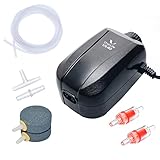
For a replacement, match the pump to the aquarium volume and the number of outlets. For example, the Uniclife 64 GPH dual-outlet pump is listed for 10- to 100-gallon tanks and is commonly priced around $14 to $20. The Pawfly 50 GPH dual-outlet pump is listed for 10- to 60-gallon tanks and typically costs about $9 to $15. Actual prices can change. Neither a higher flow rating nor a lower price automatically guarantees quieter operation; correct setup matters just as much.
Step-by-Step
1. Identify where the noise comes from (5 minutes)
With the aquarium operating normally, listen from several angles. A low hum that changes when you touch the pump usually indicates vibration. A rattling or buzzing sound may come from a loose cover, fitting, or internal component. A hissing sound generally points to an air leak, split tubing, or a connector that is not seated properly. A chattering or pulsing noise can indicate a blocked air stone or a damaged diaphragm.
Do not place your ear directly over the pump or aquarium. Instead, lightly touch the cabinet, pump body, airline, and air stone to locate the vibration. Unplug the pump before making adjustments.
2. Stabilize the pump and reduce vibration (5 minutes)
Set the pump on a level, solid surface with a ¼- to ½-inch-thick rubber, silicone, or dense foam pad underneath it. The pad should be slightly larger than the pump’s base and should not cover ventilation openings. Keep the unit away from the cabinet wall, since contact can turn a mild hum into a loud resonating buzz.
If the pump has rubber feet, confirm that all feet touch the surface. Replace missing feet with manufacturer-approved parts rather than taping the pump directly to furniture. Do not wrap the pump in a towel or enclose it in a box; it needs air circulation to prevent overheating.
3. Check the pump’s position and water protection (5 minutes)
Place the pump above the aquarium’s waterline when practical. If it must sit below the waterline, install a properly oriented check valve in every airline. The arrow on the valve should point toward the aquarium. Leave a gentle loop of tubing between the pump and tank so the line does not pull on the outlet.
Keep the pump dry and leave a drip loop in the electrical cord below the outlet. A drip loop is a section of cord that hangs lower than the plug and outlet, allowing water to drip onto the floor instead of into the receptacle. Never operate a visibly wet pump.
4. Inspect the airline and connectors (10 minutes)
Unplug the pump, then examine the entire airline for kinks, flattened sections, algae, brittle spots, and loose ends. Cut off damaged tubing with clean scissors and push the remaining tube firmly over each fitting. A connection should be snug without requiring excessive force.
Replace tubing that has become hard or cloudy. Use aquarium-safe airline tubing of the same size as the existing setup; forcing oversized tubing over a small outlet can create a poor seal. Check T-connectors, control valves, and splitters as well. A small air leak can create a sharp hiss while also reducing the air reaching the tank.
5. Test the air stone and clean restrictions (10 to 15 minutes)
Remove the air stone and inspect its pores. Mineral buildup, algae, and debris can restrict bubbles and make the pump work harder. Rinse the stone in dechlorinated water and brush away loose deposits. Avoid soap, household cleaners, and disinfectants, which can harm fish even in small amounts.
For a badly clogged stone, replacement is often more practical than cleaning. Air stones are inexpensive wear items, and a new stone may immediately reduce strain and noise. Before reconnecting it, check that the airline is not pinched under gravel, décor, or the aquarium lid.
6. Balance airflow between outlets (5 minutes)
If your pump has two outlets, make sure both outlets have open, compatible airlines. A closed control valve or blocked line on one side can increase back pressure and make the pump louder. Open each valve gradually until the bubbles are adequate but not excessively turbulent.
Do not assume maximum airflow is best. Fish need suitable surface movement and oxygenation, but strong bubbles can stress slow-moving species, disturb plants, or create excessive splash. Adjust the flow while watching the fish and checking that the tank lid and surrounding furniture stay dry.
7. Test the system and listen again (10 minutes)
Reconnect the airline, confirm the check valve direction, and plug the pump into a dry outlet. Watch for steady bubbles and listen for at least five minutes. A properly supported pump should produce a consistent, low hum rather than a rattle, scrape, or intermittent clicking.
If the noise changes when you gently press the pump cover, unplug it and tighten only the accessible fasteners. Do not overtighten plastic screws. If the sound remains after the external checks, the diaphragm, motor, or internal armature may be worn.
Mistakes to Avoid
- Do not run the pump with a blocked airline or air stone for extended periods.
- Do not place the pump directly on a hollow cabinet shelf without vibration isolation.
- Do not submerge an air pump unless the manufacturer specifically designs it for underwater use.
- Do not use household oil, silicone spray, glue, or sealant inside the pump.
- Do not clean aquarium components with soap or bleach unless the product instructions provide a safe, fish-compatible process.
- Do not remove a check valve just to increase airflow; preventing water backup protects the pump and your electrical setup.
- Do not ignore a burning smell, hot casing, melted plug, or repeated circuit trips.
How Often
Listen to the pump weekly and inspect the airline at least once a month. Clean or replace an air stone when bubbles become noticeably weaker, uneven, or coarse. In a hard-water aquarium, inspect it every two to four weeks because mineral deposits can build quickly. Replace brittle airline tubing as soon as cracks or stiffness appear, often every six to 18 months depending on light, heat, and water exposure.
Check the pump’s vents for dust every one to three months. Unplug it first and wipe the exterior with a dry or barely damp cloth; never allow water into the housing. Follow the manufacturer’s instructions for diaphragm service, since some pumps use replaceable kits and others are intended to be replaced as a unit.
When to Call a Pro or Replace
Stop using the pump and seek help from an aquarium professional or qualified electrician if it shocks you, smells burnt, becomes unusually hot, has a damaged cord, trips a breaker, or has been exposed to water internally. Electrical problems are not suitable for trial-and-error repairs.
Replacement is usually more sensible when the motor makes grinding or scraping noises, the pump has lost most of its airflow after the airline and air stone are clear, or a replacement diaphragm costs close to a new pump. Before buying, match the replacement’s tank-size range, outlet count, tubing compatibility, and power requirements. A small aquarium pump may draw only a few watts, but use the exact wattage and voltage printed on the product label rather than guessing.
FAQ
Why is my aquarium air pump suddenly loud?
A sudden increase in noise often comes from a clogged air stone, kinked tubing, loose fitting, or pump touching the cabinet. Unplug the unit, clear the airline, inspect the stone, and place the pump on a vibration-absorbing pad. If the noise is a new grinding or scraping sound, an internal part may be failing.
Should an aquarium air pump be completely silent?
Most air pumps produce some low hum because they use a motor and vibrating diaphragm. It should not rattle, buzz sharply, scrape, or produce an intermittent clicking sound. Soft mounting, open airflow, and a clean air stone can make normal operation much less noticeable.
Can I make an air pump quieter by turning down the airflow?
Yes, a compatible control valve can reduce airflow and sometimes lower vibration, but do not close the line completely. Keep enough surface movement for the aquarium’s fish and avoid creating back pressure. For dual-outlet pumps, balance both lines rather than blocking one outlet.
How do I know whether to replace the air stone or the pump?
Remove the air stone briefly and test the airline for airflow. If the pump becomes quieter and airflow improves with the stone removed, replace or clean the stone. If the pump remains loud or weak with a clear airline and no restriction, the diaphragm or motor is more likely worn, making pump replacement the practical choice.
Ready to decide? Our #1 pick for 2026 is the Soft rubber or silicone mat.
Live price & availability on Amazon.
Related Reviews & Guides

Titanium Heater vs Glass Aquarium Heater: Which Is Right for Your Home (2026)

Best 5-Gallon Fish Tank Kits in 2026