Last Updated: September 25, 2026
How many watts aquarium heater sizing gets wrong most often is the room, not the tank, because two identical setups in a warm flat and a cold hallway need completely different units. This guide works through the measurements first, then the calculation, then the symptoms that tell you the figure was wrong.
As an Amazon Associate we earn from qualifying purchases.
As an Amazon Associate we earn from qualifying purchases at no extra cost to you. Prices and availability are accurate as of the date shown and are subject to change.

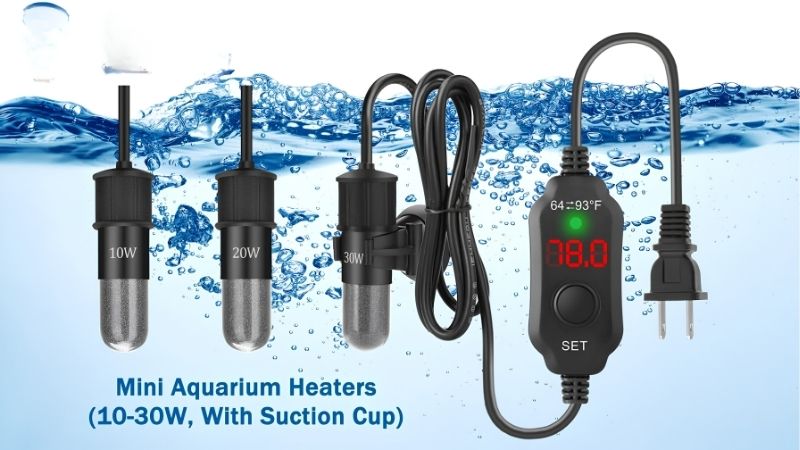
hygger Small Aquarium Betta Heater, Submersible Fish Tank Heater 10W/25W/50W/100W with LED Digital Display, Suitable for Marine Saltwater and Freshwater up to 5/10/16/26 Gallon
Selected for "How Many Watts Aquarium Heater Do You Need by Tank Size": this listing is heating (hygger Small Aquarium Betta Heater, Submersible Fish Tank Heater 10W/2), matching the equipment this article covers.
View on Amazon
DaToo Mini Aquarium Heater 25W Small Fish Tank Heater 25 Watt with Free Thermometer Sticker
Selected for "How Many Watts Aquarium Heater Do You Need by Tank Size": this listing is heating (DaToo Mini Aquarium Heater 25W Small Fish Tank Heater 25 Watt with Fre), matching the equipment this article covers.
View on Amazonhygger Small Aquarium Betta Heater, Submersible Fish Tank Heater 10W/25W/50W/100W with LED Digital Display, Suitable for Marine Saltwater and Freshwater up to 5/10/16/26 Gallon
Selected for "How Many Watts Aquarium Heater Do You Need by Tank Size": this listing is heating (hygger Small Aquarium Betta Heater, Submersible Fish Tank Heater 10W/2), matching the equipment this article covers.
View on AmazonBy David Nguyen
Measure Before You Calculate Anything
Working out how many watts aquarium heater duty requires starts with two measurements that most people skip: the real water volume in the tank and the lowest temperature the room reaches. Everything after that is arithmetic, and getting either input wrong makes the result useless.
The decisive numbers you need before calculating
Real water volume comes first, because a tank never actually holds its label figure. A 20 gallon (76 L) tank holds roughly 17–18 gallons (64–68 L) once substrate and hardscape are in, and a heavily aquascaped tank can sit a fifth below nominal capacity once everything is in place.
The second number is your coldest room reading, taken early in the morning across several days in a row rather than as a single spot check. The third is your target: most tropical community fish sit at 76–80 °F (24–27 °C), and the gap between the two figures drives the whole calculation.
Reading the symptoms of the wrong wattage
An undersized heater announces itself by simply never cycling off. If the unit runs continuously and the tank still sits a degree or two below target on cold nights, the wattage was calculated from a room reading that was too generous, not from any fault inside the heater itself.
Oversizing is a quieter problem and a more dangerous one. A large element in a small volume behaves normally until the thermostat sticks, at which point it drives the tank up far faster than a correctly sized unit would, which is why extra wattage is not a safety margin in any small tank.
When wattage is not the problem at all
Take four water readings before blaming the heater at all: ammonia, nitrite, nitrate and temperature. Ammonia and nitrite belong at 0 ppm and nitrate below 20–40 ppm, because fish showing stress in a correctly heated tank are often reacting to water quality rather than to temperature.
Room instability is the other common case. A tank beside a draughty window or an external door swings regardless of the wattage fitted, and moving it a few feet into a more sheltered position often does far more for stability than any change to the equipment sitting in the water.
| Symptom | Reading alongside it | Most likely cause | First action |
|---|---|---|---|
| Heater never switches off | Tank 1–2 °F below target | Undersized for the room | Recalculate from the coldest reading |
| Tank overshoots the setting | Above 82 °F (28 °C) | Oversized or stuck thermostat | Unplug, cool slowly, check shut-off |
| Temperature swings daily | Room varies several degrees | Placement, not wattage | Move the tank, fit a lid |
| Cold end of a long tank | 2–3 °F gradient | Single unit, weak circulation | Split wattage across two heaters |
| Fish stressed, temperature fine | Ammonia above 0.25 ppm | Water quality, not heating | Water change, pause feeding, retest |
Working Out the Number, Step by Step
The calculation behind how many watts aquarium heater output your tank needs is a single multiplication, but it only works if the inputs are properly measured rather than assumed. Work through the three steps in order and round up to the nearest heater size that is actually sold.
Step one: measure real volume and the room low
Estimate the real volume by subtracting 10–15 percent from the nominal figure for a normal substrate bed, or up to 20 percent for a heavily hardscaped layout with deep substrate. Then log the room temperature morning and evening for several days, and take the lowest figure rather than the average.
Do this during the coldest part of the year if you possibly can. A calculation made in June from a room sitting at 74 °F (23 °C) produces a heater that runs continuously in January, which is easily the most common reason that people replace a unit which was never actually faulty.
Step two: calculate the wattage and round up
Multiply the real gallons by the temperature rise in degrees Fahrenheit, and then by 0.4. That ratio comes from the familiar baseline of 3–5 watts per gallon at a rise of about 10 °F (5.5 °C), and it scales sensibly across the range of rises that indoor tanks actually experience.
A 29 gallon (110 L) tank holds about 25 gallons (95 L) of actual water. In a room falling to 66 °F (19 °C) with a target of 78 °F (26 °C), the rise is 12 °F, so 25 multiplied by 12 multiplied by 0.4 gives 120 W, which rounds up to a single 150 W unit in the sizes actually available.
Step three: tank size, placement and physical fit
The chosen unit must also fit below the working water line, since many models require full submersion. A 10 gallon (38 L) tank offers perhaps 10 inches (25 cm) of depth while a 55 gallon (208 L) tank gives around 19 inches (48 cm), which decides whether a full-length heater fits.
Weight sets the wider limits: a full tank runs near 10 lb per gallon (about 1 kg per L), so a 55 gallon (208 L) setup passes 600 lb (272 kg) and needs a purpose-built stand. Measure water depth against heater length with a tape before ordering, and leave a drip loop in the cable.
What Never to Do When Sizing a Heater
Three habits account for most of the mistakes that people make when deciding how many watts aquarium heater duty actually needs. Each one looks like caution and each one either creates a safety problem or produces a unit that will disappoint on exactly the nights it matters most.
Never oversize the heater as insurance
Extra wattage does not buy you a safety margin, it buys a faster failure. The rate at which a stuck thermostat raises the tank scales directly with element power, and 8 gallons (30 L) of water in a nano tank provides almost no thermal buffer at all while you work out what has happened.
Round up to the nearest available heater size and then simply stop at that. Automatic shut-off when the unit is exposed to air, correct sizing and a thermometer that is genuinely read all do far more for safety than choosing an element larger than the calculated figure ever will.
Never size from the label volume
Sizing from nominal capacity overstates the volume of water being heated by 10–15 percent, which is enough to push a borderline choice into the next size up. On a small tank that error is the difference between a 25 W and a 50 W unit, and the larger one is the riskier of the two.
Substrate depth matters more here than most people expect. Three inches (8 cm) of substrate plus rockwork can remove a fifth of the nominal volume, so recalculate whenever the layout changes substantially rather than reusing a figure that was worked out when the tank was first set up.
Never trust the dial without a thermometer
Budget units very commonly drift ±2–4 °F (1–2 °C) from the dial setting, and that error tends to grow across years of service. The dial reports what the heater was told rather than what the water is doing, which makes a separate thermometer part of the installation rather than an accessory.
Place it at the opposite end of the tank so that it reads properly circulated water rather than the warm plume leaving the element. On tanks longer than 36 inches (91 cm), two thermometers reveal the gradient directly and tell you whether the wattage needs splitting across two units.
Keeping the Figure Correct Over Time
The answer to how many watts aquarium heater output your own tank needs is never a permanent one, because rooms change with the seasons and thermostats drift steadily with age. Rechecking costs nothing and catches the slow problems long before they turn into a cold tank in January.
Recalculating with the seasons
Record the room temperature again each autumn rather than simply assuming that last year’s figure still applies. Changes to household heating, insulation, or even where the furniture sits can move the room reading enough to shift a borderline tank into a different bracket entirely.
Winter also raises evaporation in a heated room, dropping the level enough within a fortnight to expose equipment above the surface. That both increases heat loss from the surface and risks a heater running partly exposed, so weekly top-ups matter more between November and March than at any other time.
What drifts and how the drift shows up
Thermostat calibration moves across the years, so a unit holding 78 °F (26 °C) when new may sit two degrees away by its third winter with no visible sign. Suction cups harden and release their grip, dropping the heater down onto the substrate, which frequently cracks a glass body.
Controller probes drift for a different reason, since mineral scale and biofilm insulate the sensor and make it report a lower temperature than the water actually holds. Wipe them periodically, more often in hard water, and confirm against a separate thermometer rather than the display.
Early warning signs and the twelve month cost
How many watts aquarium heater sizing needs is also visible in three signals: a heater that stops cycling off, a growing gap between dial and thermometer, and a difference between the two ends of a long tank. Each of them points to sizing or placement rather than to a component that has actually failed.
Running costs here are mostly replacement rather than consumables, since heaters have no filters or media to buy. Budget for a thermometer, a spare unit for larger tanks, and replacement every few years, and check current prices at the time of purchase since they move constantly.
Frequently Asked Questions
These questions come up constantly once people begin sizing from real measurements rather than from general rules of thumb, because the honest answer to how many watts aquarium heater duty actually requires depends on a room reading that nobody else can supply for your particular house.
Is the five watts per gallon rule wrong?
It is a reasonable starting point but an incomplete one, because it quietly assumes a fixed temperature rise of about 10 °F (5.5 °C). In a warm room the same tank needs far less, and in a cold hallway it needs considerably more, so the rise has to enter the calculation somewhere.
What if my calculated wattage falls between two sizes?
Round up to the next available size, which is entirely normal since heaters come in fairly coarse steps. Do not round up twice as a precaution, and if the gap is large, consider splitting the total across two smaller units instead, particularly on tanks longer than 36 inches (91 cm).
Does a lid change the wattage I need?
Yes, and quite noticeably so. An open-top tank loses heat continuously from its surface and typically needs 15–20 percent more wattage than the same tank would when covered, so fitting a lid is often cheaper than moving up a heater size and helps with evaporation at the same time.
Should a heater ever run continuously?
Only briefly, when first heating a tank or after a particularly large water change. A unit that never cycles off in normal running is undersized for the room, and it will fall short on the coldest nights, so recalculate from your lowest recorded room reading rather than replacing it blindly.
See More:
Conclusion
The practical answer to how many watts aquarium heater output you need is real gallons multiplied by the temperature rise and then by 0.4, rounded up to the nearest available size. Measure the room at its coldest point, never oversize as insurance, and always confirm the result with a thermometer.

Best Shatterproof Aquarium Heater: Safe and Durable Picks
6 Best Aquarium Strip Thermometers 2026