Last Updated: October 21, 2026
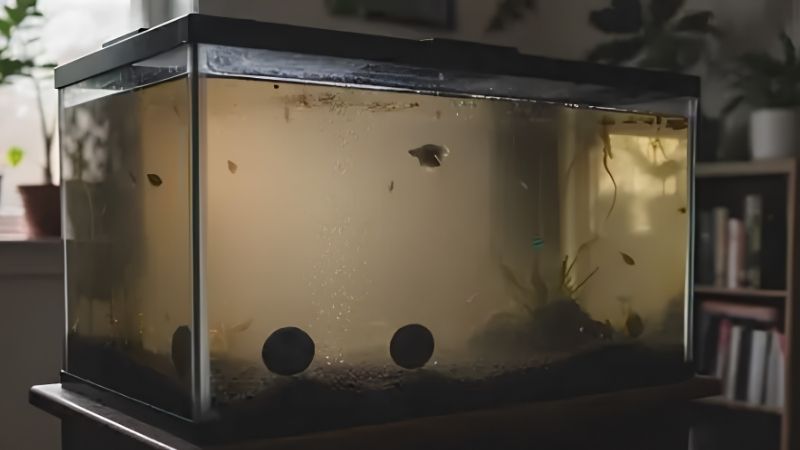
Fish tank smells bad is a symptom with one unusually useful property: the type of smell narrows the cause down considerably before you test a single thing. Rotten eggs, damp earth and a sharp chemical edge come from three completely different processes, and only one of those three counts as an emergency.
As an Amazon Associate we earn from qualifying purchases.
As an Amazon Associate we earn from qualifying purchases at no extra cost to you.




By David Nguyen
Reading the Smell Before You Test Anything
A healthy freshwater tank has a faint earthy smell or none at all. When a fish tank smells bad, something organic is decomposing faster than the system removes it, and identifying which process is running is a matter of the smell plus four readings.
Test These Four Numbers Before Anything Else
Test ammonia, nitrite, nitrate and temperature with a liquid kit. Ammonia and nitrite at 0 ppm and nitrate under 40 ppm mean the nitrogen cycle is working, and the odour is coming from somewhere the biological filter does not reach.
Ammonia above 0.25 ppm alongside a smell changes the priority entirely. That combination means the filter is not keeping pace, and the water change comes first while you work out what is decomposing.
Record two inputs alongside the readings: how much food goes in daily, and when the substrate was last vacuumed. Food consumed within one to two minutes and substrate cleaned during weekly changes are the reference points most smelly tanks have drifted well past.
The Chemistry Behind Each Smell
Rotten eggs is hydrogen sulphide, produced by bacteria working in oxygen-free pockets. It forms in deep, compacted sand, under large rocks and in dead spots where water never moves, and it is released when that pocket is disturbed.
A musty, earthy smell is usually geosmin from bacteria and algae, and it is the least concerning of the three. It intensifies with organic load and warm water, and it is the smell healthy tanks have a faint version of.
A sharp, almost chemical edge points toward ammonia in the water and decomposition in the open, which is the combination you get with a dead fish behind a decoration, uneaten food in substrate, or a filter that stopped running.
Oxygen availability sits behind all three. Aerobic bacteria break organics down without producing offensive compounds, and the smells appear precisely where oxygen runs out, whether that is deep in sand, inside a stalled filter or in a warm tank with a still surface.
Normal Ranges Against Action Thresholds
The table pairs each smell with its readings and the first move. Use it with the test results in front of you, because two of these smells appear in tanks with clean readings and one almost never does.
| What it smells like | Readings | Most likely cause | First action |
|---|---|---|---|
| Rotten eggs, sulphur | All four normal | Anaerobic pocket in deep substrate | Stir substrate in small sections weekly |
| Musty, earthy, faint | Nitrate under 40 ppm | Normal biofilm and algae | None, this is a healthy tank |
| Strong musty with visible film | Nitrate above 40 ppm | Organic load outgrowing the schedule | Change 30%, vacuum, feed less |
| Sharp, decaying, sudden onset | Ammonia above 0.25 ppm | Dead fish or stalled filter | Find and remove it, change 50% |
| Sour smell from the filter itself | Ammonia above 0 ppm | Filter stopped, media went anaerobic | Rinse media in tank water before restarting |
What This Means in a Real Tank
The same organic load produces very different results depending on volume, substrate and circulation. A fish tank smells bad far more readily in some configurations than others, and most of those factors were decided when the tank was set up.
Tank Size, Placement and Fit
Volume dilutes odour compounds exactly as it dilutes everything else. A 5 gallon (19 L) tank concentrates organics four times more than a 20 gallon (76 L) tank, so the same missed maintenance produces a noticeable smell in one and nothing in the other.
Substrate depth is the specific risk factor for the sulphur smell. Sand deeper than about 2 in (5 cm) without any disturbance develops oxygen-free zones, while gravel of the same depth allows more water movement and rarely produces it.
Placement affects both circulation and how much you notice. A tank in a small closed room concentrates any odour, and one with a tight-fitting lid and no surface agitation reduces gas exchange. Measure before you order: 4-6 in (10-15 cm) behind the tank for a hang-on-back filter, and stand capacity against roughly 10 lb/gallon (about 1 kg/L) filled.
How This Differs Across 10, 20 and 55 Gallon Tanks
Small tanks smell sooner and larger tanks smell worse when they finally do. A 10 gallon (38 L) tank shows the effect of one dead fish within a day, while a 55 gallon (208 L) tank can hide accumulated substrate waste for months before it announces itself.
Circulation scales with the tank. A baseline turnover of 4-6 times tank volume per hour suits community stocking, with 8-10 times for goldfish and cichlids, and printed GPH drops 30-50% once media and hoses are loaded. Dead spots form wherever that flow does not reach.
Surface agitation matters as much as turnover. Gas exchange happens at the surface, and a tank with a still surface and a sealed lid traps odour compounds and limits oxygen, which is the combination that makes a marginal tank smell noticeably worse.
How Stocking, Substrate and Feeding Change the Picture
Bioload drives all of it. Goldfish and large cichlids produce heavy waste that settles into substrate, so their tanks need more vacuuming and larger changes than a comparable weight of small tetras in the same volume.
Feeding is the input people underestimate. Food that reaches the substrate uneaten decomposes there, and sinking pellets in a tank of mid-water fish is one of the most reliable ways to build an organic reservoir nobody sees.
Decoration choice contributes as well. Large flat ornaments sitting directly on sand, dense driftwood tangles and unsealed caves all create zones where water does not circulate, and those are where waste settles and stays out of reach of the filter.
Summer amplifies everything. Warmer water holds less dissolved oxygen and speeds decomposition at the same time, so a tank that was fine through spring can start to smell in July with nothing about the routine having changed at all.
Common Mistakes and Myths to Retire
Three responses make the underlying situation worse whenever a fish tank smells bad. Each removes the symptom briefly, and each either strips the biological filter or masks the process that needs finding.
Myth: A Big Water Change Will Fix the Smell
A change dilutes dissolved compounds but removes nothing decomposing in substrate, behind rocks or inside the filter. The smell returns within days because the source is still there, and a change above 50% adds a chemistry swing for no benefit.
The replacement approach: find the source. Vacuum a section of substrate, check behind decorations, count fish, and open the filter. A 20-30% change belongs in the routine either way, but as maintenance rather than as a treatment.
There is a genuine limit on change size too. Replacing more than roughly half the volume at once, particularly with hard tap water going into a soft tank, swings pH and hardness enough to stress fish, which adds a second problem to the one you started with.
Myth: Carbon or an Odour Product Solves It
Activated carbon does adsorb some organic compounds and reduces odour for a few weeks until it saturates. That makes it useful after removing a source, and actively unhelpful as a substitute for removing one, since the decomposition continues out of sight.
Products marketed for aquarium odour work on the same principle. Both mask the signal that would otherwise tell you something is wrong, which matters most in the one case where a fish tank smells bad because ammonia is climbing.
Myth: Deep Substrate Should Be Stirred All at Once
Releasing a large anaerobic pocket in one go can push accumulated hydrogen sulphide and organics into the water column at once, which is genuinely risky in a small, warm, stocked tank. This is the one case where thoroughness is the wrong instinct.
The replacement method: work a third of the substrate at a time during weekly changes, and keep sand beds under about 2 in (5 cm) unless the tank is planted with root systems doing the work. Rooted plants and burrowing snails both help continuously.
Keeping a Tank Odour Free Long Term
An odour-free tank is a maintenance outcome, not a product outcome, and a fish tank smells bad mainly when that maintenance has slipped. The routine that keeps nitrate under 40 ppm keeps smell away too, because both numbers track the same thing: how much organic material stays in the tank.
What to Do on a Schedule
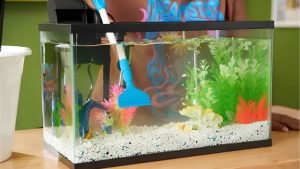
Change 20-30% weekly adjusted by measured nitrate, and vacuum a portion of the substrate during each change so waste leaves the tank rather than decomposing in it. Rotate which section you clean so the whole bed gets covered monthly.
Feed what is eaten in one to two minutes, once or twice daily, and remove anything left after five minutes. Check behind decorations and count your fish weekly, because a missing fish found at week three is a very different situation from one found the same day.
Keep surface agitation adequate year round. A filter outflow that breaks the surface, or an air stone in warmer months, maintains the gas exchange that keeps decomposition aerobic, and it costs nothing beyond aiming the outflow correctly.
Gear That Degrades and How It Shows Up
Filters lose flow as media loads and impellers wear, and less flow means more dead spots. A hang-on-back unit that loses prime after a power cut may sit still for hours, and media left without oxygen goes sour quickly enough to smell on restart.
Restarting a filter that has been off for more than a few hours deserves care. Rinse the media in tank water first rather than letting stagnant water push straight back into the tank, which is the most common way a power interruption produces a smell.
Test reagents expire and read low with age, which matters because the ammonia result decides whether the smell is urgent. Heaters drift ±2-4 °F (±1-2 °C) on budget units, and every powered device beside water needs a GFCI outlet, a drip loop and a UL or ETL mark.
The Twelve-Month Running Cost
The recurring costs are dechlorinator, mechanical media, test reagents, food and continuous power for filter and heater. A siphon that connects to a tap costs once and makes substrate vacuuming quick enough that it actually happens every week.
Filters taking loose media let you replace floss while keeping colonised biological media, which is cheaper across the year and avoids the mini-cycles that follow a cartridge swap. Those mini-cycles are a common cause of a sour smell in an otherwise established tank.
Frequently Asked Questions
These five come up most often when a tank has started to announce itself from across the room.
Is a faint earthy smell normal?
Yes. A slight earthy or mineral smell is what a healthy planted tank produces, and it comes from biofilm and algae rather than from decay. Concern begins when the smell becomes strong, sulphurous or sharp rather than merely present.
Can a smelly tank harm my fish?
The smell itself does not, but the causes can. Ammonia climbing, a large anaerobic release or oxygen depletion in warm water all affect fish directly, which is why the four readings matter more than the odour on its own.
Why does my filter smell when I open it?
Trapped detritus decomposing in low flow areas of the housing. Rinse mechanical media in a bucket of tank water monthly, never under the tap, and clean only one section at a time so the nitrifying colony stays intact.
Does a smell mean I should replace my substrate?
Almost never. Stirring sections gradually, reducing depth to under about 2 in (5 cm) and adding rooted plants addresses the cause without dismantling the tank. A full substrate replacement disturbs the biological filter and usually creates larger problems.
How long after removing the source until the smell goes?
Usually one to three days with normal filtration and a water change. If a fish tank smells bad for more than a week after you have removed what you found, there is a second source still in the tank.
The Bottom Line on Aquarium Odour
When a fish tank smells bad, read the smell before you reach for anything. Rotten eggs points to anaerobic pockets in deep substrate, musty is usually normal biofilm, and a sharp decaying smell with an ammonia reading above 0.25 ppm means finding the source today. Test the four numbers, vacuum a section of substrate each week, feed what is eaten in two minutes, and keep the filter running with good surface agitation. Carbon and odour products belong after the source is gone, never instead of finding it.
55 Gallon Aquarium Dimensions Size Guide With Measurements (2026)
Aquarium Plant Nutrient Deficiencies: A Visual Diagnosis Guide