Last Updated: October 21, 2026
- Top Pick: Ultralife Blue Green Slime Stain Remover
- Best Value: Blue Life Green Cyano Rx
- Premium Choice: Ultralife Blue Green Slime Aquarium Stain Remover, 150 Gallons
Blue green algae aquarium treatment is the one algae job where waiting even a fortnight makes the situation materially worse. The slimy sheets are cyanobacteria rather than true algae, they spread across substrate and plants within days, and they need the circulation corrected as well as the sheets removed.
As an Amazon Associate we earn from qualifying purchases.
As an Amazon Associate we earn from qualifying purchases at no extra cost to you.






By David Nguyen
Not Algae at All, and Why That Matters
Cyanobacteria are photosynthetic bacteria, not algae, which is why several standard algae responses do nothing against them. Effective blue green algae aquarium treatment starts from that distinction, because the conditions it needs are different from anything else on the glass.
The Deciding Factors: Flow, Organics and Speed of Response
Circulation is the first number. A baseline turnover of 4-6 times tank volume per hour suits community stocking, and printed GPH drops 30-50% once media and hoses are loaded. Cyanobacteria establishes wherever water genuinely stops moving.
Organic load is the second. Test nitrate against a ceiling of 40 ppm, and look at when the substrate was last vacuumed. Accumulated detritus in a low-flow corner is the exact combination that produces the first patch.
The third factor is not a measurement but a deadline. A patch the size of a coin can cover a substrate bed within one to two weeks, so this is the algae type where acting the same day genuinely changes the outcome.
The Biology: Why It Spreads So Fast
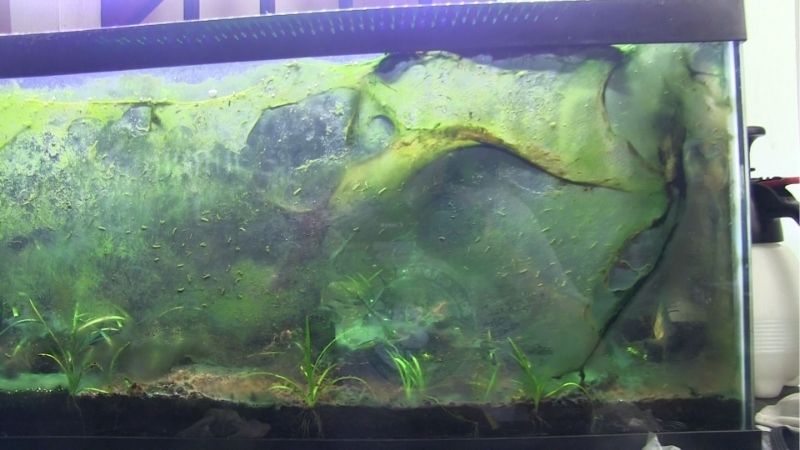
Cyanobacteria forms sheets that lift off in one piece rather than films that wipe away. That structure lets it smother plants, block gas exchange at the substrate surface and expand across a flat bed far faster than attached algae can.
Many strains fix nitrogen from the water directly, which means low nitrate does not limit them the way it limits green algae. This is why a lean, carefully dosed planted tank can develop it while a heavily fed tank next to it does not.
The distinctive musty smell comes from compounds these bacteria produce, and it is the fastest identification method available. If a patch smells strongly when you lift a piece out on a net, the identification is settled before you look at anything else.
Colour is less reliable than texture. Cyanobacteria appears blue-green, dark green or almost black depending on the strain and the light, so the test that matters is whether it peels away in a sheet rather than what shade it happens to be.
Ranges Against Action Thresholds
The table pairs each pattern with what it indicates. Location matters more than quantity here, since the spot it starts in tells you which condition to correct.
| Where it appears | Readings and inputs | What it indicates | First action |
|---|---|---|---|
| Substrate front glass, one corner | Flow not reaching that area | Dead spot with settled detritus | Siphon out, redirect outflow |
| Across the whole substrate bed | Nitrate above 40 ppm | Organic load and weak circulation | Blackout plus flow correction |
| On plants and moss | Turnover under 4x volume per hour | Stagnant planted areas | Trim, siphon, increase flow |
| In a lean, low-nitrate tank | Nitrate under 10 ppm | Nitrogen-fixing strain, not nutrient limited | Blackout, then raise plant competition |
| Returning after every clean | Substrate deep and compacted | Anaerobic pockets feeding it | Stir substrate in sections, add flow |
What This Means in a Real Tank
Blue green algae aquarium treatment succeeds or fails on layout more than on feeding. Hardscape density, substrate depth and where the outflow points explain most of the difference between a tank that gets it and one that never does.
Tank Size, Placement and Fit
Layout creates the dead spots. Large flat rocks resting on substrate, dense planting against the front glass and tall hardscape all block circulation, and a filter rated well above tank volume still leaves stagnant pockets if flow does not reach them.
Substrate depth compounds it. Sand deeper than about 2 in (5 cm) without disturbance develops oxygen-free zones, and cyanobacteria frequently establishes directly above those areas where organics are decomposing anaerobically underneath.
Measure before you order: powerhead or filter outflow position against tank length, 4-6 in (10-15 cm) behind the tank for a hang-on-back filter, cabinet height for a canister, and stand capacity against roughly 10 lb/gallon (about 1 kg/L) filled.
How This Differs Across 10, 20 and 55 Gallon Tanks
Long tanks are harder to circulate. A 55 gallon (208 L) tank needs flow carried the full length, which a single hang-on-back unit at one end rarely achieves, while a 20 gallon (76 L) tank usually circulates adequately from one point.
Small tanks reach a visible outbreak faster. A 10 gallon (38 L) tank can go from one patch to a covered substrate bed in a week, so the deadline for response is shorter in a nano setup than in a large one.
Blackouts are also easier on small tanks. Covering a 10 gallon tank completely takes a towel, while a 55 gallon tank in a bright room needs more effort to exclude light entirely, and partial darkness does not work.
Turnover requirements scale with stocking as well as volume. Community tanks sit at 4-6 times volume per hour, while goldfish and cichlid tanks want 8-10 times, and those higher-waste tanks are exactly the ones where organics settle fastest in still corners.
How Substrate, Planting and Style Change the Picture
Nutrient-rich soil substrates release organics when disturbed and hold more of them permanently, which raises the risk in exactly the tanks aquascapers favour. That is a trade-off of the substrate rather than a fault in the setup.
Plant health decides how much competition exists afterwards. A tank where stems are growing and being trimmed monthly recovers from an outbreak far more reliably than one where the plants have been stalled for months and the substrate is doing all the work.
The soil-substrate and low-tech Walstad style spreading through aquascaping social media makes this more common than it used to be. Those tanks are workable, and they need genuine attention to circulation, because an organic-rich bed with minimal flow is what cyanobacteria wants most.
Dense carpet plantings create their own dead zones. A thick carpet across the front of a tank stops water reaching the substrate surface beneath it, and cyanobacteria commonly starts at the front glass where nobody expects it.
Feeding practice matters here too. Sinking pellets in a tank of mid-water fish leave food on the substrate to decompose, and that is the organic supply feeding a patch that keeps returning to the same spot after every clean.
Common Mistakes and Myths to Retire
Three responses to blue green algae aquarium treatment either fail outright or spread the problem further. Each treats cyanobacteria like green algae, which it is not.
Myth: Standard Algae Products Will Handle It
Products aimed at green algae generally do little against cyanobacteria, because it is a bacterium with different biology. Meanwhile many of them contain copper, which is lethal to shrimp and snails at very low concentrations, so the cost is real and the benefit is not.
Antibiotic-based treatments are sometimes recommended and this guide does not cover dosing them. What is worth knowing is the mechanism: anything that kills bacteria in the water reaches the nitrifying colony too, and an ammonia spike afterwards is a common outcome.
Myth: Scrub It Off and It Is Gone
Breaking a sheet up scatters fragments across the tank, and each fragment establishes a new patch within days. Scrubbing is the single most effective way to turn one corner of cyanobacteria into six of them.
The replacement technique: siphon it out whole. Lift each sheet with the hose so it leaves the tank intact, work slowly, and do this during a water change so the removed volume is being replaced anyway.
Handle affected plants the same way. Trim badly covered leaves and remove them from the tank rather than shaking them clean in the water, since shaking is the plant equivalent of scrubbing and produces the same scattering of fragments.
Myth: Cutting Nutrients Will Starve It
Many strains fix nitrogen from the water, so reducing nitrate does not limit them the way it limits green algae. Lean tanks develop cyanobacteria regularly, and cutting dosing further simply weakens the plants that would otherwise compete.
The replacement approach: fix flow and organics, use a blackout to knock the population down, then strengthen plant growth. Nutrient reduction is close to irrelevant as a blue green algae aquarium treatment on its own.
Treating and Preventing It Long Term
The reliable blue green algae aquarium treatment sequence is siphon, blackout, flow correction, then plant competition. A blackout without the flow fix buys a few weeks, and a flow fix without the blackout leaves an established population in place.
The Blackout Method and What Follows
Siphon out as much as possible first, then cover the tank completely so no light enters for three to four days. Keep the filter running, add an air stone, and do not feed. Partial darkness does not work, and longer than four days damages plants.
When the cover comes off, change 30-40% with temperature matched to within 1-2 °F (about 1 °C) and siphon any remaining material. Restore light at six hours rather than the previous schedule, and expect to repeat the process if flow was not corrected.
Test ammonia and nitrite the day after a blackout ends. A large die-off of any organism adds organic matter to the tank, and confirming the biological filter has kept pace is worth five minutes before deciding the job is finished.
Gear That Degrades and How It Shows Up
Filter flow drops 30-50% as media loads and impellers wear, which recreates the dead spots you corrected. A hang-on-back unit that lost prime after a power interruption may be moving almost nothing while sounding perfectly normal.
Powerhead impellers wear and suction cups perish, letting a unit drop and point at the substrate. Timers get reset by power interruptions, leaving lights running longer than intended, which favours regrowth after treatment.
Check flow physically rather than assuming. Watching where fine particles travel during a water change shows you the dead spots directly, and it takes a minute of observation that no test kit can substitute for.
Test reagents expire and read low with age, which matters after any bacterial treatment when the ammonia reading is doing important work. Every powered device beside water belongs on a GFCI outlet with a drip loop and a UL or ETL mark.
The Twelve-Month Running Cost
The recurring items are dechlorinator, replacement mechanical media, test reagents and continuous power for filter, light and heater. A powerhead is a one-off purchase that addresses the flow half directly and prevents recurrence better than any consumable.
Prices for equipment change constantly, so check at the time of purchase rather than working from any figure quoted elsewhere. The comparison that matters is the twelve-month cost of running a device rather than what it costs on the shelf.
Frequently Asked Questions
These five come up most often once a patch has appeared and the smell has confirmed exactly what it is.
How fast does treatment work?
A blackout knocks the population down in three to four days, and visible clearance follows within one to two weeks. That is fast compared with other algae types, and it only lasts if flow and organics were corrected at the same time.
Is cyanobacteria dangerous to fish?
It smothers plants and can foul water in heavy outbreaks, and dense mats reduce gas exchange at the substrate. Add an air stone during any outbreak or blackout, and watch for rapid gill movement, particularly before dawn.
Can I do a blackout in a planted tank?
Yes, for three to four days. Most plants tolerate that period, though delicate stems may drop some leaves and will recover. Longer blackouts cause melting, which adds decomposing plant matter to a tank that already has an organic problem.
Why did it start in a clean, low-nutrient tank?
Because nitrogen-fixing strains are not limited by low nitrate, and lean tanks often have weaker plant growth. Check flow into every corner first, since a stagnant area in a clean tank is the usual explanation.
Will it come back after treatment?
It returns whenever the conditions do. Any blue green algae aquarium treatment that clears the tank without fixing circulation and organics buys a few weeks at most, which is why the flow correction is the part worth spending money on.
See More:
The Bottom Line on Cyanobacteria
Blue green algae aquarium treatment is a same-day job: siphon the sheets out whole rather than scrubbing them, then run a complete three to four day blackout with the filter going and an air stone in. Afterwards, correct what caused it by redirecting flow into dead corners, keeping turnover at 4-6 times volume per hour, vacuuming substrate in sections and reducing substrate depth under about 2 in (5 cm). Reducing nutrients does very little, and standard algae products do less.
hygger Small Aquarium Betta Heater vs auomii USB 10W Mini Submersible Aquarium: Which Should You Buy?
Betta Fish Tank Setup Guide: Build the Perfect Betta Home