Last Updated: September 25, 2026
Best reef tank light comparisons are settled by PAR at the coral rather than by wattage at the fixture. Soft corals want 50-100 µmol, LPS 100-200, and SPS 200-400, measured at the depth the coral actually sits rather than at the surface. Coverage across the whole footprint, not just under the centre of the fixture, decides most of the rest.
As an Amazon Associate we earn from qualifying purchases.
As an Amazon Associate we earn from qualifying purchases at no extra cost to you. Prices and availability are accurate as of the date shown and are subject to change.

NICREW NavaReef LED Reef Light, 65W Aquarium Lighting for Soft/LPS Corals
Selected for "Best Reef Tank Light: Compared by PAR, Spectrum and Cost": this listing is lighting (NICREW NavaReef LED Reef Light, 65W Aquarium Lighting for Soft/LPS Cor), matching the equipment this article covers.
View on Amazon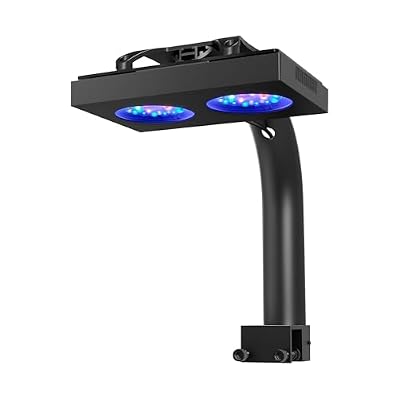
NICREW HyperReef 100 Gen 2 LED Reef Aquarium Light, 100W for LPS SPS Corals
Selected for "Best Reef Tank Light: Compared by PAR, Spectrum and Cost": this listing is lighting (NICREW HyperReef 100 Gen 2 LED Reef Aquarium Light, 100W for LPS SPS C), matching the equipment this article covers.
View on Amazon
NICREW 32W Saltwater Aquarium Light, Marine LED Reef Light for Corals, Programmable Timer Controller, 30 to 36-Inch
Selected for "Best Reef Tank Light: Compared by PAR, Spectrum and Cost": this listing is lighting (NICREW 32W Saltwater Aquarium Light, Marine LED Reef Light for Corals,), matching the equipment this article covers.
View on Amazon
SMATFARM Aquarium Light- 140W Reef Light Wide Coverage Sunrise Sunset Moonlight Saltwater Lights for Coral with Master Slave Group Control & Timer & Screen
Selected for "Best Reef Tank Light: Compared by PAR, Spectrum and Cost": this listing is lighting (SMATFARM Aquarium Light- 140W Reef Light Wide Coverage Sunrise Sunset ), matching the equipment this article covers.
View on AmazonBy David Nguyen
PAR at the Coral Rather Than Watts at the Fixture
Choosing the best reef tank light means matching output to coral type and coverage to footprint. Watts tell you almost nothing, and two fixtures drawing identical power can differ by a factor of two in PAR at 18 in (46 cm).
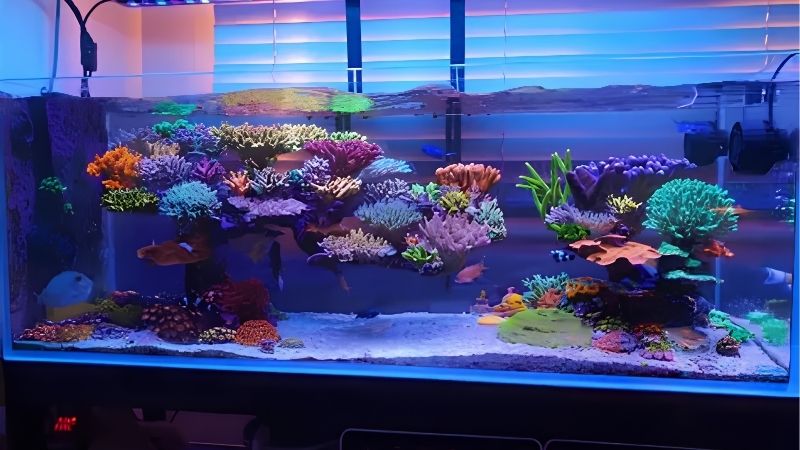
The Deciding Number: PAR at Coral Depth
PAR falls sharply with distance from the fixture, so a figure quoted at 6 in (15 cm) is not the figure your coral receives at 18 in (46 cm). Always compare fixtures at the depth of your own tank rather than at the manufacturer’s chosen distance.
Match the number to the animal. Mushrooms, zoanthids and leathers sit comfortably at 50-100 µmol; hammer, torch and most LPS at 100-200; acropora and other SPS at 200-400. Exceeding a coral’s range bleaches it rather than growing it faster.
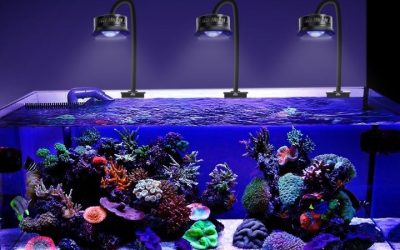
Placement then does the fine adjustment. A single fixture over a 20 in (51 cm) deep tank produces a considerable range from the top of the rockwork to the sand bed, which is what lets one light serve softies low down and LPS higher up.
Two More Criteria With Numbers Attached
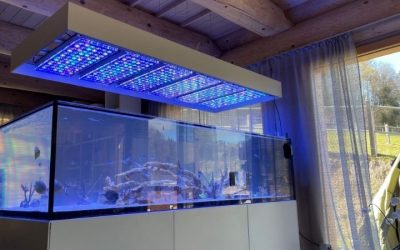
Coverage decides how many fixtures you need. A single panel typically covers around 24 x 24 in (61 x 61 cm) with usable PAR, so a 48 in (122 cm) tank needs two units or a bar-style fixture rather than one panel centred over it.
Spectrum and control come next. Reef fixtures usually run in the 14000-20000 K range for colour rendering, and programmable ramping over an 8-10 hour photoperiod avoids the light shock that a hard on-off cycle produces in newly added corals.
Blue-weighted output is standard for a reason beyond appearance. Corals use the shorter wavelengths most effectively, and the blue-heavy look most reef fixtures produce reflects that rather than being a purely aesthetic choice by manufacturers.
Tank Size, Placement and Fit
Measure the tank length and the water depth against the fixture’s stated coverage before ordering, since a unit rated for a 24 in (61 cm) tank spreads too thinly over 36 in (91 cm) and leaves the ends underlit.
Mounting height changes everything. Raising a fixture from 6 to 12 in (15 to 30 cm) above the water widens coverage and lowers PAR substantially, which is a useful adjustment and one to plan for rather than discover afterwards.
The Options by Coral Type and Tank Length
Four fixture classes cover essentially every reef. Each is matched below to a coral group and a footprint, because the best reef tank light depends on what you intend to keep rather than on which technology is newest.
Nano LED Panel: For Tanks Up to 24 Inches
Main numbers: coverage around 20 x 20 in (51 x 51 cm), delivering 100-200 µmol at 12 in (30 cm) on most units. That range suits soft corals and LPS in a 10-20 gallon (38-76 L) all-in-one comfortably.
It suits nano reefs where one fixture covers the whole footprint without leaving dark corners. It does not suit SPS, since few nano panels reach 200-400 µmol at depth, and it does not spread across a tank longer than about 24 in (61 cm).
Programmable LED Panel or Bar: The General-Purpose Choice
Main numbers: 150-400 µmol at 18 in (46 cm) depending on model and height, with per-channel spectrum control and ramping. Two panels or a single bar cover a 48 in (122 cm) tank without dark ends.
It suits mixed reefs and anyone who may move toward SPS later, since output can be dialled up as corals adapt. It does not suit a tight budget, and the control app is an extra dependency that some keepers find intrusive.
T5 Fluorescent: For Even Coverage and Colour
Main numbers: a four to eight bulb fixture delivering broad, even PAR across the full footprint with no shadowing between bulbs. Colour rendering is widely regarded as excellent, and there is no point-source shimmer.
It suits tanks where even coverage matters more than control, and low-light corals placed under overhangs. It does not suit anyone unwilling to replace bulbs, since output falls measurably and they need changing roughly annually.
LED and T5 Hybrid: For Demanding Mixed Reefs
Main numbers: LED channels for intensity and control plus T5 tubes for spread, reaching 200-400 µmol across the footprint rather than only under the panel. This is the arrangement most SPS-dominant tanks converge on.
It suits established reefs with demanding corals across a long tank. It does not suit a first reef, since the cost is the highest of the four and the additional capability is wasted on soft corals that want 50-100 µmol.
| Option | PAR at 18 in (46 cm) | Coverage | Recurring cost | Best for |
|---|---|---|---|---|
| Nano LED panel | 100-200 µmol at 12 in | 20 x 20 in (51 x 51 cm) | None until replacement | Nano reefs, softies and LPS |
| Programmable LED | 150-400 µmol | 24 x 24 in (61 x 61 cm) each | None until replacement | Mixed reefs, future SPS |
| T5 fluorescent | 150-250 µmol | Full fixture footprint | Bulbs roughly annually | Even coverage, colour rendering |
| LED and T5 hybrid | 200-400 µmol | Full fixture footprint | Bulbs roughly annually | SPS-dominant established reefs |
| Freshwater plant light | Wrong spectrum | Not applicable | Not applicable | Not suitable for corals |
Head to Head, and When Not to Buy
Two of these get compared constantly, and there are cases where a new fixture is the wrong purchase. The best reef tank light is sometimes the one already fitted, raised or dimmed rather than replaced.
LED Versus T5
LED wins on control, on running cost with no bulbs to replace, and on the ability to raise output as corals adapt. It loses on shadowing, since point sources leave dark areas under overhangs that a diffuse source fills.
T5 wins on even coverage and colour rendering, which is why hybrids exist at all. It loses on recurring cost and on the absence of dimming, so a T5 tank is adjusted by raising the fixture rather than turning it down.
When a New Light Is the Wrong Fix
Pale corals with parameters in range are more often over-lit than under-lit. Raise the fixture or reduce intensity by 10-20% and wait three weeks before buying anything, since coral colour responds slowly to a lighting change.
Poor growth with good colour is usually alkalinity, calcium or magnesium rather than light. Test the full set and check the alkalinity trend between water changes before concluding that the fixture is the limiting factor.
The Cheaper Route That Works
Borrow a PAR meter from a local aquarium club before spending. One afternoon of measurements at coral height tells you whether the existing fixture already delivers what your corals need, and it frequently does.
Adjusting mounting height is free. Lowering a fixture by 4 in (10 cm) raises PAR noticeably, and raising it widens coverage, so a fixture that seems too weak in the corners is often just mounted too low for the footprint.
Running It and the 12-Month Cost
The best reef tank light runs 8-10 hours a day for years, so degradation matters more than the purchase price does. This section covers what fades, what fails and what each class costs to keep running.
What Degrades and How Fast
LED output falls measurably across two to three years without the fixture appearing dimmer, which shows up as corals slowly losing colour or growth. Only a PAR measurement catches it, which is why an annual check is worth the effort.
T5 bulbs decline faster and more predictably, losing useful output within about twelve months. Replace them on a calendar rather than when they look dim, and stagger replacements so the tank does not see a step change in intensity.
Failure Points and Safety
Drivers and fans are the usual LED failures, and fan noise increasing is often the first sign. Salt creep corrodes connectors on any fixture mounted close to the water, so leave clearance and wipe the underside periodically.
Every fixture over saltwater should carry a recognised certification such as UL or ETL, sit on a GFCI circuit and have a drip loop formed in its cable. Salt spray is conductive, which makes cable routing a safety matter rather than tidiness.
Photoperiod, Running Cost and Timing
Run 8-10 hours with a ramp at each end rather than a hard switch. Longer photoperiods drive nuisance algae without benefiting corals, and a fixture at 60-70% intensity across a longer day is not equivalent to full intensity for fewer hours.
On timing, reef lighting sees its deepest discounts in late June and again in late November, which suits a planned upgrade. A sale changes nothing biological, since corals still need weeks to adapt to a new fixture, and prices move constantly.
Best Reef Tank Light Questions
These arrive once corals are planned but before the fixture is ordered. Every answer about the best reef tank light stays with PAR and coverage, since those two decide outcomes far more than the technology label does.
How do I know my PAR without a meter?
Borrow one from a local club, or use the manufacturer’s PAR map matched to your mounting height and tank depth. Coral behaviour is the fallback: retracted polyps and pale tissue near the top usually mean too much rather than too little.
Can I use a freshwater plant light?
No. The spectrum is weighted differently and the intensity at depth is generally far below what corals need. It will grow algae adequately, which is the usual outcome when one is fitted over a reef.
How long should the light run?
Eight to ten hours including a ramp up and down of 30-60 minutes each. Extending beyond that feeds algae rather than corals, and a sudden full-intensity start stresses newly added corals more than the total hours do.
Do I need to acclimate corals to new light?
Yes. Start a new fixture at 50-60% of intended intensity and raise it by roughly 10% a week across a month. Corals adapt their pigment over weeks, and a full-intensity switch commonly bleaches animals that would have been fine.
See More:
Conclusion
The best reef tank light is the one delivering the PAR your corals need at the depth they sit: 50-100 µmol for softies, 100-200 for LPS and 200-400 for SPS, across the whole footprint rather than only under the centre.
For most mixed reefs a programmable LED panel or bar is the default, with T5 or a hybrid where even coverage and colour matter most. Check coverage against tank length, ramp over 8-10 hours, and re-measure PAR annually as output fades.
5 Best Coral Decoration Fish Tanks 2026
Reef Tank Auto Top Off System: Sizing and Failure Modes