Last Updated: October 4, 2026
Choosing the right protein skimmer is less about buying the largest model that fits your budget and more about matching the skimmer to your aquarium’s actual water volume, livestock load, sump layout, and maintenance habits. Many reef keepers make the same mistakes: they trust the manufacturer’s biggest gallon rating, ignore the skimmer’s footprint, buy a model that is too powerful for a lightly stocked tank, or forget to leave room for cup removal and adjustment.
The goal is a stable foam head that removes dissolved organic waste without constantly overflowing or stripping the tank too aggressively. This guide explains how to choose reef protein skimmer size in 2026, using practical capacity ranges, physical measurements, operating costs, and ownership details that matter after installation.
As an Amazon Associate we earn from qualifying purchases at no extra cost to you.


Decide These 3 Things First
- Your true water volume: Calculate display volume plus sump water, then subtract rock, sand, and unused space. A “100-gallon” aquarium may hold only 75 to 85 gallons of actual water.
- Your bioload: Count fish, feeding frequency, coral type, and whether you plan to add livestock. A lightly stocked fish-and-soft-coral tank needs less skimming than a heavily fed mixed reef.
- Your sump space and water depth: Measure the available footprint, height, and operating depth before shopping. A skimmer with a 9-by-9-inch footprint may still be unusable if the collection cup cannot be removed.
Once those three points are clear, compare the decisive factors below. Manufacturer capacity ratings are useful for narrowing choices, but they are not standardized. For dependable performance, select a skimmer whose realistic rating is about 20% to 30% above your calculated water volume, especially if you keep several fish or feed heavily.
1. Size and Capacity
Skimmer sizing starts with the amount of water and waste the unit must process. For a lightly stocked reef, choose a model rated for roughly 1.2 times your real water volume. For a heavily stocked system, aim closer to 1.5 times the actual volume, provided the skimmer can be adjusted gently enough for normal operation.
As a general guide:
- Small systems, 20 to 40 gallons: Look for a compact skimmer rated around 40 to 80 gallons. Typical footprints are 6 by 6 to 8 by 8 inches, with heights of 16 to 22 inches.
- Medium systems, 40 to 90 gallons: Consider a skimmer rated for 80 to 150 gallons. Expect a footprint of approximately 8 by 8 to 11 by 11 inches and a height of 19 to 25 inches.
- Larger systems, 90 to 150 gallons: A 150- to 250-gallon-rated unit is usually appropriate, depending on livestock. Footprints commonly range from 10 by 10 to 13 by 13 inches, with heights of 21 to 27 inches.
- Very large or heavily stocked systems: Look for a larger body, a controllable pump, or two skimmers rather than relying on one oversized, difficult-to-tune unit.
Do not judge size by body diameter alone. A tall, narrow skimmer can produce effective contact time, while a shorter, wider body may fit better in a crowded sump. Leave at least 2 to 4 inches above the collection cup for removal and another 1 to 2 inches around the body for cleaning.
2. Material and Construction
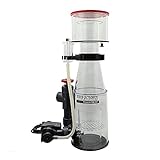
Most modern skimmers use acrylic, molded plastic, PVC components, silicone seals, and a needle-wheel pump. Clear acrylic makes the foam head easy to observe, while opaque or tinted sections can hide algae and residue. Look for thick, evenly formed components with smooth seams and a cup that locks securely without excessive twisting.
For a home reef, the most important material details are not cosmetic. Check whether the collection cup has an O-ring, whether the neck can be removed, and whether replacement seals and pump parts are available. A skimmer that uses common tubing and a replaceable impeller is easier to keep running than one that requires a complete replacement for a minor failure.
Expect a small skimmer to weigh approximately 4 to 8 pounds dry, a medium unit to weigh 7 to 14 pounds, and a larger in-sump model to weigh 12 to 25 pounds. Weight is not a direct measure of quality, but a stable base and rigid body are helpful when the sump is crowded or the pump creates vibration.
3. Construction, Footprint, and Maintenance Access
Construction quality shows up in the parts you handle every week. A removable pump, tool-free cup, drain port, and accessible bubble diffuser can reduce cleaning time considerably. The collection cup should lift out without moving nearby plumbing or removing the entire skimmer.
Measure the sump compartment in three directions: length, width, and usable height. Then compare those measurements with the skimmer’s assembled dimensions. Add space for a drain hose if the cup supports one. A unit that is 22 inches tall may not fit beneath a cabinet with only 23 inches of clearance because the cup needs room to lift off.
Also check the recommended water depth. Many in-sump skimmers work best in approximately 7 to 10 inches of water, though the correct range varies by design. If your sump runs at 12 inches, use a stable stand rather than guessing. A stand that raises the skimmer 2 to 4 inches can make tuning possible, but it must be rigid, saltwater-safe, and wide enough to prevent tipping.
4. Noise, Control, and Foam Performance
Performance is more than gallons per hour. A good skimmer should produce a consistent column of fine bubbles, respond predictably to its water-level adjustment, and operate quietly enough for the aquarium’s location. A controllable DC pump is useful because you can reduce output during break-in, feeding, or periods of low nutrient demand.
Typical skimmer pumps in this category consume about 8 to 25 watts for compact and medium models. Larger units may use approximately 20 to 40 watts. At an electricity rate of $0.16 per kilowatt-hour, a continuously running 20-watt pump costs about $2.30 per month, while a 40-watt pump costs about $4.60 per month.
Needle-wheel pumps can be efficient, but vibration and air intake noise vary by design and installation. A silicone airline muffler, level stand, and clean impeller can make a noticeable difference. Avoid selecting a skimmer solely because it has the highest advertised air draw; a high-output model can be frustrating on a lightly stocked tank if the foam head repeatedly collapses or overflows.
5. Price Tiers
For current buying comparisons, budget in-sump skimmers generally cost about $150 to $250. The MagTool DC N100 Plus is listed for under $200, while the N130 Plus is listed at $229. These models illustrate the lower and middle end of the market for buyers who want adjustable pump control without moving into premium pricing.
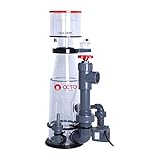
Midrange and premium models commonly fall between $250 and $450. The Reef Octopus Classic 110-INT is listed for under $350, and the Classic 150INT is listed for under $400. The extra cost may reflect a larger body, stronger pump, better adjustment hardware, or broader replacement-part support. It does not automatically mean the skimmer is the right choice for a smaller aquarium.
Set aside another $20 to $60 for a stand, replacement airline, drain tubing, or a spare impeller over the life of the skimmer. A controllable DC model may cost more initially but can be cheaper to live with if it prevents the need to replace an undersized unit after adding fish.
6. Warranty and Replacement Parts
Look for at least a one-year manufacturer warranty, with clear coverage for the pump, controller, and electrical components. Confirm whether the warranty is handled directly by the brand or only through the retailer. Pumps are usually the most important covered component because they do the continuous work.
Before buying, search the product listing for replacement impellers, needle-wheel assemblies, venturi fittings, collection-cup seals, and controllers. Replacement parts should be reasonably priced and available individually. If a pump costs $70 to $150 to replace, that expense should be part of your ownership calculation.
7. Delivery, Assembly, and Installation
Most in-sump skimmers arrive partially assembled. Allow 20 to 45 minutes for assembly, rinsing, and installation. Wash acrylic and plastic parts with warm water only; avoid soaps and household cleaners, which can leave residues that interfere with foam production.
Check the shipping box immediately for cracked cups, warped bodies, loose fittings, or missing tubing. A medium skimmer typically ships in a box weighing about 8 to 18 pounds, while larger units may exceed 20 pounds. Keep the packaging until the skimmer has run successfully for several days.
After installation, expect a break-in period of several days to two weeks. During that time, the foam may be unstable, especially if the acrylic has manufacturing residue. Adjust the water level gradually, make one change at a time, and keep the collection cup high until overflowing stops.
Spec Checklist
| Spec | Budget | Mid | Premium |
|---|---|---|---|
| Typical price | $150–$230 | $230–$330 | $330–$450+ |
| Best actual water volume | 30–80 gallons | 50–120 gallons | 80–180 gallons |
| Typical footprint | 6–9 inches square | 8–11 inches square | 10–14 inches square |
| Typical height | 16–23 inches | 19–26 inches | 21–30 inches |
| Pump power | 8–18 watts | 12–28 watts | 20–40 watts |
| Recommended sump depth | 7–10 inches | 7–10 inches | 8–11 inches |
| Useful features | Manual adjustment, drain port | DC control, removable pump | Fine adjustment, durable diffuser, broad parts support |
Red Flags
- A gallon rating with no distinction between light, medium, and heavy bioloads.
- No published footprint, height, operating depth, or pump wattage.
- A collection cup that cannot be removed without dismantling the sump.
- Permanent pump mounting that makes impeller cleaning difficult.
- No replacement impeller, controller, seal, or venturi parts listed.
- A skimmer body so large that it leaves less than 2 inches of access around the cup.
- Claims of silent operation without practical information about pump design or air intake.
- A return policy that excludes opened aquarium equipment, even if damage appears during setup.
FAQ
Should I buy a skimmer rated exactly for my aquarium volume?
Usually, no. Choose a model rated about 20% to 50% above your actual water volume, depending on bioload. A lightly stocked 75-gallon reef may work well with a skimmer rated for 90 to 120 gallons, while a heavily fed system may need a rating closer to 150 gallons.
Can a protein skimmer be too large?
Yes. An oversized skimmer may struggle to maintain a stable foam head when there is not enough dissolved organic waste. If the unit has a controllable pump and fine adjustment, it can be dialed back. Otherwise, choose a closer match rather than automatically buying the largest model that fits.
What matters more: body size or pump wattage?
Neither specification works alone. Body diameter, neck size, bubble quality, air intake, water depth, and adjustment control all affect performance. A high-wattage pump does not guarantee better nutrient removal, and a large body is not useful if the pump cannot produce a stable foam column.
How often should I clean a reef protein skimmer?
Empty and rinse the collection cup every few days to once a week, depending on how quickly it fills. Clean the neck at least weekly, and inspect the air intake and impeller monthly. Give the body and pump a more thorough cleaning every three to six months to prevent salt buildup and declining performance.
Ready to decide? Our #1 pick for 2026 is the Typical price.
Live price & availability on Amazon.
Related Reviews & Guides


How to Calculate Turnover Rate for a Reef Tank: Top Proven

Aquarium Nitrate Reactor Sulfur