Last Updated: September 25, 2026
Best plants for shrimp tank choices are judged on surface area rather than appearance. Shrimp graze biofilm, so a plant that offers dense structure at 15-30 PAR with no CO2 is worth more than a showpiece needing high light. Fertiliser copper content is the disqualifying fault, which rules out most comprehensive liquid products.
As an Amazon Associate we earn from qualifying purchases.
As an Amazon Associate we earn from qualifying purchases at no extra cost to you. Prices and availability are accurate as of the date shown and are subject to change.

Generic Shrimp Up Aquatics™ 20+ Mixed Color Neocaridina Shrimp Live Freshwater Aquarium Inverts Live Arrival! Mixed
Selected for "Best Plants for Shrimp Tank: Options Compared by Numbers": this listing is aquarium equipment (Generic Shrimp Up Aquatics™ 20+ Mixed Color Neocaridina Shrimp Live Fr), matching the equipment this article covers.
View on Amazon
Amazon Sword - Echinodorus Bleheri x3 Plants - Live Aquarium Plant
Selected for "Best Plants for Shrimp Tank: Options Compared by Numbers": this listing is aquarium equipment (Amazon Sword - Echinodorus Bleheri x3 Plants - Live Aquarium Plant), matching the equipment this article covers.
View on Amazon
Hornwort - Young, Healthy, Super Easy Live Aquarium Plant, 1 Bundle 5-6 in. Great for Betta, Guppy, Cherry Shrimp, Barbs, Platys etc etc! Produced by Aquatic Discounts. B U Y 2 GE T 1 Deal!
Selected for "Best Plants for Shrimp Tank: Options Compared by Numbers": this listing is aquarium equipment (Hornwort - Young, Healthy, Super Easy Live Aquarium Plant, 1 Bundle 5-), matching the equipment this article covers.
View on Amazon
Live Aquarium Plant Bundle for Shrimp Neocaridina Low Light Tank
Selected for "Best Plants for Shrimp Tank: Options Compared by Numbers": this listing is lighting (Live Aquarium Plant Bundle for Shrimp Neocaridina Low Light Tank), matching the equipment this article covers.
View on AmazonBy David Nguyen
Judging Plants by Surface Area, Not Appearance
Picking the best plants for shrimp tank use inverts the usual planted tank priorities. Growth rate matters less than texture, light demand should be low rather than impressive, and anything requiring a fertiliser regime brings a copper question with it.
The Deciding Numbers: PAR, CO2 and Surface Texture
Light comes first. Low-light species run at roughly 15-30 PAR measured at the substrate, medium at 30-50, and high above 50. Shrimp tanks should stay in the low band, because strong light without CO2 and heavy planting produces algae rather than plant growth.
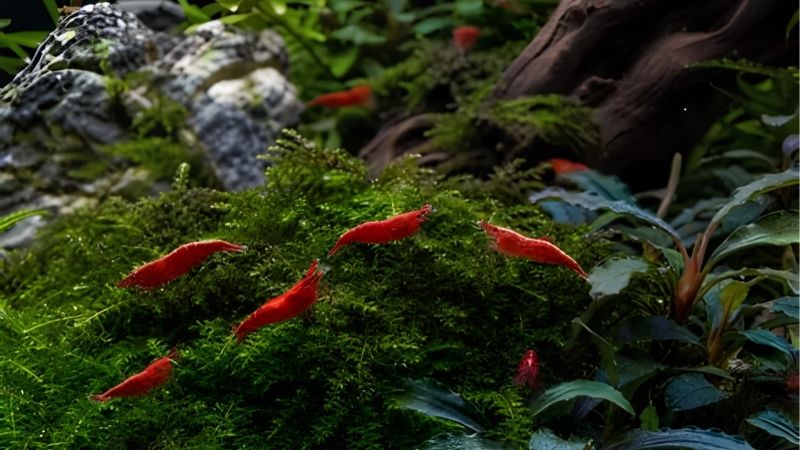
Texture is the number nobody publishes. Fine, branching structures such as moss hold vastly more biofilm per square inch than a broad smooth leaf, and biofilm is what juveniles graze continuously in the first weeks after they are released.
Two More Criteria With Numbers Attached
Feeding route matters because it decides your substrate. Rhizome and moss species feed from the water column and attach to hardscape, so they work over inert sand. Root feeders need a nutrient substrate, and active soils strip KH in a way Neocaridina do not want.
Fertiliser compatibility is the hard limit. Many comprehensive liquid fertilisers contain trace copper, which is lethal to invertebrates far below concentrations tolerated in drinking water, where the US EPA Lead and Copper Rule, first set in 1991, uses an action level of 1.3 mg/L. Choose species that need no dosing at all.
Tank Size, Placement and Fit
Measure the tank height against your light before ordering plants, since a fixture rated for a 12 in (30 cm) deep tank delivers noticeably less at 18 in (46 cm) and pushes a nominally low-light species into a struggle it will not win.
In tanks under 10 gallons (38 L), plant footprint competes with swimming and grazing space. A moss wall covering one end of a 5 gallon (19 L) tank is excellent for a colony; the same mass spread across the whole floor leaves nowhere to siphon.
The Options by What the Colony Needs
Four species groups cover almost every shrimp build. Each is matched below to a purpose, since the best plants for shrimp tank duty depend on whether you need grazing surface, juvenile cover, nutrient export or simply something that survives neglect.
Java Moss: For Biofilm and Juvenile Cover
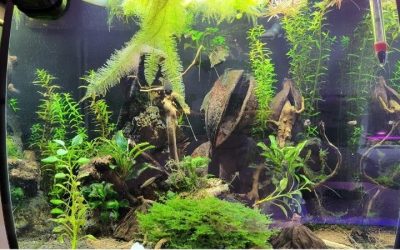
Main numbers: 15-30 PAR, no CO2 required, tolerant across 68-82 °F (20-28 °C) and pH 6.0-8.0, moderate growth. Nothing else in the hobby produces comparable biofilm surface per unit volume, which is why it appears in almost every serious breeding tank.
It suits colonies where population growth is the goal, since juveniles hide and graze inside the mass. It does not suit a tidy display, because it traps detritus and needs periodic thinning, and it will attach itself to hardscape you intended to keep clear.
Anubias: For Hardscape Cover That Survives Anything
Main numbers: 15-30 PAR, no CO2, very slow growth, rhizome attached to wood or rock rather than buried. Anubias nana petite stays under 2 in (5 cm) tall, which suits a nano tank where a full-sized variety would dominate the layout within a year.
It suits keepers wanting structure with almost no maintenance and no fertiliser. It does not suit anyone needing fast nutrient uptake, and its broad smooth leaves collect algae in bright tanks, since the plant grows far too slowly to outcompete anything.
Java Fern: For Height and Shade Without Substrate
Main numbers: 15-30 PAR, no CO2, slow to moderate growth, rhizome attached rather than planted. It reaches 8-12 in (20-30 cm) and provides vertical structure and shading, which lowers algae pressure on the glass beneath it in a small tank.
It suits tanks with inert sand where a taller plant is wanted without a nutrient substrate. It does not suit keepers who bury the rhizome, which rots it, and it is slower to establish than most people expect, often looking poor for the first two months.
Floating Plants: For Nutrient Export and Light Control
Main numbers: fast growth, no CO2, and direct nutrient uptake from the water column, which is what makes them the most effective algae control available in a shrimp tank. Salvinia and frogbit both develop trailing roots that shrimp graze constantly.
They suit tanks with surplus nutrients or a light that is too strong for the species below. They do not suit tanks with a tight lid and heavy surface flow, since both damage the leaves, and they need thinning weekly or they block light entirely.
| Option | Light needed | CO2 | Growth rate | Best for |
|---|---|---|---|---|
| Java moss | 15-30 PAR | Not required | Moderate | Biofilm, juvenile cover, breeding |
| Anubias nana petite | 15-30 PAR | Not required | Very slow | Hardscape cover, low maintenance |
| Java fern | 15-30 PAR | Not required | Slow to moderate | Height and shade over inert sand |
| Floating plants | Uses surface light | Not required | Fast | Nutrient export, algae control |
| High-light carpets | 50+ PAR | Required | Fast | Not suited to shrimp tanks |
Head to Head, and When Not to Buy
Two of these get compared constantly, and there is a common case where more plants are the wrong purchase entirely. The best plants for shrimp tank use are sometimes the ones already in the tank, given a further two months to establish properly before anything is replaced.
Java Moss Versus Anubias
Moss wins decisively on biofilm surface and juvenile survival, which makes it the better choice in any tank where the colony should be expanding. It loses on tidiness, since it traps detritus and needs thinning every few months to stay healthy.
Anubias wins on appearance and on requiring nothing at all. In a display tank holding a stable adult population rather than a breeding colony, it is the more sensible default, and a mixed layout using both covers each set of weaknesses.
When More Plants Are the Wrong Fix
Algae in a shrimp tank is a light duration and nutrient problem before it is a planting problem. Cut the photoperiod to six or seven hours and measure nitrate before the weekly change, aiming under 20 ppm, before buying anything further.
Plants that melt after purchase are usually adapting from emersed growth rather than dying, which takes four to eight weeks. Replacing them during that window wastes money and restarts the clock, so give new stock two months before deciding it has failed.
The Cheaper Route That Works
Ask in a local aquarium club or online forum before buying. Moss, floaters and anubias all propagate faster than most keepers can use, so trimmings are widely available for postage costs, and they arrive already adapted to submerged growth rather than emersed.
Subwassertang and Christmas moss are worth knowing about as alternatives with similar biofilm properties. Neither is easier than java moss, but both give slightly different texture, and a tank running two moss types offers a broader range of grazing surfaces.
Living With Them and the 12-Month Cost
The best plants for shrimp tank use are infrastructure that grows, so the maintenance pattern differs from replacing a piece of equipment. This section covers what degrades, what you keep spending, and the safety points around anything dosed into the water.
What Goes Wrong Over Time
Moss traps detritus and the interior of a thick mat eventually dies off, producing a brown core that fouls the water. Thin it by half every three to four months, pulling the mass apart rather than cutting the surface, and rinse the trimmings in tank water.
Anubias and java fern rhizomes rot when buried, sometimes months after planting, and floating plants collapse when surface flow soaks the leaves. All three failures look like plant death and are actually placement errors that can be corrected.
Fertiliser, Copper and What to Avoid
The species listed above need no fertiliser in a stocked shrimp tank, since shrimp waste and food supply enough nutrients for low-light growth. That is a feature rather than a compromise, because it removes the copper question from the tank entirely.
Where dosing is unavoidable, use a shrimp-safe product and dose at a fraction of the stated rate, checking the label for copper before it goes near the tank rather than afterwards. Root tabs buried under inert sand are the lower-risk option.
Recurring Cost and Timing
Ongoing spend is close to zero once established, which is unusual in this hobby. The real costs sit in lighting and in the occasional replacement of a plant that never adapted, and both are one-time rather than monthly outlays.
On timing, lights and small tanks discount most deeply in late June and again in late November, which suits a planned build. Plants themselves ship poorly in extreme heat or cold, so ordering live stock in midsummer or midwinter carries a real transit risk regardless of price.
Best Plants for Shrimp Tank Questions
These arrive after the tank is cycling but before the plant order. Every answer about the best plants for shrimp tank use stays with light, texture and fertiliser needs, since those three decide outcomes more than species names do.
How much plant mass does a colony need?
Aim for roughly a third of the tank floor covered by moss or similar fine-textured growth in a breeding tank. Below that, juvenile survival drops noticeably, since there is less grazing surface and less cover during the vulnerable first weeks.
Do shrimp eat live plants?
No. Shrimp graze biofilm and algae growing on plant surfaces, and they will strip a decaying leaf, but healthy tissue is not food to them. A plant being visibly eaten is almost always a plant that was already dying from another cause entirely.
Can I use a nutrient substrate?
Only for Caridina. Active soils strip KH and pull pH down, which suits bee shrimp and works against Neocaridina. For cherry shrimp, use inert sand with rhizome and moss species that feed from the water column instead, since that leaves your source water chemistry untouched.
Are floating plants worth the mess?
Usually yes. They export nutrients faster than anything else available without CO2, shade a tank whose light is too strong, and grow trailing roots that shrimp graze. Thin them weekly or they seal the surface and shade everything below.
See More:
Conclusion
The best plants for shrimp tank use are java moss for biofilm and juvenile cover, anubias and java fern attached to hardscape for structure, and floating plants for nutrient export. All four run at 15-30 PAR with no CO2 and no fertiliser routine.
On a tight budget, moss trimmings from a local club plus a handful of floaters cover most of the benefit for postage costs. Keep the photoperiod at six or seven hours, avoid any fertiliser containing copper, and let new stock have two months before judging it.

Aquarium Quarantine Tank Setup Review
Best Aquarium Overflow Box Maintenance and Cleaning Kit