Last Updated: September 25, 2026
Best aquarium stand selection starts from filled weight, which runs about 10 lb per US gallon (1.2 kg per litre) once substrate and hardscape are counted. A 55 gallon (208 L) tank therefore loads its stand with more than 600 lb (272 kg), which is more than most domestic furniture is designed to carry.
As an Amazon Associate we earn from qualifying purchases.
As an Amazon Associate we earn from qualifying purchases at no extra cost to you. Prices and availability are accurate as of the date shown and are subject to change.
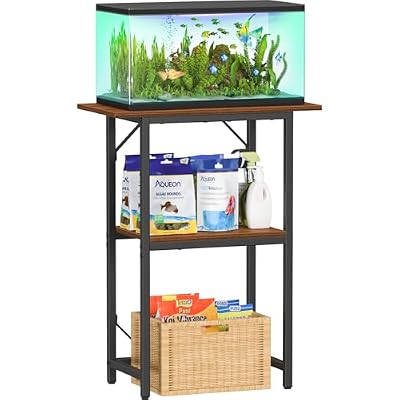
Snughome 10-20 Gallon Fish Tank Stand, Aquarium Stand 2-Tier Storage Shelves, Heavy Duty Terrarium Stand for Home Office Fish Tank Shelf, 24" L x 11.81" W x 30.71" H, Rustic Brown
Selected for "Best Aquarium Stand: Load Rating, Footprint and Material": this listing is stands and furniture (Snughome 10-20 Gallon Fish Tank Stand, Aquarium Stand 2-Tier Storage S), matching the equipment this article covers.
View on Amazon
Herture 20-29 Gallon Fish Tank Stand, Aquarium Stand with Cabinet Accessories Storage, Heavy Duty Metal Frame, 31.49" L*15.74" W Tabletop, 330LBS Capacity, Black PG07YGB
Selected for "Best Aquarium Stand: Load Rating, Footprint and Material": this listing is stands and furniture (Herture 20-29 Gallon Fish Tank Stand, Aquarium Stand with Cabinet Acce), matching the equipment this article covers.
View on Amazon
Heybly 55-75 Gal Fish Tank Stand with Drawer, Power Outlet, Black HAS005BK
Selected for "Best Aquarium Stand: Load Rating, Footprint and Material": this listing is stands and furniture (Heybly 55-75 Gal Fish Tank Stand with Drawer, Power Outlet, Black HAS0), matching the equipment this article covers.
View on Amazon
MZNZ 5-10 Gallon Fish Tank Stand with Storage Shelves, 3-Tier Aquarium Stand with Rust-Proof Metal Frame, Heavy Duty Waterproof Reptile Turtle Tank Stand for Home Office Up to 150LBS, 21.5" L x 11.5" W x 30" H, Rustic Brown
Selected for "Best Aquarium Stand: Load Rating, Footprint and Material": this listing is stands and furniture (MZNZ 5-10 Gallon Fish Tank Stand with Storage Shelves, 3-Tier Aquarium), matching the equipment this article covers.
View on AmazonBy David Nguyen
Quick answer: For most people in 2026, the best aquarium stand is the Metal stand — our #1 rated choice. See the full ranked comparison, alternatives and buying advice below.
A Structural Decision, Not a Furniture One
Choosing the best aquarium stand is a structural decision rather than a furniture one. Four figures settle it, and the first two are non-negotiable in a way that almost nothing else in this hobby is.
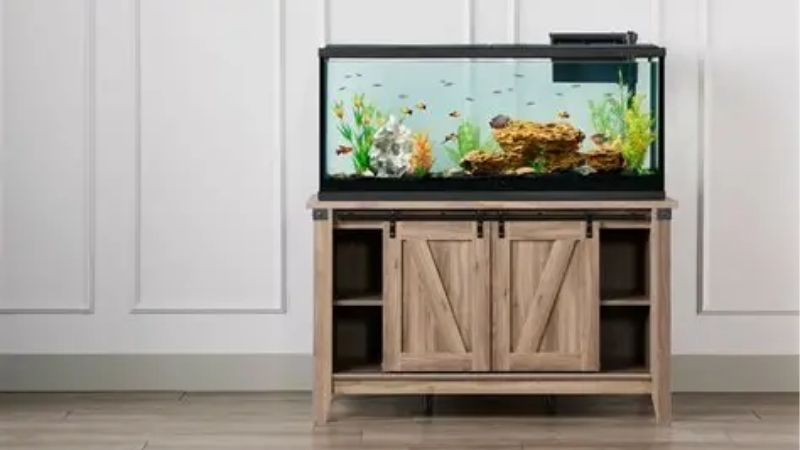
The Deciding Numbers: Load Rating and Footprint Match
Calculate filled weight first. Freshwater runs roughly 10 lb per gallon (1.2 kg per litre) including substrate and rock, and saltwater with live rock runs higher still, so a 75 gallon (284 L) marine build approaches 950 lb (431 kg).
The footprint has to match the tank base exactly. Rimmed tanks transfer load through their frame to the perimeter, and rimless tanks load the entire base, but neither tolerates overhang at the corners where the silicone seams are weakest.
Two More Criteria With Numbers Attached
Levelness is measured rather than estimated by eye. Aim for within about 1/8 in (3 mm) across the length of the tank, since one sitting on a twisted surface carries uneven stress through its seams for as long as it stands there.
Material decides how the stand ages rather than how much it initially holds. Particleboard and MDF swell where spills soak in, losing flatness at the base and top, which is a slow failure rather than a sudden one.
Tank Size, Placement and Fit
Measure the tank base and the stand top in both directions before ordering, and check the cabinet door opening against any sump or canister you intend to house inside, since equipment that will not fit through the door cannot be installed.
Check the floor as well. Place a large tank across floor joists rather than parallel between them, and on a ground floor or above a supporting wall wherever the layout allows, since 600 lb (272 kg) on a small footprint is a real load.
The Options by Tank Size and Room
Four types cover essentially every build. Each is matched below to a situation, because the best aquarium stand depends on tank weight, on whether equipment goes underneath and on how the room is used.
Purpose-Built Metal Stand: For Load Above Appearance
Main numbers: welded steel rated well beyond typical filled weight, with an open frame that leaves the space underneath fully accessible. Nothing swells, nothing sags, and the load path from tank to floor is direct.
It suits fish rooms, large tanks and anywhere maximum strength matters most. It does not suit living rooms without a panel kit, since an open frame shows every hose and cable, and bare steel corrodes where saltwater is splashed.
Manufacturer-Matched Cabinet: The General-Purpose Choice
Main numbers: a cabinet built to the exact footprint of a specific tank, typically rated to that tank’s filled weight with a modest margin. The match is the point, since the top and base align with the load path by design.
It suits most home installations from 20-125 gallons (76-473 L) where equipment lives underneath. It does not suit damp handling, since particleboard and MDF construction swells at the base from spills that are not wiped promptly.
Solid Wood or Plywood Stand: For Longevity
Main numbers: framed construction in dimensional timber or void-free plywood, easily rated beyond any home tank when built to a proper design. It tolerates moisture far better than particleboard and can be refinished rather than replaced.
It suits large tanks, custom footprints and anyone building rather than buying. It does not suit those unwilling to check the design, since a stand assembled without a proper frame can look substantial and still deflect under load.
Repurposed Furniture: Rarely the Right Answer
Main numbers: a load rating that is almost never published and a top that is almost never flat within 1/8 in (3 mm). Most domestic furniture is designed for a fraction of what a filled aquarium applies.
It suits nano tanks under 10 gallons (38 L) on a solid desk or a sturdy sideboard. It does not suit anything above 20 gallons (76 L), where the combination of unknown rating and unknown flatness is not worth the saving.
| Option | Typical suitability | Moisture tolerance | Equipment access | Best for |
|---|---|---|---|---|
| Metal stand | Any size, high load | Good, watch for corrosion | Fully open | Fish rooms, large tanks |
| Manufacturer cabinet | 20-125 gallons (76-473 L) | Poor if spills are left | Through doors | Most home installations |
| Solid wood or plywood | Any size when built well | Good, can be refinished | Depends on design | Large or custom footprints |
| Repurposed furniture | Under 10 gallons (38 L) | Varies, usually poor | Varies | Nano tanks on solid desks |
| Any stand with overhang | None | Not applicable | Not applicable | Never acceptable at any size |
Head to Head, and When Not to Buy
Two types get compared constantly, and there is a case where the stand is not what needs replacing. The best aquarium stand is sometimes the one you have, levelled properly with a mat under the tank.
Manufacturer Cabinet Versus Metal Stand
The cabinet wins on appearance and on hiding equipment, which matters in a living space. It loses on moisture, since board construction swells at the base over years, and on access, because doors restrict what fits underneath.
The metal stand wins on strength, on longevity and on being able to reach every part of a sump without lying on the floor. It loses on looks, and it needs a panel kit or a curtain to be acceptable in most rooms.
When a New Stand Is the Wrong Fix
A tank that is slightly out of level is a shimming problem rather than a stand problem. Measure with a spirit level in both directions and shim the low corners, since most floors rather than most stands are the cause.
A rimless tank on a flat but slightly imperfect top usually needs a levelling mat rather than a new stand. A closed-cell foam mat distributes minor irregularities and is standard practice for rimless glass regardless of stand quality.
The Cheaper Route That Works
Building a framed stand from dimensional timber is inexpensive relative to a cabinet and produces something stronger, provided it follows an established design with a proper top and bottom frame rather than a box of butt joints.
Shims, a spirit level and a foam mat together cost very little and resolve most complaints about an existing stand. Try those before spending, since a level stand and a flat top are what the tank actually requires.
Living With It and the 12-Month Cost
The best aquarium stand is bought once and carries the tank for a decade, so its failure mode matters far more than its purchase price. This section covers what degrades, the checks worth running and the safety points around a heavy load.
What Degrades Over Time
Particleboard and MDF swell where water soaks in, most often at the base near the doors and around the top edge behind the tank. Swelling lifts the top out of flat, which transfers uneven load into the tank bottom.
Fasteners loosen on flat-pack construction as the board compresses under sustained load. Check and retighten cam fittings and bolts annually, since a stand that was square at assembly can rack slightly across a couple of years.
Checks Worth Running
Level the stand before the tank goes on it, not afterwards, and check in both directions. Once filled, a large tank cannot be lifted to correct anything, so the levelling opportunity exists only during setup.
Inspect annually for swelling, racking and any gap opening between tank base and stand top. Wipe spills immediately rather than letting them sit, since that single habit prevents the most common long-term failure in board construction.
Watch the cabinet floor if a sump or canister lives inside. Slow drips from a fitting soak into board construction from underneath, where nothing is visible until the base has already swollen out of shape.
Safety, Load Path and Timing
Never leave overhang at the corners, never place a tank on a stand narrower than its base, and treat published load ratings as maximums rather than targets. Anchor tall stands to a wall where children or pets are in the house.
On timing, stands and cabinets see their deepest discounts in late June and again in late November, which suits a planned build. A sale changes nothing about load rating, and prices move constantly, so check at the moment of purchase.
Best Aquarium Stand Questions
These arrive before a tank is filled, which is the only point at which most of them can still be acted on. Every answer about the best aquarium stand stays with weight, footprint and levelness.
Can I use a normal cabinet or sideboard?
Only under about 10 gallons (38 L) on something genuinely solid. Domestic furniture is rated for a fraction of a filled aquarium, and the top is rarely flat within 1/8 in (3 mm), which matters as much as the rating does.
Does the stand need to match the tank exactly?
The footprint does. The tank base must sit fully supported with no overhang at any corner, since overhang concentrates load exactly where the silicone seams are weakest and is the most common cause of a seam failure.
How level does it need to be?
Within about 1/8 in (3 mm) across the length, measured in both directions with a spirit level. Shim the low corners before filling, because once water is in the tank the opportunity to correct it has gone.
Do I need a mat under the tank?
For rimless tanks, yes, since the whole base bears on the stand and a closed-cell foam mat absorbs minor irregularities. Rimmed tanks transfer load through the frame and generally do not need one on a flat top.
See More:
Conclusion
The best aquarium stand is whichever option is rated comfortably beyond your filled weight of roughly 10 lb per gallon (1.2 kg per litre), matches the tank footprint exactly with no overhang, and sits level within 1/8 in (3 mm).
A manufacturer-matched cabinet suits most home installations to 125 gallons (473 L), a metal or timber-framed stand suits larger and wetter setups, and domestic furniture suits nothing above 20 gallons (76 L). Level it before filling, not after.
Ready to decide? Our #1 pick for 2026 is the Metal stand.
Live price & availability on Amazon.
Related Reviews & Guides




Best Quiet Aquarium Overflow Box: Silent Flow Top Picks
How to Choose an Auto Top Off System: Smart Buying Guide