Last Updated: October 4, 2026
The choice between building your own stand and buying one comes down to structural certainty, customization, time, and a fair cost comparison. Weighing the best diy vs prebuilt aquarium stand for 75 gallons means matching a 48.5 x 18.5in footprint and roughly 785lb of filled weight, however you get there.
As an Amazon Associate we earn from qualifying purchases.
By David Nguyen
Quick answer: For most people in 2026, the best diy vs prebuilt aquarium stand for 75 gallons is the Structural certainty — our #1 rated choice. See the full ranked comparison, alternatives and buying advice below.
How DIY and Prebuilt Stands Work
Both approaches must support the same tank: a 75-gallon on a 48.5 x 18.5in footprint weighing about 785lb filled. A prebuilt stand hands you a known footprint and a stated load target with no build time, while DIY offers full customization if you can design and verify the structure. Cost only compares fairly against a complete bill of materials. That single point is where most DIY-versus-prebuilt debates go wrong, so it is worth settling before anything else.
| Factor | DIY | Prebuilt | Note |
|---|---|---|---|
| Structural certainty | You design and verify | Stated or implied by maker | Prebuilt gives a target number |
| Load target (75gal) | Must exceed ~785lb filled | e.g. 900lb (Aquatic Fundamentals) | 785lb is the weight to beat |
| Cost | Complete BOM (unverified) | ~under $250-under $350 | under $20 of parts is not a stand cost |
| Customization | Full (size, access, finish) | Fixed to model | DIY wins on custom fit |
| Time and skill | High | None | Prebuilt is ready to use |
Footprint
Whichever route you take, the stand must match the tank’s footprint. A 75-gallon uses a 48.5 x 18.5in-class base, so a prebuilt like the Marineland/Seapora at 48 x 18in aligns closely, and a DIY frame must be built to the same footprint.
The tank has to rest fully supported on the top rails or perimeter. With DIY you control the exact footprint; with prebuilt you confirm the model matches your tank before buying rather than after. A footprint mismatch is unsafe either way, so the tape measure matters as much as the load rating.
Structural Target
The structural target is the filled weight the stand must carry, about 785lb for a 75-gallon before rock, sand, and equipment. Both approaches have to clear that with margin, so the number to beat is the same regardless of method.
A prebuilt stand states or implies a capacity, such as the Aquatic Fundamentals at 900lb, giving you a figure to check against 785lb. With DIY you must engineer the frame to exceed the load yourself, which requires real confidence in the design. Under-building a frame to save money is a false economy when the failure mode is a flooded room.
Published Ratings
Published ratings are where prebuilt has an edge. A stated 900lb capacity gives a concrete number above the 785lb reference, though it is a rating to clear the load, not a formal engineering safety factor you should quote as a percentage.
Some prebuilt stands, like the TitanEze, do not publish a verified load at all, so even here ratings vary. DIY has no published rating by definition, so its safety rests entirely on your own construction and material choices. That is a fair trade for skilled builders but a real risk for anyone guessing at the structure.
Custom Access
Customization is DIY’s strongest advantage. Building your own lets you size the interior for a specific sump, add doors where you want them, and match a finish, none of which a fixed prebuilt model guarantees.
A prebuilt stand offers only the access its design includes, which may or may not suit your equipment. If a particular sump, height, or opening is essential, DIY can deliver it where an off-the-shelf stand cannot.
Putting It Into Practice
Which approach fits depends on your tank’s role, your equipment, and your confidence in building. Match the method to your situation rather than assuming DIY is always cheaper or prebuilt always safer.
Basic Freshwater Tank
For a basic freshwater 75-gallon, a prebuilt stand is usually the simplest choice. A rated cabinet like the Aquatic Fundamentals at about $275 clears the 785lb load and needs no building, tools, or engineering judgment on your part.
Unless you specifically want a custom look or fit, the convenience and stated rating make prebuilt the low-effort path. It is ready to use the day it arrives, which suits a straightforward setup.
Reef With a Sump
For a reef with a sump, the interior layout matters, and this is where DIY can shine if you have the skills. A custom frame can be sized to your exact sump, skimmer, and plumbing, with access placed where you need it most.
A prebuilt stand works too, provided its internal clearance fits your sump and equipment. Measure your sump against any prebuilt’s interior first, and consider DIY only if no off-the-shelf model accommodates your plan.
No Engineering Confidence
If you are not confident engineering a load-bearing frame, buy prebuilt. A 75-gallon’s roughly 785lb sits on the stand continuously, and a miscalculated DIY frame risks a catastrophic failure that no cost saving justifies.
A prebuilt stand with a stated rating removes that uncertainty. When in doubt about structure, the known quantity of a rated stand is the safer choice by a wide margin.
When DIY Makes Sense
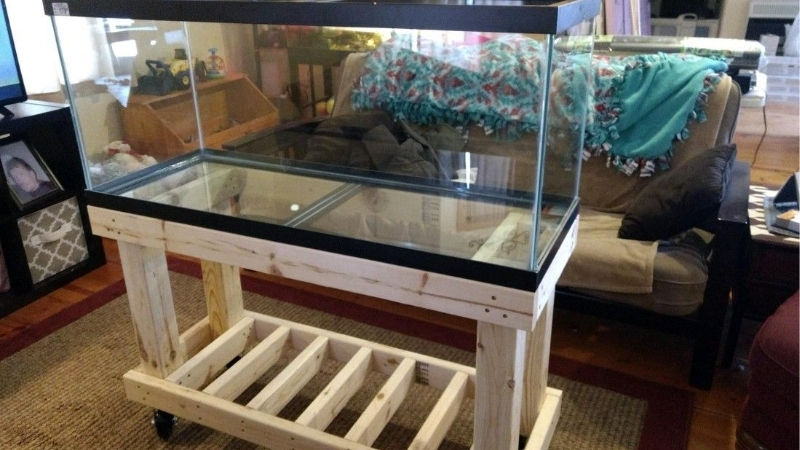
DIY makes sense when you have the woodworking skill, want a specific size or finish, and will price and build a complete, over-engineered frame. Done properly, it can match your space and equipment exactly in a way no stock model will.
It stops making sense the moment cost is the only motive, because a proper DIY build is not as cheap as a couple of hardware items suggest. Choose DIY for control and fit, not for a shortcut on price.
Frequently Asked Questions
Buyers ask whether 2x4s are strong enough, whether DIY is really cheaper, whether a dresser or no-rating stand will do, and how the two compare on cost over time. Honest numbers and structural certainty shape the answers.
Are 2x4s Strong Enough for a 75-Gallon Stand?
Properly designed, a 2×4 frame can carry a 75-gallon’s roughly 785lb, since the load runs largely in vertical compression down the legs. The strength depends on the design, joinery, and bracing, not on the lumber alone.
A poorly braced frame can still fail regardless of the wood used. If you cannot verify the design, a rated prebuilt stand is the safer route than trusting an unproven frame.
Is a DIY Stand Actually Cheaper?
Not as cheap as a couple of parts imply. A pack of screws at about $10 and glue at about $10 is roughly $20 of hardware, but that is not a stand cost, only two line items.
A complete build also needs lumber, plywood, finish, and tools, plus your time, and that full bill of materials is unverified here. Compare a prebuilt’s under $250 to under $350 price only against a complete DIY bill, not against a few fasteners.
Can You Use a Dresser or a Stand With No Load Rating?
It is risky. Furniture like a dresser is not built for a concentrated 785lb load, and a stand with no published rating gives you nothing to verify against the tank’s weight.
For a 75-gallon, use a stand with a known capacity above 785lb or a DIY frame you have engineered to exceed it. An unrated piece of furniture is a gamble with a very heavy, wet failure mode, and the savings are never worth that risk.
Which Is the Better Value Over Time?
Both last for years if built or bought well, so value depends on your priorities. A rated prebuilt for under $250 to under $350 is a fixed, known cost, while a DIY build’s real cost is its complete bill of materials plus your labor.
DIY can win on fit and, sometimes, on price if you already own tools and materials. Prebuilt wins on convenience and a stated rating, which is often the better value for a standard setup. For most keepers with a standard 75-gallon, that convenience is worth more than the marginal savings DIY might offer.
Final Thoughts
In the best diy vs prebuilt aquarium stand for 75 gallons decision, both must clear the same 48.5 x 18.5in footprint and roughly 785lb filled weight. Prebuilt stands like the Aquatic Fundamentals at about $275 as of 09/2026 give a stated rating and zero build time, while DIY offers full customization if you can engineer and verify the frame. Compare cost only against a complete DIY bill of materials, never against a couple of hardware items, and never quote a load rating as a formal safety factor.
As an Amazon Associate we earn from qualifying purchases at no extra cost to you. Prices and availability are accurate as of the date shown and are subject to change.
Ready to decide? Our #1 pick for 2026 is the Structural certainty.
Live price & availability on Amazon.
Related Reviews & Guides



How to Choose an Aquarium Chiller: Trusted Expert Step Guide

Best Quiet Pond Aerator: Top Smart Shortlist for Beginners