Last Updated: October 4, 2026
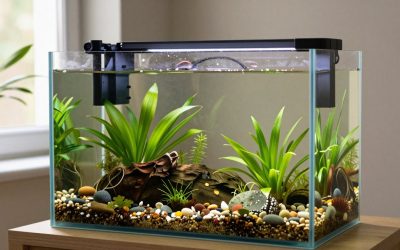
A low-tech planted tank runs low and medium-light plants without pressurized CO2, so it needs controllable, sufficient output rather than high-tech intensity. The best aquarium light for low tech planted tank setups emphasizes moderate, consistent light you can dim, not the highest PAR number you can find.
As an Amazon Associate we earn from qualifying purchases.
By David Nguyen
How to Choose a Low-Tech Planted Tank Light
Sort it this way: pick a light rated for low-to-medium plants, judge output by PAR at depth rather than watts, start with a conservative photoperiod, and value dimming as headroom. In a low-tech tank, controllable and sufficient beats maximum output every time. The aim is steady, appropriate light, not the strongest fixture you can afford.
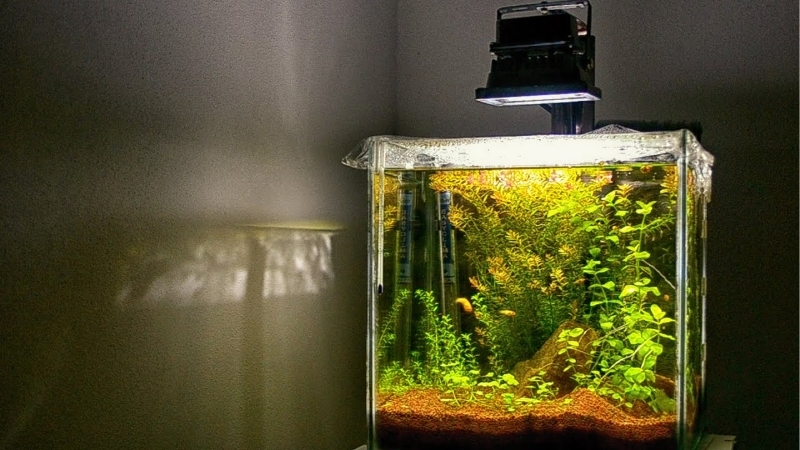
Pick Low-to-Medium-Light Suitability
Start with a fixture actually positioned for low and medium-light plants, since that is the whole point of a low-tech tank. The Aquasky is explicitly rated by Fluval for low-medium plant use with about 55 PAR at 12 inches, which suits easy species without pushing a tank that has no CO2.
Matching the light class to the plants keeps growth steady and algae low. A fixture built for demanding high-light carpets is usually the wrong tool here, because its extra output has nothing to balance against without added CO2. Sufficient light for the plants you keep is the goal, not the biggest number on the shelf.
Use PAR at Depth, Not Watts
Judge output by measured PAR at a stated depth rather than the watt rating. The Aquasky reads about 55 at 12 inches while the Plant 4.0 Nano reaches about 125 at the same depth, and for a low-tech tank the higher figure is not automatically better.
Wattage describes electricity use, not brightness or PAR, so do not read a bigger watt number as more usable light. Use depth-matched PAR to confirm a fixture reaches your plants with enough energy, and treat surplus output as something to dim rather than a selling point. Two lights of similar wattage can put very different PAR on your substrate, so read the depth figure.
Start Conservative Photoperiod
Begin with a modest daily schedule and adjust from there. Aquarium Co-Op suggests roughly six to eight hours as a starting photoperiod for a newly planted tank, which is a sensible hedge rather than an exact requirement for every setup.
A shorter photoperiod early on lets plants establish while keeping algae in check, and you can extend it cautiously as the tank matures. Treat the number as a starting point you tune to your own tank rather than a fixed rule. Watch new growth and algae over the first weeks and adjust the hours from there.
Dimming Gives Headroom
Dimming lets a stronger light serve a low-tech tank without overdriving it. The Aqueon OptiBright SMART offers 1 percent dimming increments, so you can buy output headroom and simply turn it down to a low-tech level when needed.
That flexibility is more useful than a single fixed brightness, because it lets one fixture cover a low-tech tank now and a planted upgrade later. Excess output is only an advantage if you can reliably dim it, so prioritize control over raw maximum. One dimmable fixture can serve a low-tech tank today and a higher-tech upgrade later.
Top Picks
These picks lead with low-medium suitability and control, then value and headroom. The Aquasky is the balanced overall choice, with a value 24/7 unit, a fine-dimming smart light and a growth-headroom nano alongside.
| Product | Best For | Key Spec | Watch Out For |
|---|---|---|---|
| Fluval Aquasky 3.0 12W | Best Overall | Low-medium plant use; 55 PAR at 12in | Around $100 |
| Finnex HLC-20 | Best Value | 20in; 24/7; 660nm red | Around $65 |
| Aqueon OptiBright SMART 18-24 | Best Fine Dimming | 1% increments; smart schedule | Around $125 |
| Fluval Plant 4.0 Nano | Best Growth Headroom | 125 PAR at 12in; 20W | Needs dimming in many low-tech tanks |
Fluval Aquasky 3.0 12W
The Aquasky 3.0 12W is the overall pick, explicitly rated by Fluval for low and medium-light plants at about 55 PAR at 12 inches with a full app-controlled cycle, priced around $100 as of September 2026. It matches low-tech demand closely.
Its output is sufficient for easy plants without overpowering a CO2-free tank, and the schedule keeps the day consistent. For most low-tech setups this is the fixture whose intent lines up with the plants you are actually growing. Its full app cycle also keeps the day consistent without any extra timer.
Finnex HLC-20
The Finnex HLC-20 is the value pick, a 20-inch fixture with a 24/7 cycle and 660nm red emphasis, priced around $65 as of September 2026. It delivers a full daily rhythm suited to low-tech planting at a low price.
You get the cycle and a plant-friendly red channel without app dimming, which is fine for a low-tech tank that runs a steady, moderate light. Note that Finnex comparison PAR from 48-inch fixtures must not be assigned to this 20-inch unit. Take its value and cycle at face value rather than borrowing numbers from a longer fixture.
Aqueon OptiBright SMART 18-24
The OptiBright SMART 18-24 is the fine-dimming pick, offering 1 percent increments and a BlueIQ smart schedule across an 18 to 24 inch range, priced around $125 as of September 2026. Its control is ideal for holding a low-tech level.
The precise dimming lets you set exactly the modest output a low-tech tank wants and raise it later if plans change. That flexibility, rather than raw output, is what makes it a strong low-tech choice. The 1 percent steps let you settle on a gentle level and leave it there.
Fluval Plant 4.0 Nano
The Plant 4.0 Nano is the growth-headroom pick, a 20-watt fixture reading about 125 PAR at 12 inches with dimming, priced around $150 as of September 2026. It offers room to grow if you later add more demanding plants.
In many low-tech tanks that output is more than needed, so plan to dim it rather than run it wide open. Kept turned down, it gives a low-tech tank a ceiling to grow into without forcing high light today. Run it turned down for easy plants and open it up only if your plans change.
Frequently Asked Questions
Buyers ask about photoperiod, whether 55 PAR is enough, whether more PAR is always better and whether watts indicate brightness. Each answer stays within the cited data.
How Many Hours for a Low-Tech Tank?
Roughly six to eight hours is a useful starting photoperiod for a new planted setup, per Aquarium Co-Op. Treat it as a starting point rather than a fixed rule.
Extend it cautiously as the tank matures and shorten it if algae appears. Adjust to your own tank rather than a universal number. A newly planted tank tolerates a shorter day while it settles in.
Is 55 PAR Enough?
For low-tech plants, often yes. The Aquasky is explicitly positioned for low and medium-light species, so its roughly 55 PAR at 12 inches suits that plant class. It is enough for easy plants without CO2. That intent rating is more meaningful here than a raw PAR comparison.
Demanding high-light carpets are a different case and need more. Match the figure to your plant difficulty rather than assuming more is required. For easy low-tech species, 55 PAR at 12 inches is a sensible level.
Is More PAR Always Better Without CO2?
No. In a low-tech tank without added CO2, extra light without matching CO2 and nutrients tends to grow algae rather than plants. More PAR is not automatically an upgrade.
Sufficient, controllable output is the goal, with dimming to hold it steady. Balance beats maximum in a CO2-free setup. Extra light without CO2 usually feeds algae rather than plants.
Do Watts Tell You Brightness?
No. Wattage is electricity use, not brightness or PAR, so a higher watt number does not mean more usable light. Use measured PAR at depth instead.
Two lights of similar wattage can deliver very different PAR. Judge output by the depth-specific figure, not the watt rating. A 20-watt light and a 12-watt light can land at very different PAR.
Final Thoughts
Choose the best aquarium light for low tech planted tank builds by matching low-to-medium suitability, judging PAR at depth rather than watts, and starting with a conservative six-to-eight-hour photoperiod. Value dimming as headroom so one fixture can cover a low-tech tank now and more later, and remember that extra output only helps if you can reliably turn it down.
As an Amazon Associate we earn from qualifying purchases at no extra cost to you. Prices and availability are accurate as of the date shown and are subject to change.
How to Rinse Aquarium Substrate Safely (2026): Step-by-Step
Best Black Sand Substrate for Aquarium: Well-Researched Pick