Last Updated: September 25, 2026
Aquarium heater placement decides whether a correctly sized unit heats the whole tank or creates a warm corner beside a cold one. Water is a poor conductor and convection alone moves very little heat around, so where the unit sits relative to the filter flow matters just as much as the wattage printed on it.
As an Amazon Associate we earn from qualifying purchases.
As an Amazon Associate we earn from qualifying purchases at no extra cost to you. Prices and availability are accurate as of the date shown and are subject to change.

DaToo Mini Aquarium Heater 25W Small Fish Tank Heater 25 Watt with Free Thermometer Sticker
Selected for "Aquarium Heater Placement: Where It Goes and Why It Matters": this listing is heating (DaToo Mini Aquarium Heater 25W Small Fish Tank Heater 25 Watt with Fre), matching the equipment this article covers.
View on Amazon
hygger Small Aquarium Betta Heater, Submersible Fish Tank Heater 10W/25W/50W/100W with LED Digital Display, Suitable for Marine Saltwater and Freshwater up to 5/10/16/26 Gallon
Selected for "Aquarium Heater Placement: Where It Goes and Why It Matters": this listing is heating (hygger Small Aquarium Betta Heater, Submersible Fish Tank Heater 10W/2), matching the equipment this article covers.
View on Amazon
HiTauing Aquarium Heater, 50W/100W/200W/300W/500W Submersible Fish Tank Heater with Over-Temperature Protection and Automatic Power-Off When Leaving Water for Saltwater and Freshwater
Selected for "Aquarium Heater Placement: Where It Goes and Why It Matters": this listing is heating (HiTauing Aquarium Heater, 50W/100W/200W/300W/500W Submersible Fish Tan), matching the equipment this article covers.
View on Amazon
HiTauing Aquarium Heater 25W/50W/100W/200W/300W, Adjustable Knob Fish Tank Heater with Digital Thermometer, Submersible Betta/Turtle Tank Heater for Freshwater and Saltwater Tanks
Selected for "Aquarium Heater Placement: Where It Goes and Why It Matters": this listing is heating (HiTauing Aquarium Heater 25W/50W/100W/200W/300W, Adjustable Knob Fish ), matching the equipment this article covers.
View on AmazonBy David Nguyen
How Placement Moves Heat and the Numbers Behind It
Getting aquarium heater placement right is a circulation problem rather than a heating problem. The element warms the water immediately around it, and something else has to carry that water through the rest of the tank, which in almost every freshwater setup means the filter return.
The decisive numbers behind where the unit sits
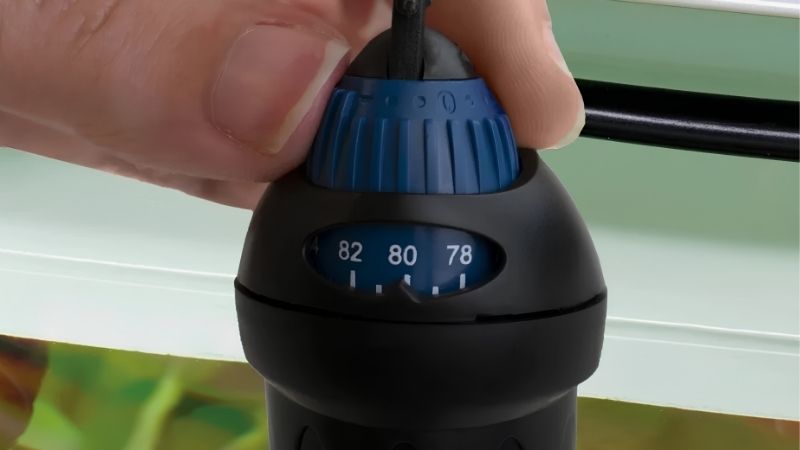
Submersion depth comes first of all. Most units must be fully below the water line, and the heated section needs to stay covered even at the lowest point of a water change, which on a tank that loses half an inch (1 cm) a week to evaporation is a narrower margin than it first appears.
Clearance is the second figure to check. Keep the body at least an inch (2.5 cm) clear of substrate and glass so water can move freely on all sides, since a heater pressed against the back pane heats the glass rather than the water and can crack it under repeated thermal cycling.
Gradient is the number that tells you whether the placement actually worked. A well-circulated tank should hold within about 1 °F (0.5 °C) end to end, while a poorly placed unit in a long tank can leave a difference of 2–3 °F (1–1.5 °C) between the two ends without any fault developing.
Why flow does the work rather than convection
Warm water rises, which produces a thin plume above the element and very little horizontal movement. In a tank with no circulation, that plume spreads across the surface and the lower layers stay noticeably cooler, which is why an unfiltered container heats unevenly no matter the wattage.
Aquarium heater placement works because filter flow turns a local plume into an evenly heated volume. Positioning the heater where the return stream or the intake draws water across it puts the warmed water directly into the circulation path, and that single decision resolves most temperature gradient complaints.
Turnover gives a rough guide to whether the flow is genuinely sufficient. A community tank running 4–6 times its real water volume per hour normally distributes heat well, whereas a lightly filtered tank at 2–3 times turnover often needs the heater placed unusually close to the outflow.
Normal ranges against situations that need action
Some variation is entirely expected. A degree of difference between the top and bottom of a deep tank, or a slightly warmer patch immediately beside the element, is normal and harmless. Fish moving freely across the whole tank is a better indicator than any single thermometer reading.
Action is needed once the gradient reaches 2–3 °F (1–1.5 °C), when fish consistently avoid one end, or when the heater sits partly exposed at any point in the maintenance cycle. Each one of those points to placement or to circulation rather than to a heater that has actually failed.
| Position | What happens | Typical gradient | What to do |
|---|---|---|---|
| Beside the filter outflow | Heat enters circulation at once | Under 1 °F (0.5 °C) | Nothing, this is the target |
| Near the filter intake | Warmed water pulled through | Under 1 °F (0.5 °C) | Also fine, check clearance |
| Dead corner behind décor | Warm pocket, cold far end | 2–3 °F (1–1.5 °C) | Move into the flow path |
| Resting on substrate | Restricted flow, hot spot | Variable | Raise it clear by an inch (2.5 cm) |
| Partly above the water line | Thermal stress on the body | Not applicable | Lower it or top the tank up |
What This Looks Like in a Real Tank
The principle stays constant but the practical answer changes with volume and layout. Aquarium heater placement in a 10 gallon (38 L) nano is mostly a question of fitting the unit at all, while in a 55 gallon (208 L) tank it becomes a question of covering a long footprint evenly.
Tank size, placement and physical fit
Depth decides orientation. A 10 gallon (38 L) tank offers perhaps 10 inches (25 cm) of water while a 55 gallon (208 L) tank gives around 19 inches (48 cm), so a full-length heater that stands vertically in the larger tank may need angling or horizontal mounting in the smaller one.
Weight sets the wider constraints: a full tank runs near 10 lb per gallon (about 1 kg per L), so a 55 gallon (208 L) setup passes 600 lb (272 kg) and needs a purpose-built stand. Measure water depth against heater length with a tape before ordering, and leave a drip loop in the cable.
How the picture changes across 10, 20 and 55 gallon tanks
Small tanks leave almost no room for error at all here. In 8 gallons (30 L) of real water there is often only one position where the unit fits without touching substrate or glass, which means the filter outflow usually has to be aimed at the heater rather than the other way around.
Long tanks present very much the opposite problem. A 48 inch (122 cm) footprint heated from one end develops a measurable gradient, and the usual answer is to split the total wattage across two units at opposite ends, which distributes heat evenly and improves the failure picture as well.
Orientation and filter type both change the answer
Vertical mounting is the default option and it suits deep tanks, since the whole heated section sits well below the surface. Horizontal mounting near the bottom is often better in shallow tanks, because it keeps the unit fully submerged and places heat where the coolest water sits.
Check the manufacturer instructions rather than simply assuming, since some units are rated for one orientation only and mounting them the wrong way can trap air against the thermostat. Angled mounting is a reasonable compromise where depth is marginal but horizontal is not permitted.
Filter type also shifts where the ideal spot falls. With a hang-on-back, the strongest flow is near the outflow at one end, so the heater goes there. With a canister, the return and intake are often at opposite ends, which gives two workable positions and makes even heating considerably easier.
Myths That Lead to Cold Corners
Three beliefs about aquarium heater placement survive largely because they sound reasonable and because the resulting problem is invisible without a second thermometer. Each one produces a tank that reads correctly where the thermometer sits and colder somewhere the fish actually use.
The myth that hiding the heater behind décor is harmless
Concealing the unit behind rock or behind a plant thicket is the most common placement error, precisely because it looks tidy. Décor blocks the flow that carries heat away, so the water immediately around the element warms while the rest of the tank sits below the target temperature.
The practical fix keeps the aesthetics without the problem. Position the heater in the flow path first, then screen it with a taller plant placed to one side rather than directly in front of it, leaving water free to move across the full length of the heated section at all times.
The myth that resting on the substrate is fine
A heater lying flat on gravel or sand has restricted flow along its lower surface, which produces a local hot spot and, in the worst case, thermal stress on the glass body. Sand is the more troublesome of the two, since it packs closely around the element and insulates it further.
Keep at least an inch (2.5 cm) of clearance underneath it at all times. This also matters for maintenance, because a heater resting on substrate is far more likely to be disturbed during a gravel vacuum and to end up partly buried without anyone noticing until the temperature drifts.
The myth that placement stops mattering with enough wattage
Extra wattage simply heats the same small volume faster rather than spreading heat further, so a badly placed 300 W unit produces a hotter pocket rather than an evenly warmed tank. Oversizing also worsens the outcome if the thermostat sticks, which makes this a doubly poor trade.
Distribution is a circulation question and it always has been. Improving the flow, or splitting the wattage between two units at opposite ends, achieves what more power in a single badly placed heater never will, and it usually costs less than replacing the unit with a larger one.
Keeping Placement Correct Over the Years
Aquarium heater placement is not a decision that you make just once at setup, because suction cups age, layouts get changed and water levels fall. Most tanks drift away from their original arrangement gradually, and the change is only noticed when a thermometer reading finally moves.
What to check periodically, and how often
Look at the heater every time you feed the tank: is it fully submerged, still clear of substrate, and still in the flow path. Top the tank up weekly so the heated section never approaches the surface, since a heated room can drop the water level noticeably within a single fortnight.
Switch the unit off before any water change that is going to drop the level below it, and allow it to return to tank temperature before switching it back on. That habit prevents most cracked bodies, and it costs nothing beyond remembering to do things in the right order each time.
What degrades and how the failure appears
Suction cups harden and lose their grip within a year or so of use, dropping the heater onto the substrate or letting it drift into a corner. This is easily the most common cause of a placement that was correct at setup and quietly wrong six months later without anything visibly breaking.
Mineral scale builds up on the body in hard water areas and insulates it slightly, while biofilm does much the same thing rather more slowly. Neither of them is dangerous, but both reduce efficiency and, on units with an external controller probe, scale on the sensor causes genuine calibration errors.
The twelve month cost of getting this right
The recurring items here are genuinely trivial: replacement suction cups or brackets, one or two thermometers, and a soft cloth for wiping scale from the body. None of it is expensive, and prices move constantly, so check at the time of purchase rather than budgeting from memory.
Seasonal conditions change the workload noticeably. Indoor heating through the cold months dries a room quickly and accelerates evaporation, which is why midwinter produces a reliable cluster of heaters running partly exposed in tanks that were perfectly set up during the summer.
Frequently Asked Questions
These questions tend to follow once the tank is treated as a circulation system rather than as a container with a heater sitting in it, because most disputes about aquarium heater placement come down to whether the flow is carrying the heat away or leaving it to pool around the element.
Should the heater go near the filter intake or the outflow?
Either position works perfectly well. Both positions put the element in moving water, which is what matters. The outflow is usually more convenient on a hang-on-back, while a canister with return and intake at opposite ends offers two good positions and makes even heating easier to achieve.
Can I mount the heater horizontally?
Many units permit it and some actually require it in shallow tanks, but check the instructions rather than assuming. Horizontal mounting near the bottom keeps the unit fully submerged and places heat where the coolest water sits, provided it stays clear of the substrate underneath.
How far should the heater be from the glass?
Around an inch (2.5 cm) is enough for water to move freely on all sides. Pressing a glass-bodied unit flat against the back pane heats the glass directly rather than the water, and repeated thermal cycling in that position is a genuine cause of cracked panes in older tanks over time.
Do I need two heaters in a long tank?
Not always, but do measure the tank before deciding. Put a thermometer at each end of any tank longer than 36 inches (91 cm): if the difference reaches 2–3 °F (1–1.5 °C), then splitting the wattage across two units at opposite ends fixes it and improves redundancy at the same time.
Is it safe to put the heater behind the filter?
Only if the water still flows freely around it. Directly behind a hang-on-back box the flow is very often stagnant, which creates exactly the warm pocket you are trying to avoid, so check with a thermometer at the far end rather than assuming that proximity to the filter is enough.
See More:
Conclusion
Good aquarium heater placement comes down to three rules: keep the unit fully submerged with at least an inch (2.5 cm) of clearance from substrate and glass, put it in the flow path near the filter intake or the return, and never hide it behind décor where circulation is blocked.
Verify with a thermometer at the opposite end rather than trusting the position by eye alone, and add a second thermometer on tanks longer than 36 inches (91 cm). If the gradient reaches 2–3 °F (1–1.5 °C), improve circulation or split the wattage across two units at opposite ends.
Best Heater for 10 Gallon Tank: Watts, Fit and Safety Tips
Led Aquarium Light Dimensions for 75 Gallons Size Guide With Measurements (2026)