Last Updated: October 4, 2026
The real split here is monitoring now versus monitoring plus power control the day it arrives, not cheap versus good. The neptune apex jr vs full apex which controller question comes down to outlets and networking, since the Jr ships with 0 controllable outlets while the full Apex adds the 8-outlet EB832 and Ethernet for about $375 more.
As an Amazon Associate we earn from qualifying purchases.
As an Amazon Associate we earn from qualifying purchases at no extra cost to you. Prices and availability are accurate as of the date shown and are subject to change.
By David Nguyen
Quick answer: For most people in 2026, the best neptune apex jr vs full apex which controller is the FMM inputs — our #1 rated choice. See the full ranked comparison, alternatives and buying advice below.
How to Choose Between Apex Jr and Full Apex
Decide whether you need monitoring or immediate control, compare expansion ports, check your network requirements, and calculate the real price difference. Both units monitor pH and temperature, so the decision turns on outlets, connectivity and cost rather than one being a better version of the other.
Decide Whether You Need Monitoring or Immediate Control
The clearest difference is outlets: the Jr includes 0 controllable AC outlets, while the full Apex includes 8 AC outlets on the EB832. So the Jr monitors and alerts out of the box, whereas the Apex can switch a heater, pump or light immediately without extra power hardware.
Decide which you need first. If you only want pH, temperature and leak monitoring today, the Jr covers it, but if you want the controller to act on those readings by switching equipment straight away, the full Apex’s included outlets are the reason to pay more.
Compare Expansion Ports
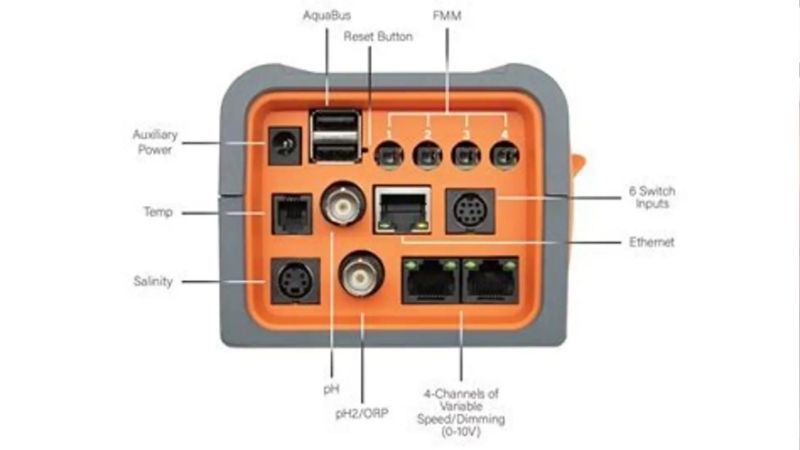
The Jr has 2 FMM inputs and the full Apex has 3, so the Apex accepts one more FMM-based sensor before expansion. Both are expandable, so neither locks you out of adding sensors later, but the starting count affects how much you can wire on day one.
Match the port count to your sensor plan. If you intend to run several leak, optical or level sensors immediately, the Apex’s extra input helps, while a simpler monitoring setup fits within the Jr’s two inputs, so let your sensor list rather than the label guide the choice.
Check Your Network Requirements
Networking differs: the Jr is Wi-Fi-only, while the full Apex supports Wi-Fi and hard-wired Ethernet, and Neptune suggests a wired network where possible for the Apex and Apex Pro. So a stand far from strong Wi-Fi may favor the Apex for a reliable wired link.
Consider where the controller sits relative to your router. If Wi-Fi at the tank is solid, the Jr’s wireless-only design is fine, but if you prefer or need Ethernet for stability, that option exists only on the full Apex, which can decide the choice on its own.
Calculate the Real Price Difference
At the same retailer, the Jr is around $325 and the full Apex around $700 as of September 2026, a gap of about $375 or roughly 119%. That difference should be read as an upfront-price comparison at checked pricing, not as proof the Apex is a better-value pump overall.
Weigh that gap against what the extra money buys: the EB832’s 8 outlets and Ethernet. If you need immediate equipment control, the difference is buying capability rather than paying more for the same thing, so match the spend to whether you need switching now or later.
Apex Jr vs Full Apex by Use Case
Both share pH and temperature monitoring, so the decision turns on outlets, ports, networking and price. The table pairs each factor with the unit it favors, and the sections below cover where the Jr fits and what it defers, then where the full Apex fits and what it costs.
| Factor | A3 Apex Jr | A3 Apex | Best For |
|---|---|---|---|
| FMM inputs | 2 | 3 | Apex if expanding sensors |
| AC outlets included | 0 | 8 | Apex for immediate automation |
| Ethernet | No | Yes | Apex for wired networking |
| pH/temp monitoring | Included | Included | Both |
| Checked BRS price | ~under $350 | ~under $700 | Depends on required hardware |
Apex Jr for Monitoring-First Reef Tanks
The Apex Jr covers pH and temperature monitoring with 2 FMM ports and support for leak and optical sensors, priced around $325 as of September 2026. For a tank that mainly needs connected monitoring and alerts, it delivers that at the lower entry cost of the two.
Its trade-off is no included controllable outlets, so it does not switch equipment out of the box. That makes it the monitoring-first choice, ideal when you want to watch parameters now and decide on automation later rather than paying for switching capability you are not ready to use.
Apex Jr for Users Who Want to Expand Later
Neptune describes the Jr as monitoring-focused but expandable to control, so buying it does not lock you out of automation. You can add controllable power hardware down the line, turning a monitoring base into a switching system as your needs grow.
So the Jr suits reefers who want a lower upfront cost with a clear upgrade path. Treat its 0 included outlets as a starting point rather than a ceiling, since the expansion route means you are deferring the outlet cost, not giving up the capability permanently.
Full Apex for Heater, Pump and Equipment Automation
The full Apex includes the EB832 with 8 relay-switched 120V AC outlets, plus 3 1LINK and 2 switched 24VDC connections. That lets it control heaters, pumps and lights immediately, which is the core reason to choose it over the Jr for an automation-ready build.
Read the outlet figure correctly: 8 are AC outlets, not 13, since the total connection count mixes three types. For a tank where you want the controller switching equipment from day one, those 8 included AC outlets are what the higher price actually buys.
Full Apex for More Complex Reef Systems
The full Apex adds 3 FMM inputs, 6 digital inputs and Ethernet alongside Wi-Fi, priced around $700 as of September 2026. That extra input capacity and wired networking suit more complex systems running several sensors and benefiting from a stable network connection.
So it fits reefers whose plans go beyond basic monitoring. The added ports and Ethernet are the practical reasons to step up, so choose the full Apex when your sensor count and networking needs justify the roughly 119% higher upfront cost over the Jr.
Frequently Asked Questions
Buyers ask whether the Jr can control equipment, whether it has Ethernet, when to choose it over the Apex, and when both are wrong. The answers below stay with Neptune’s current A3 specs and keep “0 outlets included” separate from “cannot control after expansion.”
Can Apex Jr Control Aquarium Equipment?
Yes, after expansion. Out of the box the Jr includes 0 controllable outlets, while the standard Apex includes 8, so on its own the Jr monitors rather than switches. Adding controllable power hardware later gives it equipment control it does not have in the base package.
So “0 outlets included” does not mean the Jr can never control gear. It means switching is deferred until you add the hardware, which is different from a permanent limitation, so plan for that expansion if immediate control is not needed on day one.
Does Apex Jr Have Ethernet?
No. The current A3 Jr is Wi-Fi-only, while the standard A3 Apex supports Ethernet in addition to Wi-Fi. So if a wired network connection matters for your placement or reliability, that option exists on the full Apex but not the Jr.
Check your tank’s Wi-Fi signal before deciding. If wireless is strong and stable at the stand, the Jr’s Wi-Fi-only design is not a problem, but if you want the option of a wired link, that alone can point you toward the full Apex.
When Should I Choose Apex Jr Instead of Apex?
Choose the Jr when your immediate need is pH, temperature, leak and level monitoring and you do not yet need the 8-outlet EB832. At the checked prices, that avoids roughly $375 of upfront cost while still giving you connected monitoring and alerts.
It suits reefers who want to start monitoring now and add control later. If switching equipment is not a day-one requirement, the Jr covers the monitoring job for less, with the option to expand into automation when you are ready rather than paying for it immediately.
When Are Both Apex Jr and Apex the Wrong Choice?
Both are wrong if the tank does not need connected monitoring or automation at all, or if you are committed to another controller ecosystem. In those cases, neither unit’s strengths apply, so a simpler standalone monitor or your existing platform makes more sense.
There is no minimum tank size that rules them out, since Neptune does not define one, so do not invent a gallon threshold. The deciding factor is whether you want connected monitoring or automation, not the size of the tank they would sit on.
Final Thoughts
The neptune apex jr vs full apex which controller decision is best framed as monitoring-first versus monitoring plus immediate power control, not a cheap unit against a good one. Match FMM ports, outlets and networking to your plan, read the roughly 119% price gap as upfront cost at checked pricing, and remember the Jr can still expand into control later.
Ready to decide? Our #1 pick for 2026 is the FMM inputs.
Live price & availability on Amazon.
Related Reviews & Guides



8 Best Budget Aquarium Lighting for Coral Growth

6 Best Beginner Saltwater Aquarium Kits 2026