Last Updated: October 4, 2026
- Stop first when anything is wet or damaged
- What a GFCI does—and does not do
- A drip loop controls a path, not electricity
- Power strips and extension cords are not wiring upgrades
- Calculate load, then let an electrician judge the circuit
- Inspect each appliance as a system
- Pumps, sumps, and leak paths
- Safe maintenance sequence
- Monthly audit and emergency label
Aquarium Electrical Safety: GFCIs, Drip Loops and Load
Water, grounded equipment, and mains electricity share very little margin for improvisation. Aquarium electrical safety is not a DIY wiring lesson; it is a pre-flight check that helps an aquarist recognize when to stop. Outlet installation, grounding, circuit capacity, damaged building wiring, and code compliance belong to a licensed electrician familiar with local rules.
A drip loop, a GFCI, and a power strip solve different problems. None substitutes for the others, and none makes wet or damaged equipment safe. Product instructions and the authority having jurisdiction determine the actual installation.
As an Amazon Associate we earn from qualifying purchases at no extra cost to you.




Editorial illustration; not evidence for species identification.
Stop first when anything is wet or damaged
Do not touch a wet plug, outlet, power strip, switch, or exposed conductor. Keep people away and isolate power upstream only if that can be done from a known dry, safe location. If there is smoke, arcing, heat, burning odor, shock, or fire, use emergency services and utility procedures for the jurisdiction. Never reach into water to rescue equipment while a circuit may be energized.
After any shock, seek medical evaluation according to local emergency guidance, even if the person initially feels well. Do not re-energize the aquarium until a licensed electrician and, where relevant, the equipment manufacturer have assessed the cause. Fish welfare matters, but it does not justify a person entering an electrical hazard; a qualified aquatic professional can help plan temporary life support after the area is safe.
The U.S. Consumer Product Safety Commission publishes electrical safety information, and the Electrical Safety Foundation International provides home electrical safety resources. Readers outside the United States must use their own regulator, utility, and electrical code.
What a GFCI does—and does not do
A ground-fault circuit interrupter monitors an imbalance in current and is designed to interrupt a ground fault rapidly. It can reduce shock risk, but it is not a guarantee against injury, overload, fire, or every wiring fault. It does not excuse wet hands, damaged insulation, missing grounding, or equipment used outside its rating.
Aquarium outlets in wet-adjacent locations should be assessed by a licensed electrician. GFCI requirements, device types, upstream protection, and testing rules vary. Do not replace an outlet or alter a panel based on an aquarium article. Ask the electrician to identify which outlets are protected and how the installed device should be tested.
Use the device manufacturer’s TEST and RESET procedure at the stated interval, without defeating protection to keep life-support equipment running. A unit that will not test or reset, trips repeatedly, feels hot, or shows damage requires professional investigation. Repeated tripping is information about a fault, not an inconvenience to bypass.
A drip loop controls a path, not electricity
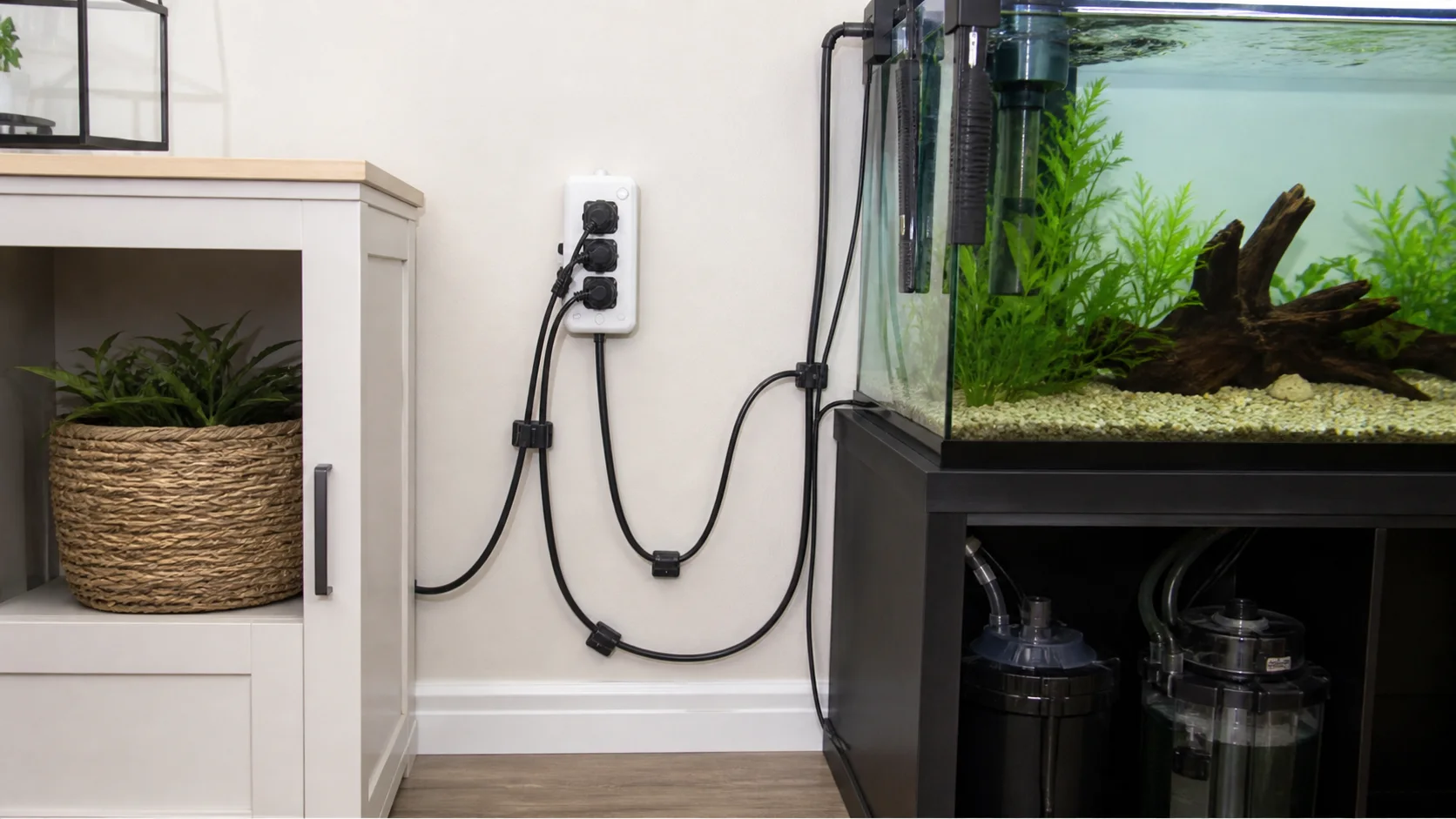
A drip loop is the part of a cord that hangs below the outlet or connection before rising to it. Water traveling down the cable should reach the low point and drip off rather than flow directly into the receptacle. Every cord approaching an outlet or dry connector needs deliberate routing.
The loop must remain below the connection, free of clips that guide water upward, and visible enough to inspect. It cannot protect against splashes, flooding, condensation inside equipment, capillary travel through a connector, or a cord lying in standing water. A towel wrapped around a plug is not a safety device.
Keep outlets and power strips away from the tank’s splash and overflow paths. Arrange hoses so a leak does not follow them into electrical equipment. Provide strain relief without crushing insulation. Never staple, sharply bend, knot, splice, or trap appliance cords under a stand.
Power strips and extension cords are not wiring upgrades
Use only listed or certified equipment appropriate to its environment and follow every manufacturer instruction. UL Solutions explains that safety certification relates to evaluated uses and markings; it does not approve daisy-chaining, overloading, or exposing an indoor strip to water.
Do not plug one power strip into another. Do not use a cube adapter to multiply aquarium loads. Extension cords are often intended for temporary use and can introduce undersized conductors, loose connections, and trip hazards. If permanent equipment cannot reach a properly located outlet, ask a licensed electrician to provide a compliant solution.
Mounting a power strip high on a dry side wall may reduce exposure, but only if the product permits mounting in that orientation and the location remains outside splash, condensation, and leak paths. Never place it loose on the floor beneath an aquarium or inside a humid enclosed cabinet unless specifically rated and professionally accepted for that environment.
Calculate load, then let an electrician judge the circuit
List each device’s nameplate watts or current: heaters, chillers, pumps, filters, lights, air pumps, controllers, dosers, and anything intermittent. Consider equipment that may operate simultaneously, including multiple heaters during a cold start. Do not use advertised tank size as a load value.
Basic arithmetic can inventory connected load, but it cannot determine whether household wiring, breakers, receptacles, shared appliances, continuous-load rules, or startup current are acceptable. Give the list to a licensed electrician. Do not replace a breaker with a larger one or change a fuse to stop trips; conductor and equipment ratings govern protection.
Controllers add switching and sensing but do not increase circuit capacity. The site’s heater controller guide can help evaluate aquarium functions, while all mains-load conclusions remain with the electrician and manufacturer.
Inspect each appliance as a system
Before installation, read the manual for required grounding, submersion depth, dry-side placement, ventilation, orientation, and maintenance isolation. A submersible pump may have a cord and plug that must remain dry. A splash-resistant light is not necessarily submersible. The aquarium LED guide should be used alongside, never instead of, the exact fixture instructions.
Check cords for cracking, swelling, cuts, discoloration, exposed copper, stiff sections, or damaged strain relief. Inspect plugs for bent pins, corrosion, looseness, and heat marks. Replace the complete appliance through the manufacturer-approved route; do not tape, splice, or mold a repair around a damaged flexible cord.
Heaters need special visual inspection. Disconnect power according to instructions and allow the specified cooling time before exposure to air or removal. A cracked tube, condensation where the design does not permit it, failed seal, or erratic control means removal from service. Never energize a heater outside its specified water level.
Pumps, sumps, and leak paths
Return pumps combine continuous operation with plumbing that can leak or siphon. Use manufacturer-approved hose, clamps, unions, and support. Test power-off behavior with safe supervision: the sump must accept drain-down volume without overflowing. The return pump and sump guide covers hydraulic planning, not electrical sign-off.
Keep pump connectors, controllers, and adapters out of the sump cabinet’s wet floor and condensation zones. A leak detector may add warning, but it does not isolate a hazardous circuit unless a listed, professionally designed system explicitly does so. Route cables so a plumbing leak cannot run along them.
Airline pumps should sit where back-siphoned water cannot reach the pump or electrics. Use a correctly oriented check valve where the manufacturer recommends one, but also position the pump safely; small valves can fail or clog.
Safe maintenance sequence
Plan shutdown before putting hands in water. Use clearly labeled plugs or a manufacturer-approved control arrangement so the correct equipment can be isolated without grabbing cords. Dry hands and the surrounding floor. Switch off and unplug according to manuals, then verify heaters have cooled and pumps will not restart unexpectedly.
Never pull a plug by its cord. Keep disconnected plugs on a dry support, not dangling where water can reach the pins. After maintenance, inspect water level, valve position, guards, and cable routing before restoring power. Energize while observing from a safe, dry position and stop if any device behaves abnormally.
Maintain oxygenation and temperature within animal-safe limits during planned downtime. For long repairs, ask an experienced aquatic professional for a temporary husbandry plan. Animal illness or unexplained behavior after an incident requires a qualified aquatic veterinarian, but only after human electrical safety has been established.
Monthly audit and emergency label
Trace every cord from appliance to outlet. Confirm intact insulation, a real drip loop, a dry connector, no daisy chain, readable labels, open ventilation, and no salt or mineral track that could conduct moisture. Test GFCI protection exactly as instructed and log the result. Inspect behind the stand with a light rather than assuming hidden areas are dry.
Post the circuit location, emergency contact, and safe isolation instruction where another adult can find them. Do not include a step that requires touching wet equipment. Revisit the load inventory whenever a heater, chiller, large pump, or additional aquarium is added.
The safest aquarium electrical layout is uneventful and easy to inspect. If a cord cannot form a loop, a strip must live under a leak, a device repeatedly trips protection, or the circuit history is unknown, stop and call a licensed electrician. Convenience is never evidence that an arrangement is safe.
Sources
- U.S. Consumer Product Safety Commission: Electrical Safety
- Electrical Safety Foundation International: Home Safety
- UL Solutions safety resources
- National Fire Protection Association: Electrical safety
Related Reviews & Guides
6 Best Pressurised Co2 System Aquariums 2026
Do I Need Two Aquarium Filters? An Honest Answer (2026)