Last Updated: October 4, 2026
- Top Pick: HITOP Dual Outlet Aquarium Electric Air Pump, Whisper Adjustable Fish Tank Aerator, Quiet Oxygen Pump with Accessories for 10 to 100 Gallon
- Best Value: Uniclife 64 GPH Aquarium Air Pump with Dual Outlets Adjustable Quiet Fish Tank Air Pump with Air Stone Airline Tubing Check Valve and Connector Accessories for 10-100 Gallon Fish Tank
- Premium Choice: AQQA Aquarium Air Pump, 3W Powerful Dual Outlet Adjustable Oxygen Aerator
Shopping for a quiet aquarium air pump is less about finding the product with “whisper” in its name and more about matching the pump to your tank, placement, and tolerance for vibration. Many buyers make the same mistakes: they compare advertised gallons per hour without considering back pressure, assume more wattage always means more noise, or place the pump directly on a hard cabinet where vibration becomes amplified. Others buy a pump with two outlets but never check whether each outlet can be adjusted independently.
This aquarium air pump buying guide for noise focuses on the details that make the biggest practical difference: pump size, construction, airflow control, vibration isolation, accessories, price, and support. The goal is not absolute silence—air bubbles and surface agitation always make some sound—but a setup that is quiet enough for a bedroom, office, or living room.
As an Amazon Associate we earn from qualifying purchases at no extra cost to you.



Decide These 3 Things First
- Your aquarium size and depth: A pump rated for 10 to 60 gallons may be adequate for a shallow tank but underpowered for a tall aquarium with multiple air stones. Measure the distance from the pump to the diffuser, not just the tank volume.
- How much airflow you need: An air stone, sponge filter, under-gravel filter, and decorative bubbler each create different resistance. Choose adjustable output when possible so you can reduce bubbling and noise after installation.
- Where the pump will sit: A pump on a hollow wood cabinet can sound much louder than the same pump on a dense rubber pad. Decide whether it will be beside the tank, inside a ventilated cabinet, or mounted above the waterline.
For a typical 10- to 30-gallon freshwater aquarium with one small air stone or sponge filter, a compact 1.5- to 3-watt pump is often enough. Tanks from 40 to 100 gallons, or setups using two diffusers, generally benefit from a dual-outlet model with independent flow control.
Size and Airflow Capacity
Tank-size labels are useful starting points, but they are not precise performance ratings. Budget pumps commonly list ranges such as 10 to 60 gallons or 10 to 100 gallons. Those ranges assume relatively modest water depth and uncomplicated tubing. A tall 75-gallon tank with a fine-pore air stone may need more usable pressure than a shallow 100-gallon breeding setup.
Look for an airflow rating in gallons per hour (GPH) or liters per minute (L/min). A rating around 30 to 60 GPH—roughly 1.9 to 3.8 L/min—can suit many small and medium tanks. For two outlets, check whether the listed airflow is total output or output per outlet. A pump advertised at 64 GPH may divide that amount between both outlets rather than supply 64 GPH from each one.
Depth also matters. For most home aquariums, a pump that can maintain airflow against approximately 18 to 24 inches of water pressure is a more useful choice than one with a high free-air rating but weak pressure. If the pump will run a sponge filter and an air stone simultaneously, select a model with separate controls or plan to add inline valves.
Material and Heat Management
The outer housing is usually made from ABS plastic or another molded polymer. Plastic keeps weight and cost down, but the quality of the housing affects resonance. Look for a thick, tightly fitted shell with ventilation slots that do not feel flimsy. A pump weighing roughly 8 to 16 ounces is common for compact aquarium models; an extremely light unit may still work well, but it can be easier to move and vibrate.
Airline tubing is usually soft silicone or clear PVC. Silicone tubing is more flexible and remains easier to handle around corners, while PVC often costs less and can hold its shape. For quiet operation, use tubing that fits snugly over the outlet. A loose connection can hiss, leak air, and force the pump to work harder.
Do not cover ventilation openings to reduce sound. Pumps need airflow to manage heat. If installing one inside a cabinet, leave at least 2 inches of clearance around the housing and provide an opening for fresh air. Excess heat can shorten the life of the diaphragm and may increase mechanical noise.
Construction and Vibration Control
Noise usually travels through vibration rather than through the air alone. A pump with a well-sealed housing can still sound loud if its feet touch a resonant surface. Look for rubber feet, a broad stable base, and a diaphragm assembly designed for continuous operation. Dual-outlet pumps may produce more mechanical vibration because they are doing more work, although a well-built model can remain quieter than a poorly isolated single-outlet pump.
Place the pump on a dense silicone mat, a ¼-inch rubber pad, or several thick furniture-grade felt pads. Avoid soft, unstable foam that allows the pump to wobble. Keep it away from the back wall and cabinet sides; a gap of 1 to 2 inches can prevent direct contact from amplifying the hum.
Check the pump after connecting the tubing. If the sound changes when you lightly steady the housing, the problem is probably vibration or an uneven surface. If the noise is a sharp rattle, inspect the air stone, check valve, and tubing for blockage before assuming the motor is defective.
Comfort and Performance in Daily Use
“Quiet” is not a standardized measurement for aquarium pumps. Unless a manufacturer provides a repeatable decibel test with a stated distance and room condition, treat quietness claims as comparative marketing rather than a guaranteed sound level. A low mechanical hum may be acceptable in a living room but distracting beside a bed.
Adjustable airflow is one of the most useful comfort features. Running a pump at full output can create unnecessary bubble noise, splashing, and surface turbulence. With an adjustable dial or inline valve, you can reduce flow until the water remains oxygenated without making the tank noisy. For a bedroom tank, position the air stone below the surface and use a fine diffuser rather than a large, coarse bubbler.
Air pumps are commonly rated between 1.5 and 4 watts for household aquariums. At continuous operation, a 3-watt pump uses approximately 26.3 kilowatt-hours per year; a 4-watt pump uses about 35 kWh per year. Actual electricity cost depends on local rates, but wattage is still a helpful indicator of energy use and motor workload.
Price Tiers and What You Get
Budget aquarium pumps generally cost about $9 to $16. Examples in this category include compact dual-outlet models priced near $10 to $15, often bundled with airline tubing, air stones, connectors, and check valves. They can be practical for smaller tanks, quarantine systems, and backup use. Expect more variation in finish, dial smoothness, and vibration isolation.
Midrange pumps cost approximately $17 to $30. They may offer better airflow adjustment, a sturdier base, quieter operation by design, or more consistent performance against water pressure. A 3-watt dual-outlet model around $25 fits this category. The extra cost is worthwhile when the tank is in a bedroom or when you need to operate two filters.
Premium home-aquarium pumps usually begin around $30 and may exceed $60, particularly for high-pressure, linear, or specialty systems. The premium is most useful when you need dependable pressure at greater depth, low heat, replaceable parts, or a longer warranty. It is not automatically worthwhile for a simple 10-gallon tank with one air stone.
Warranty and Replacement Parts
Look for at least a one-year limited warranty, with two years being preferable when the pump will run continuously. Read what the warranty covers: some policies include the motor but exclude tubing, air stones, diaphragms, and other wear items. A clear replacement-parts policy is more valuable than a vague promise of long life.
Diaphragms and rubber components eventually wear. Before buying, check whether replacement diaphragms or complete repair kits are available. If a low-cost pump cannot be repaired, replacing it every few years may still be economical; however, a serviceable pump creates less waste and avoids having to reconfigure the aquarium.
Delivery, Setup, and Assembly
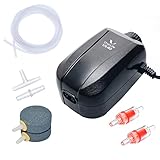
Most aquarium air pumps require only a few minutes of assembly, but confirm that the package includes the parts you need. A useful kit may contain 4 to 6 feet of airline tubing, one or two air stones, a check valve, connectors, and airflow control valves. Included accessories reduce startup cost, but they are not necessarily the quietest or most durable components.
Install the pump above the aquarium waterline whenever possible. If it must sit below the waterline, use a check valve on every airline to prevent a siphon during a power outage. Keep electrical connections in a drip loop, with the cord hanging below the outlet before rising to the receptacle. Test the system for leaks and allow the air stone to become fully saturated before judging the final sound level.
Spec Checklist
| Spec | Budget | Mid | Premium |
|---|---|---|---|
| Typical price | $9–$16 | $17–$30 | $30–$60+ |
| Suggested tank range | 10–60 gallons | 20–100 gallons | 40–150+ gallons, depending on pressure |
| Power draw | 1.5–3 watts | 2–4 watts | 3–8 watts |
| Outlets | One or two | Two, preferably independently adjustable | Two or more, with strong pressure control |
| Useful airflow range | 20–60 GPH | 40–100 GPH | 60–150+ GPH, depending on application |
| Noise-focused features | Rubber feet and an airflow dial | Heavy base, low-vibration housing, separate controls | Improved isolation, replaceable parts, refined pressure control |
| Included accessories | Often tubing, stones, valves, and connectors | Usually a more complete starter kit | May prioritize the pump over accessories |
Red Flags
- Only “whisper quiet” is listed: Without a test method, this phrase does not tell you how the pump will sound in your room.
- No airflow adjustment: A fixed-output pump can create excess bubble noise and may be difficult to match to a small diffuser.
- Unclear gallon rating: Avoid relying on a tank range if the listing does not explain airflow, pressure, or outlet distribution.
- Loose or rattling housing: Poorly fitted panels can create mechanical noise and may worsen over time.
- No check valve in a below-tank setup: This increases the risk of water traveling back toward the pump during an outage.
- Accessories with no dimensions: Very small air stones may clog sooner, while oversized stones can overload a compact pump.
- No warranty or parts information: Continuous-use equipment deserves clear support terms.
FAQ
What is the quietest type of aquarium air pump?
A low-vibration diaphragm pump with adjustable airflow, rubber feet, and a stable housing is usually the best choice for home use. Placement and the air stone often contribute as much noise as the motor itself.
Is a dual-outlet air pump louder?
It can be, because the motor may work harder, but outlet count alone does not determine noise. Independent adjustment lets you reduce unused airflow, and a well-isolated dual-outlet pump may be quieter than a poorly built single-outlet model.
How can I make an existing air pump quieter?
Put it on a ¼-inch rubber or silicone pad, leave 1 to 2 inches of clearance from walls, replace clogged air stones, secure loose tubing, and lower the airflow gradually. Never seal the ventilation openings or place the pump on an unstable cushion.
How much should I spend on a quiet aquarium air pump?
For a basic 10- to 30-gallon tank, $10 to $20 is often sufficient. Spend about $20 to $30 for smoother adjustment and better isolation, or more than $30 when you need higher pressure, replaceable components, or stronger warranty support.
Ready to decide? Our #1 pick for 2026 is the Typical price.
Live price & availability on Amazon.
Related Reviews & Guides


Aqueon vs Tetra Aquarium Kits Which Is Better: Top Compared

How to Choose an Aquarium Substrate: Complete Buying Guide (2026)