Last Updated: October 4, 2026
- Top Pick: AstroAI L7 Tire Inflator Portable Air Compressor,150 PSI Cordless Bike Pump
- Best Value: OlarHike Tire Inflator Portable Air Compressor,Dual Power-3*2000mAh &12V DC
- Premium Choice: hygger Mini Wave Maker for 15-40 Gallon Aquarium with Magnetic Mount Quiet Powerhead for Saltwater and Freshwater Fish Tank 530 GPH
Choosing between an air pump and a powerhead is less about picking the “stronger” aquarium device and more about deciding what your tank actually needs. Do you need dependable oxygen exchange, stronger circulation, quieter operation, or a cleaner-looking setup? The answer can change with tank size, fish species, room layout, and whether the aquarium sits in a bedroom, living room, or busy family space.
In the air pump vs powerhead for aquarium debate, an air pump moves air through airline tubing and an air stone. A powerhead moves water directly, creating circulation and surface movement. Some powerheads also include an air-injection feature, but they are not interchangeable in every tank. Here is how to choose the better fit for your home in 2026.
As an Amazon Associate we earn from qualifying purchases at no extra cost to you.


Quick Verdict
Choose an air pump if your priority is reliable aeration, gentle movement, a sponge filter, or a low-cost backup for a community aquarium. Air pumps are especially useful in small tanks, quarantine tanks, breeding setups, and aquariums with fish that prefer calm water.
Choose a powerhead if your tank needs stronger circulation, fewer dead spots, better waste distribution, or current that reaches across a longer aquarium. Powerheads are usually the better choice for larger freshwater tanks, planted tanks with dense décor, and saltwater aquariums that need broad water movement.
For many home aquariums, the best answer is both: an air pump for backup aeration or filtration, plus a properly sized powerhead for circulation. Neither device should be selected solely by gallons per hour or bubble output. Fish behavior, tank shape, noise, and adjustability matter just as much.
Side by Side
| Factor | Air Pump | Powerhead for Aquarium |
|---|---|---|
| Primary job | Pushes air through tubing, an air stone, or a sponge filter | Moves and circulates aquarium water |
| Comfort | Usually gentle for bettas, fry, shrimp, and calm-water fish | Can be comfortable when adjustable, but strong flow may stress slow swimmers |
| Durability | Often lasts several years when kept dry and protected from vibration | Submersible motors can last for years, but impellers need regular cleaning |
| Typical price range | About $15–$50 for most home aquarium models | About $17–$80, depending on flow, controls, and wave-making features |
| Maintenance | Replace airline tubing or air stones; clean intake filters | Remove algae and debris from the housing and impeller |
| Space needed | External pump is commonly 3–6 inches wide, plus tubing and an air stone | Usually occupies 2–5 inches inside the tank and needs an unobstructed outlet |
| Look | Visible bubbles and tubing; equipment can be hidden behind décor | More discreet, but the internal unit and cord remain visible |
| Energy use | Commonly about 2–8 watts | Commonly about 3–30 watts; high-flow models may use more |
| Resale and flexibility | Easy to reuse with sponge filters, quarantine tanks, and air stones | More specialized, but useful across freshwater and saltwater setups |
| Best for | Gentle aeration, backup oxygen, sponge filtration, and small tanks | Water circulation, larger aquariums, wave action, and eliminating dead spots |
Where Air Pump Wins
An air pump wins when oxygen exchange and gentle movement are more important than strong circulation. Bubbles rising through an air stone disturb the surface, helping oxygen enter the water and carbon dioxide leave it. The pump itself does not “oxygenate” every part of the aquarium directly; its main benefit comes from surface agitation and the water movement created by rising bubbles.
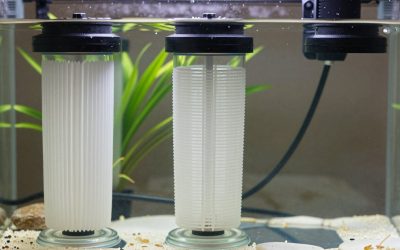
Air pumps are also a practical match for sponge filters. A sponge filter provides biological filtration while the air pump drives water through the sponge. This combination is inexpensive, forgiving, and useful for shrimp, fry, quarantine tanks, hospital tanks, and aquariums where a powerful current would be inappropriate.
They are generally easier to position because the motor remains outside the aquarium. A 2–8 watt pump typically adds little to a household electric bill, and replacement parts such as airline tubing, check valves, and air stones are inexpensive. A check valve is important because it helps prevent water from siphoning backward into the pump during a power outage.
The tradeoff is vibration. Even a small pump can create a hum if it touches a hard cabinet wall. A soft rubber pad, open air intake, and a small amount of slack in the tubing can reduce noise. Air stones also become less effective as they clog with mineral deposits, so they may need replacement every few months to a year depending on water hardness and cleaning.
Do not confuse an aquarium air pump with a portable tire inflator. For example, the AstroAI L7 Tire Inflator Portable Air Compressor, 150 PSI Cordless Bike Pump, listed for under $30, and the OlarHike Tire Inflator Portable Air Compressor, Dual Power with 3*2000mAh and 12V DC, listed for under $40, are designed for inflating tires and sporting equipment. Their pressure, fittings, noise, and operating design are not intended for continuous aquarium aeration.
Where Powerhead for Aquarium Wins
A powerhead for aquarium use wins when water needs to travel across the tank rather than simply rise toward the surface. It can push water behind rocks, through planted areas, and along the length of a large aquarium. This reduces stagnant zones where debris can settle and helps distribute temperature and dissolved oxygen more evenly.
Powerheads are especially useful in tanks with heavy décor, canister filters that do not create enough internal movement, and saltwater systems that benefit from broad, irregular flow. A wave maker can also create more natural movement than a narrow filter outlet. Look for adjustable flow or multiple speed settings if your fish are not strong swimmers.
Installation is usually straightforward. Magnetic mounts are convenient because they avoid suction cups that can loosen over time, but a magnet-mounted unit still needs a stable, unobstructed position. Keep the intake away from gravel, plant leaves, and long-finned fish. A guard or pre-filter sponge can help protect shrimp and fry, although it will require more frequent cleaning.
Several compact models fall into the budget category. The hygger Mini Wave Maker for 15–40 gallon aquariums is listed for under $30 and is described as a quiet, magnetic-mount powerhead with 530 GPH. The AquaMiracle Aquarium Powerhead Pump is listed for under $20, with 135 GPH circulation for 10–40 gallon aquariums and an aerating feature. These specifications illustrate the range available, but actual performance depends on tank shape, décor, water depth, and how much flow your livestock can tolerate.
A powerhead with an air-injection attachment may produce bubbles, but bubbles alone do not make it equivalent to a dedicated air pump and sponge filter. If filtration, emergency aeration, or gentle bubble movement is the goal, retain an air pump even when a powerhead handles everyday circulation.
Cost Over 5 Years
The purchase price is only part of the five-year cost. A basic aquarium air pump typically costs $15–$50. Add approximately $3–$8 for airline tubing and check valves, plus $5–$15 for replacement air stones or small diaphragms over five years. A reasonable total is about $23–$73, excluding electricity.
A basic powerhead usually costs $17–$80. Budget approximately $5–$20 for replacement pre-filter sponges, impeller parts, or a new mounting accessory over five years. That creates an estimated total of $22–$100, excluding electricity.
Energy costs depend on local rates and runtime. At an illustrative electricity rate of $0.16 per kilowatt-hour, a 5-watt air pump running continuously uses about $7 per year. A 15-watt powerhead uses about $21 per year. Over five years, that is roughly $35 versus $105. Actual costs will vary, but lower wattage is one reason air pumps remain attractive for small tanks and backup systems.
Which One for Your Home
Small apartment
Choose a quiet air pump for a small aquarium, especially if the tank is near a bed, desk, or sofa. Its low wattage and external placement make it easy to manage. If the tank has dead spots, use a small adjustable powerhead at its lowest setting rather than buying a high-flow model that creates unnecessary noise and turbulence.
Family with kids or pets
An air pump paired with a sponge filter is a forgiving choice for a family aquarium. The equipment is simple, and a sponge guard can reduce the risk of small fish or shrimp being pulled into an intake. Secure cords with a drip loop, keep the pump above the tank when possible, and use a covered aquarium stand to limit access by curious pets.
Rental home
Pick equipment that is easy to remove without modifying the property. An external air pump leaves no permanent installation and works well with temporary tank layouts. A magnetic powerhead is also renter-friendly, but place it carefully to avoid scratching the glass or acrylic and route the cord neatly so it does not create a trip hazard.
Long-term home
If you expect to keep the same aquarium for years, consider using both devices. A powerhead can provide everyday circulation while an air pump remains available for a quarantine tank, sponge filter, heat-related oxygen demand, or power outage backup connected to a battery system. This arrangement costs more initially but gives the aquarium greater flexibility.
FAQ
Is an air pump or powerhead better for oxygen?
An air pump is usually the simpler choice for dependable surface agitation and aeration. A powerhead can also improve oxygen exchange if it ripples the surface, but a unit aimed too deeply may circulate water without creating enough surface movement.
Can a powerhead replace an air pump?
Sometimes, but not always. If the powerhead has an air-injection feature and creates visible surface movement, it may meet the needs of a basic community tank. It cannot replace the role of an air-driven sponge filter unless the aquarium has another filtration method.
Does every aquarium need a powerhead?
No. A properly sized filter may already provide sufficient circulation. Add a powerhead when you notice dead spots, debris collecting in corners, uneven temperature, or fish that require stronger current. Always begin at a low setting.
Should an air pump run all night?
In most aquariums, an air pump can run continuously. Consistent aeration is often preferable to switching it on and off. If noise is a concern, use a quieter pump, a vibration-damping pad, and a check valve rather than stopping aeration without confirming that filtration and oxygen levels remain adequate.
Ready to decide? Our #1 pick for 2026 is the Primary job.
Live price & availability on Amazon.
Related Reviews & Guides

5 Best Aquarium Filters in 2026: Clean, Clear Water
Is Aquarium Uv Sterilizer Worth It? An Honest Answer (2026)