Last Updated: October 4, 2026
- Top Pick: AQUANEAT LED Aquarium Light Full Spectrum for 18 Inch to 24 Inch Fish Tank Light Fresh Water
- Best Value: AQUANEAT LED Aquarium Light Full Spectrum 12 Inch Fish Tank Light Fresh Water
- Premium Choice: hygger Clip On 24/7 Lighting Aquarium LED Light,Sunrise-Daylight-Moonlight and DIY Mode, Adjustable Timer/Brightness Fish Tank Light with 7 Colors for Planted Tank (14W for 12~20in Tank)
The Short Answer
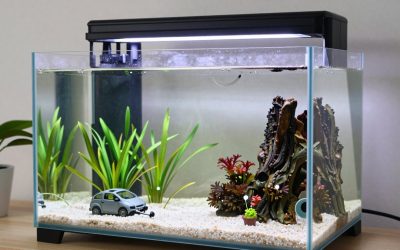
For most aquariums, choose an LED light that is close to the tank’s actual length, not necessarily the exact length printed on the aquarium label. A 20-inch tank generally needs a light made for 18 to 24 inches, while a 48-inch aquarium typically needs a fixture rated for 48 to 54 inches.
The best answer to “what size LED light for aquarium” depends on three measurements: the tank’s length, the distance from the light to the water, and the type of life inside the aquarium. Fish-only tanks usually need modest brightness. Live plants require stronger, more evenly distributed light, especially when they are demanding species.
As an Amazon Associate we earn from qualifying purchases at no extra cost to you.

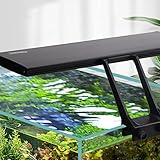
As a practical starting point, select an adjustable aquarium LED that overlaps the tank by about 1 to 3 inches on each end. This helps reduce dark corners without forcing a long fixture to sit precariously on the glass. For a basic freshwater setup, common LED aquarium lights cost roughly $7 to $40, depending on length, controls, brightness, and timer features.
Standard Sizes
Aquarium lights are commonly sold by the tank length they fit rather than by the fixture’s exact physical measurement. Check the manufacturer’s minimum and maximum span before purchasing. The table below shows common aquarium lengths and the approximate light size to consider.
| Nominal tank size | Tank length | Tank length in centimeters | Recommended light range | Typical use |
|---|---|---|---|---|
| Nano or desktop | 8–12 in | 20.3–30.5 cm | 8–12 in / 20–30 cm | Shrimp, bettas, small fish |
| Small | 14–16 in | 35.6–40.6 cm | 12–18 in / 30–46 cm | Small freshwater tanks |
| Medium | 18–24 in | 45.7–61.0 cm | 18–24 in / 46–61 cm | Community aquariums |
| Medium-long | 30–36 in | 76.2–91.4 cm | 30–36 in / 76–91 cm | Longer community tanks |
| Large | 48 in | 121.9 cm | 48–54 in / 122–137 cm | Large freshwater tanks |
| Extra-large | 60 in | 152.4 cm | 60–72 in / 152–183 cm | Long display aquariums |
These ranges describe coverage, not brightness. Two fixtures with the same length can produce very different results. A basic 12-inch full-spectrum light may suit a small fish tank, while a 14-watt adjustable light may be more appropriate for a planted aquarium in the 12- to 20-inch range. For larger tanks, a 48- to 54-inch light provides more continuous coverage than a short fixture placed in the center.
Example pricing illustrates the usual spread. A simple 12-inch freshwater LED may cost about $7 to $10. A basic light designed for an 18- to 24-inch aquarium may cost approximately $14 to $20. An adjustable model with sunrise, daylight, moonlight, timer, and color controls may run around $25 to $35. Long 48- to 54-inch fixtures commonly fall near $35 to $45. Prices can change with seller, promotions, and included accessories.
How to Measure Your Space
- Measure the aquarium’s outside length. Use a tape measure from the left outside edge to the right outside edge. Record the result in inches. Do not rely only on the tank’s advertised gallon capacity because two tanks with the same capacity can have different shapes.
- Measure the rim or lid opening. If the aquarium has a frame, hood, glass canopy, or plastic lid, measure the surface where the light will rest. A fixture can fit the tank length but fail to fit safely on a narrow rim.
- Check the fixture’s adjustment range. Look for wording such as “18 to 24 inches” or “12 to 20 inches.” The smallest setting should not be wider than the aquarium’s support area, and the largest setting should provide full edge-to-edge coverage.
- Measure tank height. Measure from the bottom of the aquarium to the top of the water, then account for gravel, plants, and any space between the water and the light. A deep tank needs more intensity than a shallow tank of the same length.
- Identify the mounting method. Confirm whether the light uses extendable brackets, clips, suction cups, legs, or a hanging kit. Check that the support points sit securely and do not rest on a flexible lid that could bend or crack.
- Allow room for maintenance. If you frequently remove the lid to feed fish or trim plants, an adjustable light with legs or a liftable bracket may be more convenient than a tightly fitted hood light.
For a tank that measures 23 inches long, a fixture rated for 18 to 24 inches is usually a sensible fit. For a 25-inch tank, move up to a range that reaches at least 25 inches rather than forcing a 24-inch model to cover the entire aquarium.
By Room or Use Case
Bedroom or Office Aquarium
Small desktop tanks often need a compact 8- to 12-inch fixture. Choose a lower-output LED if the aquarium contains a betta, shrimp, or low-light plants. A timer is especially useful in a bedroom or office because it provides a consistent schedule without adding another task. Look for dimming if the aquarium is close to your desk or bed, where glare can be distracting.
Living Room Community Tank
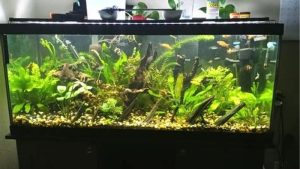
For a typical 18- to 24-inch freshwater aquarium, choose a light spanning at least 18 inches and preferably close to the full tank length. A full-spectrum LED with a built-in timer can provide attractive color and regular day-night cycles. If the tank is in a bright room, avoid compensating with excessive light; algae may increase when natural sunlight and long LED schedules combine.
Planted Aquarium
Plant lighting depends on species, tank depth, and placement, so length alone is not enough. Low-light plants such as anubias, java fern, and many mosses can often use a moderate LED. Carpeting plants and other high-light varieties may need a brighter fixture or multiple lights. For a planted tank measuring 12 to 20 inches, a 14-watt adjustable LED is one example of the type of product marketed for that range, but wattage is not a universal brightness rating. Compare the light’s stated output, dimming range, and recommended tank depth.
Large Display Aquarium
A 48-inch aquarium should generally use a light rated for 48 to 54 inches. A fixture in this range may cost about $35 to $45 for a basic freshwater model. If the tank is unusually deep, has a center brace, or contains plants across the entire bottom, consider two shorter fixtures or a higher-output system. Multiple lights can reduce shadows, but they also increase energy use, heat, and purchase cost.
Open-Top or Rimless Tank
Rimless aquariums require extra attention to mounting and splash protection. Choose a light with stable legs, a clip designed for the glass thickness, or a secure hanging system. Do not let the fixture touch the water, and keep cords arranged so water cannot run toward the outlet. The light’s length should cover the tank without extending so far that it becomes unstable.
Common Sizing Mistakes
- Buying by gallon capacity alone: A 20-gallon long tank and a 20-gallon tall tank need different light coverage and intensity.
- Confusing fixture length with coverage length: A light listed for 18 to 24 inches may have a shorter central body with extendable supports. Verify both the usable span and the support width.
- Choosing a fixture that is too short: A 12-inch light centered over a 24-inch tank can leave the ends dim and make plants grow unevenly.
- Assuming more watts always means better: Wattage measures power consumption, not a complete measure of brightness or plant performance.
- Ignoring tank height: Light loses intensity as it travels through water. A fixture suitable for a shallow tank may be inadequate for a tall aquarium.
- Forgetting the lid and rim: Make sure brackets fit the aquarium and do not interfere with feeding openings, hinges, or a center brace.
- Using an overly long light: Excess length can make the fixture unstable, create awkward overhang, or place controls where they are exposed to splashes.
FAQ
Should an aquarium light be the same length as the tank?
It should be close to the tank length, but it does not have to match exactly. An adjustable light rated for the aquarium’s length range is usually the easiest choice. For example, an 18- to 24-inch fixture can suit a tank anywhere in that range.
What size LED light do I need for a 20-gallon aquarium?
Measure the tank because 20-gallon models vary. If the aquarium is about 24 inches long, choose a light rated for 18 to 24 inches or a fixture that extends to at least 24 inches. If it is a 30-inch-long model, choose a 30- to 36-inch light instead.
How many watts should an aquarium LED have?
There is no dependable wattage rule for every aquarium. Fish-only tanks can use relatively modest lighting, while planted tanks require output suited to plant type and tank depth. Use wattage as an energy-use figure and review the manufacturer’s coverage and brightness guidance.
How long should an aquarium LED stay on?
Start with about 6 to 8 hours per day, then adjust based on plant growth and algae. A timer keeps the schedule consistent. Reduce the duration or brightness if algae becomes excessive, especially when the aquarium also receives direct daylight.
Ready to decide? Our #1 pick for 2026 is the Nano or desktop.
Live price & availability on Amazon.
Related Reviews & Guides
Best All in One Saltwater Tank for the Money: Top Ultimate
29 Gallon Aquarium Setup Ideas: Depth, Stocking and Cost