Last Updated: October 4, 2026
- Top Pick: Pawfly Aquarium Air Pump 50 GPH Fish Tank Oxygen Pump for 10-60 Gallon Fish Tanks Buckets Dual Outlet Adjustable Ultra Quiet Aerator Pump with Airline Tubing Air Stones Connectors and Check Valves
- Best Value: Uniclife 64 GPH Aquarium Air Pump with Dual Outlets Adjustable Quiet Fish Tank Air Pump with Air Stone Airline Tubing Check Valve and Connector Accessories for 10-100 Gallon Fish Tank
- Premium Choice: AQQA Aquarium Air Pump, 3W Powerful Dual Outlet Adjustable Oxygen Aerator
The Short Answer
For most home aquariums, choose an air pump based on tank volume, water depth, and the number of air-driven accessories—not just the gallon rating printed on the box. A small 10- to 20-gallon tank usually needs a single-outlet pump rated around 20 to 40 GPH. A 20- to 55-gallon aquarium typically does well with a 40 to 70 GPH adjustable pump. For a 55- to 100-gallon tank, look for a dual-outlet model in the 60 to 100 GPH range.
As a practical starting point, allow one outlet and one medium air stone for every 20 to 30 gallons of freshwater. Increase pump capacity if the tank is deeper than 20 inches, heavily stocked, warm, planted with high oxygen demand, or running multiple sponge filters. A stronger adjustable pump is generally safer than a too-small unit because you can reduce airflow with its dial or an inline valve.
As an Amazon Associate we earn from qualifying purchases at no extra cost to you.

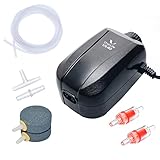


Physical size matters, too. Most compact aquarium air pumps are only 4 to 7 inches wide, but dual-outlet models can be 6 to 9 inches wide and need clear space around their intake vents. In 2026, many common pumps still fit neatly beside a standard aquarium stand, but tubing routes and check-valve placement deserve just as much planning as the pump footprint.
Standard Sizes
Aquarium air pumps do not use one universal physical-size standard. Still, their dimensions, output, and intended tank range tend to fall into predictable categories. Measure the actual product before buying if your stand cabinet has a tight opening, particularly around hinges, power strips, and canister filters.
| Tank Size | Typical Pump Output | Common Pump Dimensions | Typical Wattage | Best For |
|---|---|---|---|---|
| 2.5–10 gallons | 10–25 GPH | 3.0–4.5 W x 2.0–3.0 D x 2.0–3.0 H in 7.6–11.4 x 5.1–7.6 x 5.1–7.6 cm |
1.5–2.5 watts | Betta tanks, shrimp tanks, nano sponge filters |
| 10–30 gallons | 20–45 GPH | 4.0–5.5 W x 2.5–3.5 D x 2.5–3.5 H in 10.2–14.0 x 6.4–8.9 x 6.4–8.9 cm |
2–3 watts | One air stone or one small sponge filter |
| 20–60 gallons | 45–60 GPH | 5.0–6.5 W x 3.0–4.0 D x 3.0–4.0 H in 12.7–16.5 x 7.6–10.2 x 7.6–10.2 cm |
2.5–4 watts | Community tanks, one large sponge filter, two air stones |
| 40–100 gallons | 60–100 GPH | 6.0–8.5 W x 3.5–5.0 D x 3.5–5.0 H in 15.2–21.6 x 8.9–12.7 x 8.9–12.7 cm |
3–6 watts | Dual air stones, two sponge filters, deeper tanks |
| 75–150 gallons | 100–175 GPH | 7.0–10.0 W x 4.0–6.0 D x 4.0–6.0 H in 17.8–25.4 x 10.2–15.2 x 10.2–15.2 cm |
5–10 watts | Large aquariums, breeding racks, multiple filters |
These are useful planning measurements rather than interchangeable specifications. For example, a 50 GPH adjustable dual-outlet pump is usually appropriate for a 10- to 60-gallon tank, while a 64 GPH dual-outlet unit often suits 10- to 100-gallon setups when airflow is adjusted correctly. Typical prices are about $9 to $16 for basic 50 to 64 GPH models, $20 to $30 for sturdier 3-watt adjustable dual-outlet pumps, and roughly $9 to $18 for budget pumps marketed for tanks up to 100 gallons.
How to Measure Your Space
- Measure the available pump shelf or cabinet floor. Record width, depth, and height in inches. Add at least 1 inch (2.5 cm) of open space on each side of the pump for ventilation and easier cord access.
- Check the cabinet opening, not only the interior. A pump that is 7 inches wide may fit on a 10-inch shelf but be awkward to install through a narrow 6-inch door opening.
- Measure from the pump location to the aquarium rim. Most starter kits include 6 to 10 feet of airline tubing. For a tidy route behind a stand, measure the full path down, across, and back up rather than estimating a straight line.
- Find the waterline height. Measure vertically from the pump’s planned location to the tank water surface. The farther air must travel downward and the deeper the air stone sits, the more resistance the pump must overcome.
- Allow for a check valve. If the pump sits below the aquarium’s waterline, install a check valve in the airline. Place it above the waterline whenever possible, with the directional arrow pointing toward the tank.
- Count every air-driven device. One pump outlet can run one air stone, one sponge filter, or a split line. Splitting one outlet reduces air delivered to each branch, so a dual-outlet pump is often preferable for two filters.
- Leave room for vibration control. Plan for a 4- to 8-inch-wide foam pad, silicone mat, or folded towel beneath the pump. This small layer can reduce buzzing transferred into a wood stand.
By Room or Use Case
Small Bedroom or Office Aquarium
For a 5- to 20-gallon aquarium near a desk or bed, select a compact 20 to 40 GPH adjustable pump with a footprint around 4 to 5 inches wide. A 2- to 3-watt model is normally enough for one small air stone or sponge filter. Put it on a soft pad and avoid letting its tubing pull tightly against furniture, which can transmit vibration. In a quiet room, an oversized pump turned fully up can create more bubbling noise than needed.
Standard Living Room Community Tank
A 20- to 55-gallon community aquarium commonly needs a 45 to 60 GPH pump, especially when using a medium sponge filter or two air stones. A pump about 5 to 6.5 inches wide fits on most stand shelves. Choose an adjustable unit if the tank has gentle-flow fish such as tetras, gouramis, or long-finned varieties. The goal is steady surface movement and reliable filtration, not a vigorous boil across the entire tank.
Deep 55- to 75-Gallon Aquarium
Tank depth changes the sizing calculation. A standard 55-gallon aquarium is often about 21 inches tall, while larger tanks can be 24 inches or deeper. For these setups, a 60 to 100 GPH dual-outlet air pump is a sensible minimum when operating two air stones or sponge filters. Use 3/16-inch airline tubing, keep runs as short as practical, and do not assume a small pump’s advertised gallon range applies equally to a shallow and deep aquarium.
Breeding, Quarantine, or Fish Room Setup
For several small tanks, size the pump by the number of outlets and filters first. A rack with four 10-gallon tanks and four sponge filters needs a multi-outlet pump or a larger pump connected to a manifold. Plan roughly 20 to 30 GPH of available output per small sponge filter, then add capacity for airflow loss through valves and long tubing. A 100 to 175 GPH pump in the 5- to 10-watt range is often more practical than trying to split a tiny single-outlet pump four ways.
Hydroponic Bucket or Utility Use
For a hydroponic reservoir or bucket, use the water volume and stone count as the guide, but prioritize tubing length and depth. A 40 to 60 GPH pump can serve a small 5- to 20-gallon reservoir with one or two stones. Keep the electrical unit dry, elevated when possible, and away from splash zones. Aquarium pumps are designed for air, not water; never place the pump itself inside the reservoir.
Common Sizing Mistakes
Buying strictly by gallon rating: A “up to 60 gallons” label may describe a lightly stocked, shallow tank with one air stone. It does not guarantee enough pressure for a deep aquarium and two sponge filters.
Ignoring depth: Air output declines as the stone sits deeper in the water. A pump that performs adequately with a stone 8 inches below the surface may feel weak at 20 inches.
Splitting one outlet too many times: Every splitter, valve, bend, and extra foot of tubing adds resistance. Use a dual-outlet pump or manifold-capable model when supplying more than two devices.
Choosing maximum airflow for delicate fish: More bubbles do not automatically mean better conditions. Excessive current can stress fish and make feeding difficult. An adjustable pump or gang valve gives better control.
Forgetting the check valve: A check valve costs little and helps prevent back-siphoning during a power outage when the pump is below the aquarium waterline.
Measuring only the pump body: Include room for the power cord bend, outlet nozzles, tubing loops, and 1 inch of breathing room around intake vents.
FAQ
What size air pump do I need for a 20-gallon aquarium?
For most 20-gallon freshwater tanks, choose a 20 to 45 GPH pump rated around 2 to 3 watts. Use the lower end for one small air stone and the upper end for a sponge filter, deeper tank, or two small air devices. An adjustable 40 GPH model offers useful flexibility.
Can an air pump be too powerful for an aquarium?
Yes. An overly powerful pump can create excessive current, loud bubbling, and unnecessary surface disturbance. It is not usually harmful if airflow can be reduced with a built-in dial or inline control valve. A powerful adjustable pump is preferable to a weak pump that cannot operate your filtration equipment.
Should I use one dual-outlet pump or two single-outlet pumps?
A dual-outlet pump is cleaner and often less expensive for two air stones or two sponge filters in one aquarium. Two separate pumps provide redundancy: if one fails, the other still runs. For breeding tanks or valuable fish, that backup can be worthwhile.
Where should an aquarium air pump sit?
Place it on a dry, stable surface outside the aquarium, ideally above the waterline. If it must sit inside a stand below the tank, use a correctly oriented check valve and keep the pump elevated from any damp cabinet floor. Never cover the pump or block its ventilation openings.
Ready to decide? Our #1 pick for 2026 is the 2.5–10 gallons.
Live price & availability on Amazon.
Related Reviews & Guides
How to Choose Aquarium Air Pump Size in 2026: What Actually Matters
How to Choose Aquarium Heater Wattage in 2026: What Actually Matters