Last Updated: September 25, 2026
RO DI system for reef tank performance comes down to one reading: output TDS at 0 ppm, verified with a meter rather than assumed. Everything else, from feed pressure to membrane rejection rate through to the cartridge replacement intervals, exists only to keep that one single number exactly where it needs to be.
As an Amazon Associate we earn from qualifying purchases.
As an Amazon Associate we earn from qualifying purchases at no extra cost to you. Prices and availability are accurate as of the date shown and are subject to change.
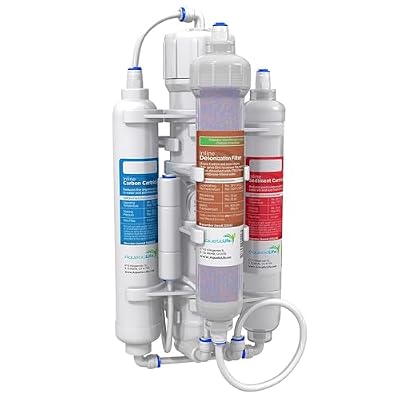
Aquatic Life RO Buddie 4-Stage Aquarium Water Filter System, Reverse Osmosis RO/DI Filtration Unit for Fish Tank, Fountains, and More, 50 GPD (Gallons Per Day)
Selected for "RO DI System for Reef Tank: Stages, TDS and Cartridge Life": this listing is filtration (Aquatic Life RO Buddie 4-Stage Aquarium Water Filter System, Reverse O), matching the equipment this article covers.
View on Amazon
Bulk Reef Supply 4 Stage Value Plus 75 GPD RO/DI Reverse Osmosis Deionization System
Selected for "RO DI System for Reef Tank: Stages, TDS and Cartridge Life": this listing is aquarium equipment (Bulk Reef Supply 4 Stage Value Plus 75 GPD RO/DI Reverse Osmosis Deion), matching the equipment this article covers.
View on Amazon
Aquatic Life Twist-in 4-Stage RO/DI Aquarium Filter, 75 GPD
Selected for "RO DI System for Reef Tank: Stages, TDS and Cartridge Life": this listing is filtration (Aquatic Life Twist-in 4-Stage RO/DI Aquarium Filter, 75 GPD), matching the equipment this article covers.
View on Amazon
4-Stage Aquarium Reverse Osmosis System with Flushing Valve
Selected for "RO DI System for Reef Tank: Stages, TDS and Cartridge Life": this listing is aquarium equipment (4-Stage Aquarium Reverse Osmosis System with Flushing Valve), matching the equipment this article covers.
View on AmazonBy David Nguyen
How the Stages Actually Work
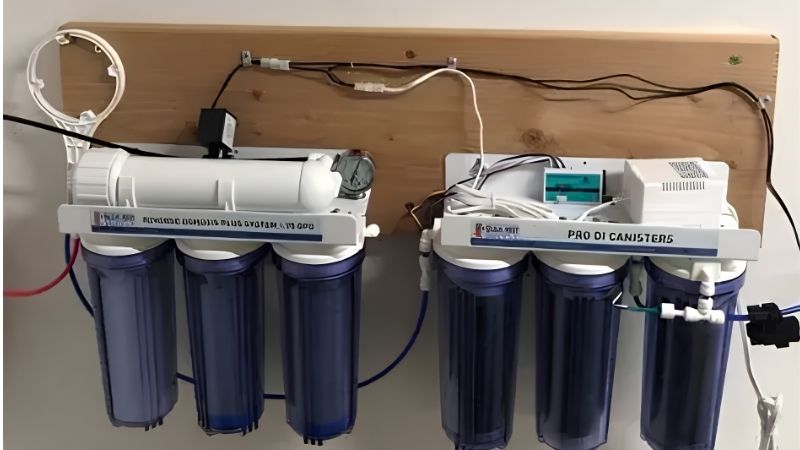
An RO DI system for reef tank use is four filters in series, each removing something the next cannot handle efficiently. Understanding which stage does what is the difference between replacing cartridges on a schedule and replacing them at random.
The Decision Numbers: TDS, Pressure and Rejection Rate
Output TDS is the headline figure and the target is 0 ppm. Anything above that means the DI resin is exhausted or the membrane is failing, and reef tanks fed water at 5 ppm accumulate silicate and phosphate faster than any export system removes them.
Feed pressure decides membrane performance. Most membranes are rated at 50-60 psi, and rejection falls noticeably below 40 psi, so a house on low mains pressure needs a booster pump rather than simply accepting slower and dirtier output.
Rejection rate is the third figure. A working membrane removes 95-98% of dissolved solids, so tap water at 300 ppm leaves the membrane at 6-15 ppm and the DI resin polishes that remainder to zero. The resin is a finisher, not a filter.
Input TDS therefore decides your running cost more than anything else. A household on 500 ppm tap water exhausts resin roughly twice as fast as one on 250 ppm, which is worth knowing before choosing between cartridge sizes.
Why Chloramine Changes the Design
Chlorine is removed easily by standard carbon. Chloramine, which many municipal supplies now use instead, needs catalytic carbon and considerably more contact time, and untreated chloramine passing through will damage an RO membrane across a few months.
Check what your supplier uses before buying, since the difference is a specification change rather than an upgrade. Systems sold for chloramine areas typically run two carbon blocks in series to provide the contact time the reaction requires.
Target Figures and Replacement Intervals
The table below sets out each stage with its job, its replacement interval and the signal that it needs changing. The intervals assume typical municipal water; heavy sediment or unusually high input TDS shortens every one of them.
| Stage | What it removes | Typical life | Replace when |
|---|---|---|---|
| Sediment filter | Particulate, rust, silt | 6 months | Visibly discoloured or flow drops |
| Carbon block | Chlorine, organics | 6 months or 6000 gallons | On schedule, to protect the membrane |
| Second carbon block | Chloramine, contact time | 6 months | On schedule, in chloramine areas |
| RO membrane | 95-98% of dissolved solids | 2-3 years | Rejection falls below 90% |
| DI resin | The remaining 2-5% | Varies with input TDS | Output TDS rises above 0 ppm |
| Feed pressure | Not a stage, a condition | Continuous | Below 40 psi, fit a booster pump |
| Waste ratio | Not a stage, a consequence | Typically 3:1 or 4:1 | Rising ratio suggests a fouled membrane |
| Production rate | 50-100 GPD typical | Falls in cold weather | Roughly halves at 50 °F versus 77 °F |
Note the production rate row. Membranes are rated at around 77 °F (25 °C), and a garage installation in winter produces far less water at the same pressure, which is normal rather than a fault developing in the unit.
Installing It in a Real Home
An RO DI system for reef tank use has to connect to a water supply and drain somewhere, which is usually the constraint rather than the unit itself. This section covers placement, sizing and how output is actually collected.
Tank Size, Placement and Fit
Measure the wall space and the distance to both a feed tap and a drain before ordering, since a four-stage unit needs roughly 20 x 18 in (51 x 46 cm) of mounting area plus room to unscrew the housings downward.
A garage or utility area suits it better than under a kitchen sink, because the unit needs to run for hours and produces waste water continuously. Cold spaces reduce output, which is a trade against convenience worth deciding deliberately.
How System Size Matches Tank Size
A 50 GPD unit produces roughly 2 gallons (7.6 L) an hour, which covers a 40 gallon (151 L) reef changing 10% weekly with time to spare. Running it unattended for an afternoon fills a mixing container comfortably.
Above 125 gallons (473 L), a 100 GPD unit saves real time, since the weekly requirement plus top-off water starts running to 20 gallons (76 L) or more. Larger membranes also foul more slowly at the same throughput.
Collecting and Storing the Output
Store RO/DI water in food-grade containers with lids, and use it within a week or two. Stored water absorbs carbon dioxide from the air, which lowers pH, though that matters far less once salt is mixed into it.
Two containers is the practical arrangement: one for pure top-off water and one for mixed saltwater. Mixing salt in the same vessel you draw top-off from is the quiet route to a salinity climb nobody can account for.
Fit a float valve or an automatic shutoff on the storage container. Systems left running unattended overflow, and a shutoff also stops the membrane sitting in stagnant water between production runs, which shortens its working life.
Label the container clearly if there is also a saltwater mixing vessel nearby. Adding mixed saltwater to a top-off reservoir is a mistake that raises salinity steadily for days before anyone works out where it came from.
Myths About RO DI Systems
Three claims cause most of the wasted money on an RO DI system for reef tank use, and each one has a measurement that replaces it the moment a TDS meter is sitting in the drawer beside the unit.
Myth: Bottled RO Water Is Equivalent
Shop-bought RO water is rarely verified and often sits above 0 ppm, sometimes considerably. Reef tanks fed water at 10 ppm accumulate silicate and phosphate steadily, which shows as diatoms and hair algae that no amount of export resolves.
Measure it rather than trusting it. A handheld TDS meter costs very little and tells you in seconds whether the water you are buying is worth the price, which frequently turns out to be the strongest argument for owning a unit.
Myth: Cartridges Last a Year
Carbon blocks are rated in gallons as well as months, and a reef changing water weekly can exhaust one well before the calendar suggests. A spent carbon block passes chlorine or chloramine straight to the membrane, which then fails early.
Replace sediment and carbon every six months as a default, sooner on heavy use, and treat the membrane as the component those two exist to protect. A replacement membrane costs several times what a carbon block does.
Myth: DI Resin Does the Real Work
The membrane removes 95-98% of everything; the resin polishes the last few per cent. Running a system with a failing membrane exhausts resin at several times the normal rate, which reads as expensive resin rather than as a membrane problem.
Use a dual inline TDS meter to see both readings. Water leaving the membrane at 6-15 ppm and the unit at 0 ppm is a healthy system; water leaving the membrane at 40 ppm means the membrane rather than the resin needs attention.
Running It Past the First Year
An RO DI system for reef tank use runs intermittently for years and fails silently, which is the whole reason the meter matters. This section covers the routine, what degrades, and what the unit costs to keep running.
The Routine That Keeps Output at Zero
Check output TDS every time you produce water, which takes seconds with an inline meter. Any reading above 0 ppm means stopping and investigating before that water goes anywhere near the tank or the mixing container.
Quarterly, check the membrane reading separately and note the waste ratio. Flush the membrane if the system has a flush valve, particularly after periods of disuse, since sitting water fouls a membrane faster than running it does.
What Degrades and What It Does
Membranes foul gradually, showing as falling rejection and a rising waste ratio rather than as a sudden failure. Resin exhausts from the inlet end forward, so a cartridge that looks half fresh may already be passing dissolved solids.
Housings and fittings develop slow weeps over years, particularly at push-fit connectors that have been disturbed. Check underneath the unit for damp at each cartridge change, since a slow leak in a garage goes unnoticed for months.
Keep the housing spanner with the unit rather than in a toolbox. Cartridge changes get postponed when the tool has to be found first, and postponed carbon changes are what shorten membrane life in most home systems.
The 12-Month Running Cost
Recurring spend is sediment and carbon cartridges twice a year, DI resin as it exhausts, and a membrane every two to three years. Waste water is the other cost, running at roughly three or four gallons discarded per gallon produced.
On timing, RO/DI units and cartridge packs see their deepest discounts in late June and again in late November, which suits stocking up on consumables. Cartridges store well sealed, and prices move constantly, so check at the moment of purchase.
RO DI System for Reef Tank Questions
These arrive before the first cartridge change, which is when most systems start drifting. Every answer about an RO DI system for reef tank use points at the TDS reading, since that number reports the state of the whole unit.
Do I really need the DI stage?
For a reef, yes. RO alone leaves 6-15 ppm of dissolved solids including phosphate and silicate, which is enough to feed nuisance algae continuously. Freshwater planted tanks often manage on RO alone; reefs generally do not.
How much waste water does it produce?
Typically three or four gallons to drain per gallon produced, varying with pressure and temperature. That waste is not harmful and can be collected for garden or household use, which offsets the running cost meaningfully.
Why has my output TDS risen?
Usually exhausted DI resin, which is normal and expected. If the membrane reading has also risen, replace the carbon block first and then assess the membrane, since a spent carbon block is often the underlying cause of both.
Can I use a booster pump?
Yes, and it is the correct answer below 40 psi feed pressure. Low pressure reduces rejection rate, which exhausts resin faster and produces water slowly, so a booster pays for itself in resin within a year in many homes.
How long can I store the water?
A week or two in a sealed food-grade container. Longer storage absorbs carbon dioxide and can allow bacterial growth in warm conditions, so producing water shortly before a water change is preferable to keeping a large standing reserve.
See More:
Conclusion
An RO DI system for reef tank use is judged on one number: output at 0 ppm TDS, verified with a meter every time water is produced. Feed pressure at 40-60 psi and 95-98% membrane rejection are what keep that number achievable.
Replace sediment and carbon every six months, resin when output rises above zero, and the membrane every two to three years or when rejection falls below 90%. Use a dual inline meter so a failing membrane is never mistaken for exhausted resin.
Best In Sump Protein Skimmer for Large Reef: How to Pick

Top 5 Nano Reef Tank Filter Systems Under $100 Amazon