Last Updated: September 25, 2026
Two Red Sea rollers, two very different tanks: the NanoMat is built for nano systems and the ReefMat 500 for mid-size reefs. The red sea reefmat 500 vs nanomat which roller question is settled by system volume, real drain flow, sump opening, and whether you want app control, not by a raw flow ratio.
As an Amazon Associate we earn from qualifying purchases.
By David Nguyen
Quick answer: Our top pick in 2026 is the Tank rating — our #1 rated choice. See the full ranked comparison, alternatives and buying advice below.
How to Choose Between the NanoMat and ReefMat 500
Match the roller to your system, not to the bigger number. The decision rests on your tank volume, the flow actually reaching the sump, the space in your sump opening, and whether app control matters. A higher maximum flow is capacity, not a measure of cleaner water.
System Volume
Start with the tank each roller is rated for. The NanoMat is rated to 53 gallons, while the ReefMat 500 is rated to 130 gallons, so they target different systems rather than competing for the same tank.
Pick the one whose rating brackets your display plus sump volume. Putting a NanoMat on a 130-gallon reef under-serves it, while a ReefMat 500 on a nano is more roller than the system needs or the sump can hold. Rating headroom is fine, but a roller far larger than the tank wastes both money and the sump real estate that nano builds rarely have to spare.
Drain Flow
The rollers list 250 GPH for the NanoMat and 1,580 GPH for the ReefMat 500 as maximum flow figures. That difference reflects capacity for larger drain lines, but it is not a filtration-quality percentage, so the ReefMat does not filter several times better than the NanoMat.
What matters is that the roller comfortably handles your real drain flow. A nano system’s modest drain suits the NanoMat, while a mid-size reef’s higher drain flow needs the ReefMat’s greater capacity to avoid being overwhelmed at feeding time. Feeding events briefly spike the particulate load, so a little flow headroom keeps the fleece feeding smoothly rather than backing up during the messiest moments of the day.
Sump Opening
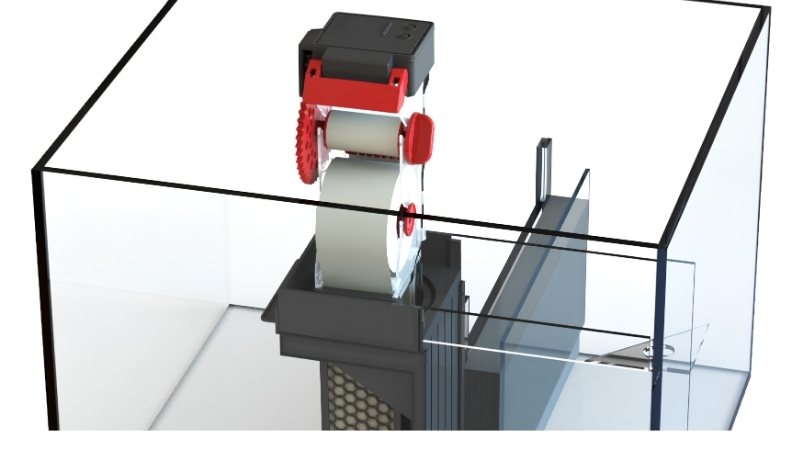
Physical fit in the sump is as important as flow. The two units differ in size and fleece width, the NanoMat using a 2.2in x 59ft roll and the ReefMat 500 a wider 4.4in x 92ft roll, so confirm your sump chamber accepts the body you choose.
Measure the opening and the depth before buying, since a roller that does not drop cleanly into the chamber is a problem no spec sheet fixes. The wider ReefMat needs more room than the compact NanoMat. It is worth dry-fitting the unit or checking its external dimensions against your chamber, because returning a roller that will not seat is a frustrating and avoidable mistake.
App Preference
Decide whether you want app connectivity. The ReefMat 500 works with Red Sea’s ReefBeat app, while the NanoMat requires no app, which some keepers prefer for simplicity and reliability on a small tank.
App control adds monitoring and alerts but also setup and dependence on connectivity. If you value a self-contained unit, the no-app NanoMat is a feature, not a limitation; if you want remote status, the ReefMat’s app fits. App control also logs fleece advances over time, which helps you spot a rising bioload before it becomes a water-quality problem on a busier reef.
NanoMat vs ReefMat 500 by Use Case
Because they target different tanks, use case is clear-cut. The NanoMat suits compact, app-free nano systems; the ReefMat 500 suits higher-flow, mid-size reefs. Prices are 09/2026 snapshots, with the NanoMat about 46.1% below the ReefMat 500 in price.
| Factor | NanoMat | ReefMat 500 | Best For |
|---|---|---|---|
| Tank rating | 53 gal | 130 gal | ReefMat for mid-size reefs |
| Max flow | 250 GPH | 1,580 GPH | Match to your real drain flow |
| Fleece roll | 2.2in x 59ft | 4.4in x 92ft | Not a per-roll price match |
| App | none required | ReefBeat | NanoMat for app-free simplicity |
| Price (as of 09/2026) | ~$215 | ~$399 | NanoMat ~46.1% below ReefMat |
NanoMat for Compact Systems
The NanoMat is the pick for nano and small tanks up to 53 gallons at about $215 as of 09/2026. Its compact body and 2.2in x 59ft roll fit small sumps where a larger roller simply would not go.
Its 250 GPH capacity is matched to small drains, so it is not intended for a mid-size reef. On the right small system, though, it brings automatic fleece filtration in a footprint that suits tight nano cabinets. Nano sumps are notoriously cramped, so a roller designed around that constraint is often the only automatic option that physically fits.
NanoMat for No-App Simplicity
The NanoMat also suits keepers who want automatic filtration without an app or network dependency. It runs on its own, which means no app setup, no connectivity issues, and one less thing to manage on a small tank.
You give up remote monitoring and alerts, so you check it in person. For a nano owner who values simplicity, that trade is often welcome rather than a drawback worth paying to avoid. Fewer connected devices also means fewer firmware updates and one less account to manage across the tank’s lifetime.
ReefMat 500 for Higher-Flow Reefs
The ReefMat 500 is the choice for mid-size reefs up to 130 gallons at about $399, with a 1,580 GPH capacity that handles a larger drain line. Its wider 4.4in x 92ft roll suits the higher detritus load of a bigger system.
It costs about 85.6% more than the NanoMat and needs more sump room, so it is overkill on a nano. On a mid-size reef, that capacity and roll width are exactly what the system requires. The wider roll also means each advance clears more surface area, which can stretch the interval between full roll changes under a heavy load.
ReefMat 500 for App-Based Reefs
The ReefMat 500 also fits keepers who want app control, integrating with Red Sea’s ReefBeat for monitoring and alerts. On a mid-size reef where downtime matters, remote status on the roller is genuinely useful.
That app adds setup and depends on your network, which not everyone wants. For a connected reef already running ReefBeat, though, the ReefMat slots neatly into the same ecosystem you already manage.
Frequently Asked Questions
Buyers ask how often fleece needs replacing, which unit to choose, whether a roller can be too big, and what the consumables cost. The choice usually follows tank size and app preference.
How Often Do You Replace the Fleece Roll?
It depends on bioload and feeding, not a fixed schedule. A heavily stocked tank advances and consumes fleece faster than a lightly stocked one, so track your own roll usage rather than assuming an interval.
The NanoMat’s 59ft roll and the ReefMat 500’s 92ft roll differ in length, so replacement frequency and cost differ too. Budget for periodic rolls as the running cost of either unit.
Should You Choose the NanoMat or ReefMat 500?
Choose the NanoMat for a nano or small tank up to 53 gallons, especially if you want an app-free unit. Choose the ReefMat 500 for a mid-size reef up to 130 gallons or if you want ReefBeat app control.
Base it on your system volume and real drain flow first, then app preference. The price gap follows the capability gap rather than marking one as simply better.
Can a Roller Be Too Big for Your Tank?
It can be more than you need. A ReefMat 500 on a nano works but wastes capacity and sump space, while a NanoMat on a mid-size reef is undersized for the drain flow.
Neither is the right answer when your tank sits far outside both ratings, in which case a differently sized roller fits better. Match the rating to your system rather than buying up or down for its own sake.
What Do the Consumables Cost?
The main consumable is the fleece roll, and its cost tracks how fast you advance it. Because the NanoMat and ReefMat 500 use different roll widths and lengths, their per-roll prices are not directly comparable.
Compare consumable cost over months of real use, not by dividing one roll price by another. Factor that ongoing spend into whichever unit fits your tank.
Final Thoughts
In the red sea reefmat 500 vs nanomat which roller decision, the tanks decide it: the NanoMat suits nano systems up to 53 gallons at about $215 as of 09/2026, and the ReefMat 500 suits mid-size reefs up to 130 gallons at about $399. The 250 versus 1,580 GPH gap is capacity for different drains, not a filtration-quality score, so match the roller to your system and app preference.
As an Amazon Associate we earn from qualifying purchases at no extra cost to you. Prices and availability are accurate as of the date shown and are subject to change.
Ready to decide? Our #1 pick for 2026 is the Tank rating.
Live price & availability on Amazon.
Related Reviews & Guides





Best Calcium Reactor for a First Reef Tank: Top Expert Guide
Best Budget Protein Skimmer: Top Expert Picks for Beginners