Last Updated: October 4, 2026
The best titanium inline chiller for saltwater earns that description through the exchanger material first, because anything less than titanium corrodes in salt. After that, the decision turns on matched flow, honestly comparable thermal data and current model generation.
As an Amazon Associate we earn from qualifying purchases.
As an Amazon Associate we earn from qualifying purchases at no extra cost to you. Prices and availability are accurate as of the date shown and are subject to change.
By David Nguyen
Quick answer: For most people in 2026, the best titanium inline chiller for saltwater is the AquaEuro Max-Chill 1/10 — our #1 rated choice. See the full ranked comparison, alternatives and buying advice below.
How to Choose a Titanium Inline Chiller
Four checks separate a sound chiller purchase from a guess: confirm the exchanger really is titanium, match the loop flow the unit requires, compare cooling figures only where conditions match, and verify electrical and refrigerant details on the current generation. Skip any of the four and you risk buying a chiller that cannot hold temperature.
Verify the Exchanger Is Titanium
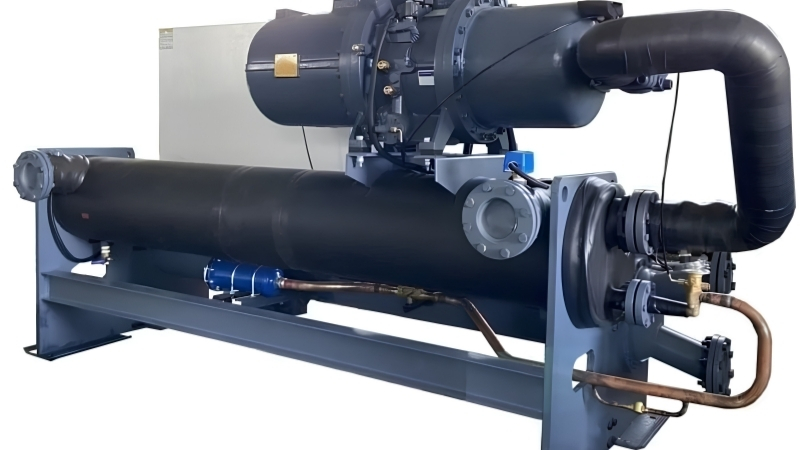
All three units here use titanium exchangers: the AquaEuro Max-Chill 1/10, the JBJ DBA-075 and the TECO TK-500. Titanium tolerates saltwater where cheaper metals corrode, which is the entry requirement for any marine loop.
Titanium resists corrosion but still fouls. Coralline algae and detritus coat the inside of the exchanger over months and reduce heat transfer, so plan periodic flushing and check whether the exchanger is serviceable rather than sealed. Ask whether replacement exchangers and control boards are sold separately, since a sealed unit becomes disposable once something fails.
Match the Required Loop Flow
Flow windows differ enormously between these chillers. The AquaEuro asks for 158 to 400 GPH, the JBJ DBA-075 accepts a far broader 240 to 960 GPH, and the TECO TK-500 needs only 106 to 211 GPH through its exchanger.
A narrow window is not weaker cooling; it reflects the contact time that design needs. Size the feed pump after head loss from lift, hose and fittings, then trim with a valve, because published pump GPH assumes zero head. Verify delivered flow at the chiller inlet after installation rather than trusting the calculation alone.
Compare Cooling Figures Carefully
AquaEuro lists 1,485 BTU per hour for its 1/10 HP unit and JBJ lists 1,270 BTU per hour for its 1/10 HP DBA-075, but the rating conditions behind those numbers are not shown for the AquaEuro, so the difference cannot be treated as a performance ranking. Read them as two separate manufacturer claims rather than one comparison.
TECO takes a different approach, publishing a controlled point: 40 gallons held at 77F in an 86F room, a 9F pull-down at a 1.89 watt per gallon heat load. A stated condition like that is worth far more than a larger BTU number with no context. Treat any capacity band without a stated ambient and heat load as marketing rather than engineering data.
Check Electrical and Refrigerant Details
The AquaEuro lists 110 to 120V at 2.2A and the JBJ lists 115V at 2.63A, which work out to roughly 242 to 264VA and about 302VA respectively. Those are volt-amp figures, not verified real watts, so they cannot be compared against TECO’s published 225W consumption.
Refrigerant is worth checking too. TECO lists R290 on the current TK-500, while AquaEuro listings conflict between R22 and R134a, which is unresolved. Confirm with the seller, since refrigerant type affects long-term serviceability. Newer refrigerants like R290 are common on current generations, and parts support follows the generation still in production.
Top Picks
Three chillers plus a plumbing note cover this category. Each entry lists manufacturer specifications, a relative price position as of 09/2026, and one genuine drawback, so you can match hardware to a measured heat load.
| Product | Best For | Key Spec | Watch Out For |
|---|---|---|---|
| AquaEuro Max-Chill 1/10 | Best entry price | Titanium; 1/10 HP; 1,485 BTU/h; 158-400 GPH | Refrigerant listings conflict |
| JBJ DBA-075 | Best flow flexibility | Titanium; 1/10 HP; 1,270 BTU/h; 240-960 GPH | Costs about $186 more |
| TECO TK-500 | Best documented performance | Titanium; 1/6 HP; 106-211 GPH; 225W; R290 | Most expensive by a wide margin |
| Loop plumbing | Best install practice | Unions either side, pump sized after head loss | Every joint adds leak risk |
AquaEuro Max-Chill 1/10: Best Entry Price
At roughly $600 as of 09/2026 the Max-Chill is the cheapest titanium option here, about 24.3% below the JBJ. It lists 1/10 HP, 1,485 BTU per hour, a 158 to 400 GPH flow requirement, 110 to 120V at 2.2A, and ideal sizing around 60 gallons with a maximum near 80. That sizing guidance still depends on your own heat load and room temperature.
Two caveats matter. The BTU rating condition is not published, so it cannot be ranked against JBJ’s figure, and current listings conflict on whether it uses R22 or R134a refrigerant. Discontinued AquaEuro Apex pages also circulate, which makes spec mixing easy. Confirm both the refrigerant and the exact model generation in writing before ordering.
JBJ DBA-075: Best Flow Flexibility
The DBA-075 pairs a titanium exchanger with 1/10 HP, 1,270 BTU per hour and an unusually wide 240 to 960 GPH flow window, drawing 115V at 2.63A with quoted accuracy of plus or minus 1F. That broad window makes pump matching straightforward on most sumps.
It costs roughly $800 as of 09/2026, about 32.1% above the AquaEuro, a gap near under $200. Its lower published BTU figure should not be read as weaker cooling, since the two ratings do not share stated test conditions. JBJ parts and service support are widely available, which matters on a device expected to run every summer for years.
TECO TK-500: Best Documented Performance
The TK-500 steps up to 1/6 HP with a titanium exchanger, R290 refrigerant, a 106 to 211 GPH flow requirement and 225W of published power consumption. TECO also states a controlled performance point rather than a bare capacity band. That level of disclosure is uncommon in this category and makes planning far easier.
At roughly $1,300 as of 09/2026 it runs about 129.3% above the AquaEuro, a gap near under $800. Its narrow flow window also means the feed pump must be sized or valved carefully, since overshooting wastes efficiency at the exchanger. Its higher 1/6 HP class also brings more capacity than a nano system needs, so match it to a genuinely larger display.
Getting the Inline Plumbing Right
Install any inline chiller downstream of the pump with unions on both sides so it can be removed for flushing without draining the system. Keep hose runs short and elbows few, since every fitting adds head that reduces delivered flow.
Leave ventilation clearance around the unit, because an inline chiller exhausts its removed heat into the cabinet. A sealed enclosure raises ambient, lengthens duty cycle and quietly undoes some of the cooling you paid for. Large reef equipment discounts hardest around Prime Day and Black Friday, useful timing when a chiller and pump are bought together.
Frequently Asked Questions
Four questions decide most purchases: why titanium is non-negotiable, how far BTU figures can be compared, what pump suits each unit, and what to make of the AquaEuro refrigerant conflict.
Why does the exchanger have to be titanium?
Because saltwater attacks most alternatives. Stainless and copper-based exchangers corrode in marine systems, releasing metals into water where invertebrates are especially sensitive, so titanium is the standard for any saltwater loop. Corals and shrimp react to trace metals long before fish show any symptoms.
Titanium still fouls with coralline and detritus, which reduces transfer efficiency over months. Plan a flushing routine and confirm the exchanger can be accessed or serviced before you commit to a particular unit. Flushing with a mild acid solution restores some transfer efficiency, but follow the manufacturer’s guidance rather than improvising.
Can I compare BTU ratings between brands?
Only when both publish the same test conditions. AquaEuro’s 1,485 BTU per hour and JBJ’s 1,270 BTU per hour look directly comparable, but the AquaEuro rating condition is not shown, so the gap does not establish which cools better.
Look for stated conditions instead, like TECO’s 40 gallons at 77F in an 86F room. Where conditions are missing, weigh flow windows, electrical data, warranty and parts availability rather than the headline thermal figure. Model generations also refresh regularly in this category, so verify the unit on sale is the one the specifications describe.
What pump should I pair with each unit?
Match each chiller’s published window at your real head. The JBJ’s 240 to 960 GPH range accommodates most return-class pumps, the AquaEuro’s 158 to 400 GPH range suits a smaller dedicated pump, and the TECO’s 106 to 211 GPH needs a modest pump or a valved larger one.
Calculate delivered flow after lift, hose length and fittings rather than using the box rating. Keep a ball valve in the line so you can trim into the window as the exchanger fouls and resistance climbs over time. A pump running well above the window wastes energy and adds unnecessary heat to the water.
What about the AquaEuro refrigerant conflict?
Current listings disagree, showing R22 in some places and R134a in others, and that conflict is unresolved in published sources. It is not a detail to guess at, since refrigerant type affects servicing and parts availability.
Ask the seller to confirm in writing for the exact unit being shipped. Discontinued AquaEuro Apex product pages remain online and are easy to confuse with current models, so verify the generation alongside the refrigerant. Serviceability is the practical consequence, since technicians need the correct refrigerant to recharge a system years later.
Final Thoughts
The best titanium inline chiller for saltwater combines a corrosion-proof exchanger, a flow window your pump can deliver, and thermal data you can actually interpret. The AquaEuro is the entry price near under $600, JBJ buys flow flexibility, and TECO documents its performance most clearly.
Ready to decide? Our #1 pick for 2026 is the AquaEuro Max-Chill 1/10.
Live price & availability on Amazon.
Related Reviews & Guides


Best RODI System for Saltwater Tanks: Top Ultimate Guide

Best Nano Reef Tank Kit: Options Compared by the Numbers