Last Updated: October 21, 2026
Most reef lighting regret comes from a few repeatable errors, and nearly all of them start by treating watts and peak PAR as if they were the whole story. The common mistakes when buying reef led light are buying by wattage, and reading every coverage or PAR claim as one shared, comparable number.
As an Amazon Associate we earn from qualifying purchases.
By David Nguyen
How Reef LED Buying Mistakes Happen
These mistakes share one root: a spec is lifted out of the condition that gives it meaning. Wattage gets treated as output, a coral-specific coverage figure gets read as universal, and PAR maps from different tests get compared side by side. Understanding why each claim is conditional is what prevents the bad purchase.
Buying by Wattage
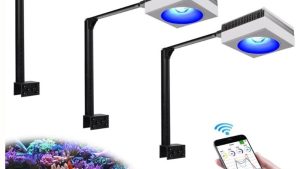
Wattage measures power draw, not usable light or coverage. The Kessil A80 lights an 18-by-18-inch soft-coral area on 15 W, while the AI Prime 16HD covers up to 24-by-24 inches on a 59 W spec, so a higher number can mean more heat and cost rather than better results for your corals.
Power ratings also mislead in subtle ways. A fixture’s supply rating, like the MJ-L230’s 36 W power brick, is a capacity figure that sits above the head’s real draw, so it is not even the fixture’s own consumption, let alone a proxy for the PAR that reaches a coral sitting on the sand bed.
Treating Every Coverage Claim as the Same Metric
Coverage figures are tied to a coral type, so they are not interchangeable. The Kessil A360XE lists 24-by-24 inches for a mixed reef but 20-by-20 inches for SPS, and the A80 shows 18-by-18 soft versus 12-by-12 mixed, which means the same fixture covers a different area depending on what you keep.
Reading the largest quoted spread as your coverage sets you up for dim corners. A light that reaches an 18-inch softie footprint may only serve a 12-inch mixed-reef zone, so match the coverage figure to your actual corals and check the edges with a meter rather than trusting a single headline area.
Comparing PAR Maps With Different Conditions
PAR only means something with its test conditions attached, and those conditions vary between makers. Red Sea publishes underwater cube figures for the ReefLED G2 60, while the Hydra Edge 44HD gives a height-based map of 60-125 PAR across 24 inches, so lining the two up one-to-one is not a valid comparison.
The fix is to read each map on its own terms. Use a fixture’s numbers to understand how it behaves at your depth and mounting height, then verify with a meter in your own water, since two lights that were never measured in the same environment cannot be ranked by a shared PAR figure.
Choosing the Light Before Coral Type and Geometry
Buying the fixture first inverts the process. General PAR bands, such as Bulk Reef Supply’s overlapping references, are planning tools rather than universal cutoffs, so a light chosen before you know your corals and tank geometry often ends up wrong for both the depth and the species you eventually stock.
Start from the corals and the tank, then shortlist lights. Decide the species and their PAR target, measure your footprint and depth, and only then match a fixture whose published coverage and PAR at depth fit, which avoids the far more expensive mistake of returning or replacing a light after the tank is running.
What These Mistakes Look Like in Practice
The table below turns each error into a check you can run before buying. It pairs the factor with its normal reference range, the point where a shortcut becomes a mistake, and the action that keeps the decision grounded in your own corals and geometry rather than a headline spec.
| Factor | Normal Range | Watch-out Threshold | What to Do |
|---|---|---|---|
| Coral PAR target | Soft/LPS ~75-150 PAR reference | Treating a band as a hard cutoff | Confirm species need and measure at coral |
| Coverage claim | Stated for one coral type | Mixed and SPS figures differ | Match coverage to your coral plan |
| PAR test conditions | Given depth and mount height | Comparing different geometries | Compare only same-condition data |
| Fixture wattage | Design and coral dependent | Ranking lights by watts | Size by footprint and PAR, not watts |
Peak PAR Read as Whole-Tank PAR
The AI Prime 16HD lists roughly 100 peak PAR at 24 inches and up to a 24-by-24-inch spread, but peak numbers describe one bright zone, not the whole footprint. Read that way, a keeper places a demanding coral in a corner expecting the peak figure and finds far less light actually arriving there.
Compounding it, the official copy shows both 55 W and 59 W, so even the power spec carries a small conflict. The practical move is to treat the peak PAR as a ceiling under the light’s center, then verify the corners and lower rock with a meter before trusting frag placement to a single quoted number.
A Depth Reading Copied to Another Tank
Red Sea’s ReefLED G2 60 shows 500 PAR at the surface and 100 PAR at 20 inches in its own 20-inch cube, but that curve is specific to that test. Copying the 100 PAR figure into a deeper or shallower tank, or one with different mounting height, imports a number that no longer applies.
Depth, water clarity, and mount height all shift the result, so the safe approach is to use the published falloff as a pattern rather than a fixed value. Re-measure at your corals whenever the tank, rockwork, or fixture height differs from the manufacturer’s stated setup instead of assuming the reading travels intact.
Two Lights Compared Across Different Tests
Setting the Hydra Edge 44HD’s height-based 60-125 PAR map beside Red Sea’s underwater cube data looks like a fair fight but is not, because the environments differ. A direct comparison here rewards whichever maker measured in the more flattering setup rather than the light that would actually serve your corals better.
When you need to choose between two fixtures, put both over your own tank, or at least a matched test, and read PAR at coral height. That single step replaces a misleading cross-brand comparison with a real one and is far cheaper than discovering the mismatch after a coral has already paled or stretched.
Coverage That Changes With the Coral
The Kessil A360XE covers 24-by-24 inches for a mixed reef but only 20-by-20 inches for SPS, so a keeper who reads the mixed figure and stocks SPS to the edges finds the outer corals underlit. The fixture did not fail; the wrong coverage number was applied to the wrong coral type.
Small fixtures show the same trap in reverse. An A80 is fine for one coral plan and undersized for another, so the honest check is to pick the coverage figure that matches your corals, then confirm the perimeter with a meter rather than assuming the larger of the two published areas is yours.
Frequently Asked Questions
A few questions capture the heart of these mistakes. Each answer opens with the direct call, then names the condition behind it, so you can apply the reasoning to whatever fixture and coral list you are weighing rather than memorizing a single rule that will not hold across tanks.
Is a Higher-Wattage Reef Light Always Better?
No. Wattage reflects power draw and design, not usable light, so a 15 W A80 and a 59 W Prime 16HD serve different footprints rather than better or worse corals. Ranking lights by watts rewards heat and cost, while the figures that matter are coverage for your coral type and PAR at depth.
Size by footprint and PAR instead. Decide the corals and their target range, measure your tank, then match a fixture whose published coverage fits, treating wattage as a rough clue to output class rather than a score, and remember a supply rating like 36 W is capacity, not the head’s real consumption.
Can I Trust One PAR Number Across Any Tank?
No, because a PAR figure is tied to a specific depth, mounting height, and test tank. Red Sea’s 100 PAR at 20 inches came from a 20-inch cube, so it does not transfer cleanly to a deeper tank or a different mount. Treat any single number as valid only under its own stated conditions.
Use the published falloff as a shape, then verify locally. A meter reading at your corals accounts for your depth, clarity, and rockwork, which a chart figure cannot, so measure after setup and after any rescape rather than assuming the manufacturer’s number describes what your corals actually receive today.
How Do I Know a Coverage Claim Fits My Tank?
Check which coral type it was rated for. The A360XE’s 24-by-24-inch figure is for a mixed reef and drops to 20-by-20 for SPS, so read the coverage that matches your corals and compare it to your actual length and width rather than to the largest number the maker happens to quote.
Then confirm the edges. Even a matching coverage figure can leave corner falloff on a long tank, so a meter check at the perimeter tells you whether one fixture truly reaches your outer corals or whether you need a second unit or a wider-spread light to cover the footprint evenly.
Should I Buy the Light or Plan the Tank First?
Plan the tank first. Deciding corals, footprint, and depth before shopping means you can match a fixture’s real coverage and PAR at depth to a known target, which avoids buying a light that is wrong for the species or the geometry you end up with once the tank is finally stocked.
General PAR bands are references for that planning, not requirements, so use them to frame the target and then verify in the water. Choosing hardware before livestock is the mistake that most often forces a costly swap, since the light gets locked in before the tank’s real needs are even known.
Final Thoughts
The thread through these errors is a spec read without its condition, so make each number earn its context: which coral type a coverage figure describes, which depth a PAR reading used, whether wattage stands in for output. Avoiding the common mistakes when buying reef led light means verifying at your own corals.

Reef LED Programmable Coral Light
Freshwater vs Saltwater Aquarium: Which Should You Start?